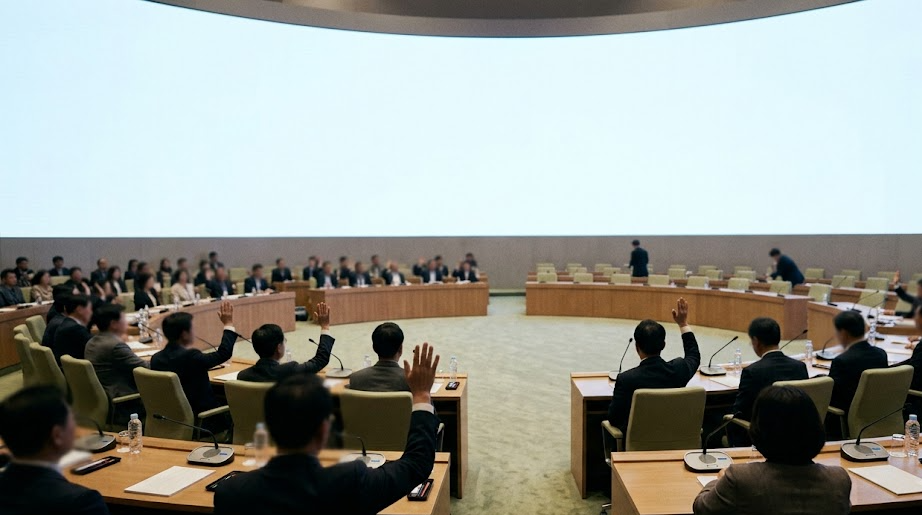
It begins with 2,000 randomly drawn phone numbers. Narrowing those down to 200 people with region, gender and age taken into account produces a citizens' deliberative body that will debate South Korea's carbon neutrality policy this year. At a forum held on the 28th at the National Assembly Members' Office Building by the National Assembly's Special Committee on the Climate Crisis and the presidential National Climate Crisis Response Committee, Hong Dong-gon, deputy secretary general of the committee's secretariat, unveiled a draft operating plan for the Climate Citizens' Assembly. The schedule is understood to complete formation and launch procedures within February at the earliest and to begin first-year activities from April.
The 200 are split into two groups. Twenty serve on a planning panel that refines the agenda, and 180 serve on a deliberation panel that handles the actual discussions. The deliberation panel will divide into two areas, greenhouse gas reduction and climate change adaptation, with energy transition included on the reduction side. Terms run for one year, and half the members are newly selected and replaced each year.
The discussion process is built in three stages: learning the agenda, deliberation and debate, and drawing conclusions. A recommendation is adopted only if at least 75 percent of participants agree, and adopted recommendations are reported to the climate committee, where they go through review and resolution as agenda items before being reflected in government policy. If necessary, the assembly can also propose a public opinion survey. Topics raised for this year include the transition to electric vehicles and regional electricity rates, along with measures for heat waves and cold spells and support for groups vulnerable to climate change.
About 2.5 billion won in operating budget has already been secured. The amendment to the Framework Act on Carbon Neutrality and Green Growth, which contains the legal basis for the body, passed the special climate committee on December 18 last year and currently sits in the Legislation and Judiciary Committee. Hong said preparations are proceeding on the premise that the assembly will operate from this year regardless of whether the amendment passes. Detailed operating matters will be set out in the enforcement decree.
The part handled most carefully in the design is who gets in. Citing consideration for the generations that will feel the effects of the climate crisis longest, a selection weight of 110 percent will be applied to those in their 10s-30s. Representativeness, independence and transparency were presented as operating principles, and the discussions will be opened through live broadcast and the website. Agenda items will be gathered through citizen proposals and online opinion collection, and an advisory group of 10 outside experts will assist with the design and proceedings.

Kim Min, head of Big Wave, who took part as a discussant, added two points. One was a proposal to put in place a mechanism for speaking on equal terms, since hierarchies can form among participants in subcommittee discussions, and the other was a reminder that age weighting was scrapped during the pilot run of the earlier Carbon Neutrality Citizens' Assembly after it ran into objections that it amounted to reverse discrimination. Kim called for the selection design to reflect the provisions of the carbon neutrality act, which already names young people, people with disabilities and farmers as groups vulnerable to the climate crisis. He served as a civilian member when the 2050 Carbon Neutrality and Green Growth Commission, the predecessor of the climate committee, was launched in 2021.
Criticism is also directed at the method of random sampling itself. Someone who can take a phone call and say yes to a year of deliberation is not the same as someone who has trouble clearing a schedule. Whether allowances and travel expenses will be paid to panel members was not disclosed in this plan, and whether low-income and non-regular workers can take part depends on it. Matching demographic ratios and actually seating those with the quietest voices are separate tasks.
In Germany, Belgium and Spain, similar bodies have been running for several years. The climate committee said it will establish this body as a permanent national forum for citizen discussion of climate issues. It is on the list of state affairs tasks and the budget is set aside, so the launch itself is likely to go ahead regardless of the amendment's handling. What will decide the outcome, then, is the operating design more than the text of the law.
In February the formation process starts, and from that point people will be selected under fixed rules. With the channels for gathering agenda items open through citizen proposals and online opinion collection, it is better to write down what you have experienced in your own neighborhood, whether on electricity rates or heat wave response. Even if you are not among the 200, those sentences can make it onto the discussion table. The round table in the meeting hall is open by live broadcast, and the more eyes watching, the larger the round table becomes.