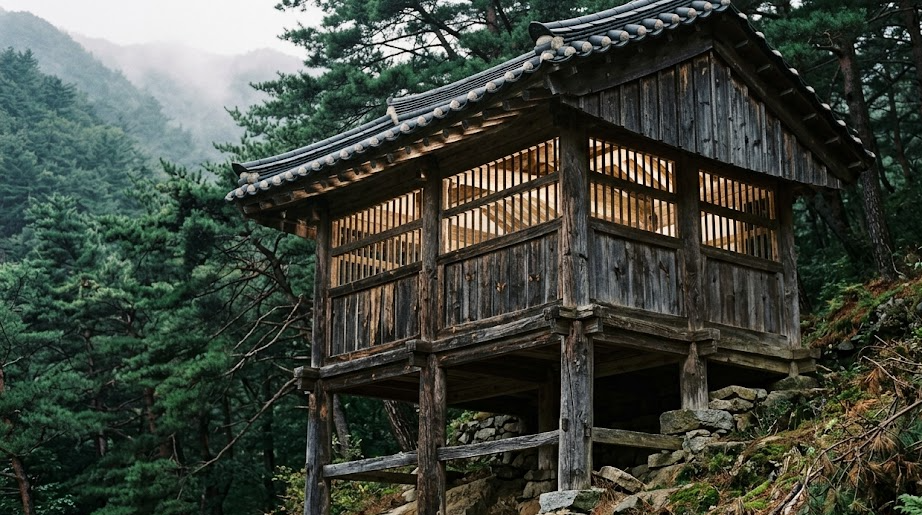
The Korea Heritage Service has announced plans to designate three temple toilets as National Folklore Cultural Heritage. They are the Cheukgan at Seonamsa Temple in Suncheon, the haeuso at Bodeoksa Temple in Yeongwol, and the haeuso at Gukilam Hermitage of Haeinsa Temple in Hapcheon. The announcement was made on the 4th.
The notice period is 30 days, and after opinions are gathered from various quarters, designation will be decided at a review by the Cultural Heritage Committee. The review is set for September.
Suncheon City (Mayor Son Hun-mo) announced the notice for the Seonamsa Cheukgan on the 5th.
The Bodeoksa haeuso was built at the temple entrance in 1882, during the reign of King Gojong of the Joseon Dynasty. The Gukilam haeuso was built in 1910. The construction dates of the three buildings were confirmed from the sangnyang ink inscriptions remaining beneath the ridge beams of the roofs.
The dates for the Seonamsa Cheukgan are not of a single layer. The "Jogyemun Jungchang Sangnyangmun," a record of the repair of the Iljumun gate, notes that it was first built in 1540 under the name "cheongcheuk." On that basis it is commonly introduced as having a 500-year history.
The Korea Heritage Service, on the other hand, put the construction date at before the 1920s, drawing together the 1928 repair ink inscription and temple records. The memory of the founding and the age of the timber standing there now do not say the same thing.
Seonamsa burned down entirely during the Jeongyu War in 1597. The Cheukgan escaped the flames along with the Iljumun. It took its present form through dismantling and repair in 1928, and was worked on again in 1996.
The building has a T-shaped plan, six bays across the front and four bays along the side. A single toilet occupies six bays.
All three sites used the rise and fall of the land as it was. Seen from the front the building is single-story, and going around to the back it becomes a two-story pavilion. The terrain does the work of creating the flow of dropping down below and clearing away from below.
The Seonamsa Cheukgan reduced odor by raising the floor in use above ground level. No doors were fitted. There are only chest-high partitions, and latticed windows in the walls let light and wind pass through.
The waste is mixed with rice husks and fallen leaves, fermented, and returned to the fields as manure. That this cycle is still maintained was included in the grounds for designation. The clear construction dates, the preservation of the original sites and original forms, and the fact that they are still in use were all recognized together. It is a decision to call a building that opens its doors every day a heritage site.
Seon temples have counted the haeuso as the dongsa, one of the seven halls of a monastery. It means the toilet was on the same list as the main Buddha hall. The name has changed several times as well.
At Seonamsa it was called cheongcheuk, jeongnang, daebyeonso and dwitkkan. "Haeuso" was first used by the monk Gyeongbong (1892-1982) of Tongdosa Temple, and spread widely after appearing in a yogurt advertisement in 1998.
The "Dwitkkan" plaque hanging at the entrance to the Cheukgan was newly made in recent years, taking only the Korean script from the "大便所 Dwitkkan" plaque written by the monk Gyeongun Wongi (1852-1936). The architect Lee Su-geun called this the finest toilet in Korea. The children's author Jeong Chae-bong wrote that it was the best privy in the country.
Preservation and use push against each other. Once something becomes heritage it grows hard to touch, and when it cannot be touched it grows hard to actually use. Since the value of the three haeuso lies in the fact that they are still in use, the management approach after the review could either protect that value or erase it. Doorless partitions and latticed windows work only when people are passing through.
The gathering of opinions continues through the 30-day notice period. Once the September review has passed, the names of the three buildings will go onto the National Folklore Cultural Heritage list. On the slopes of Jogyesan in Suncheon, past the Iljumun and a little further behind the temple, a six-bay building appears. The sound of the mountain wind passing through the gaps in the wooden lattice will not be written onto the list.