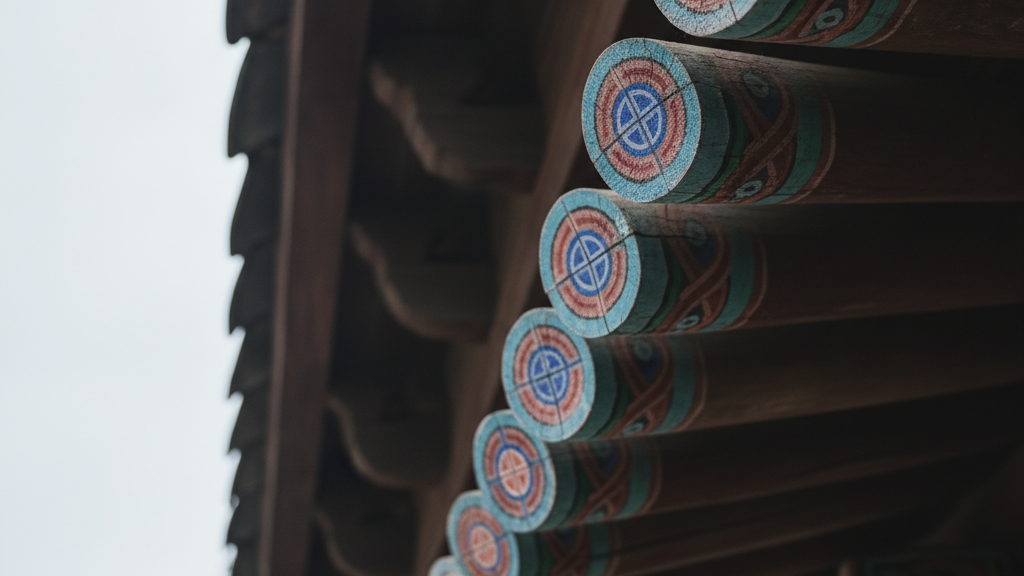
The exhibition 'Choi Dan (崔丹), the Finest Dancheong' opens on the 21st. The venue is the National Intangible Heritage Training Center in Samseong-dong, Gangnam-gu, Seoul. It runs for nine days through the 29th. Choi Mun-jeong, transmission education instructor for the national intangible heritage of dancheongjang, and 10 others including advanced trainees and apprentices put more than 70 works on display.
The Chinese characters in the exhibition's name were made by joining Choi Mun-jeong's surname with dan (丹), the "red" of dancheong. The resolve to do the finest dancheong is fixed in the name. The Korea Heritage Agency (국가유산진흥원) selected it as an open-call exhibition for the training center and is running it, and the exhibition plan was released on the 15th.
Simun is the work of gauging the character and size of the members of a wooden building and drawing patterns onto them. Gaechae is the work of returning surfaces whose color has faded and whose pigment has flaked away to their original colors and patterns. Choi Mun-jeong has done both, and she teaches younger practitioners in university classrooms and at transmission sites.
Among the works on display,
The work of the advanced trainees goes further afield.
Lee Nam-jeong's
An old tension surrounds dancheong. The side that wants to preserve the original form and the side that wants to bring it within reach of present-day eyes are always colliding. Gaechae is restoration that brings back colors that have disappeared, and
Hanging the two on facing walls in a single exhibition lets visitors walk between them themselves. Not fixing an answer is the more honest way.
There are chances to try it by hand as well. On the 23rd and 24th at 2 p.m. and 4 p.m., a hands-on program making dancheong-pattern fans and coasters is offered. Capacity and how to apply must be checked through the training center's notices. Admission is free.
The smell of pigment mixed with animal glue does not go into a photograph. Neither does the angle that makes your neck ache when you look up at the rafters. This exhibition sets that color down at eye level. The way to Samseong-dong, nine days only.