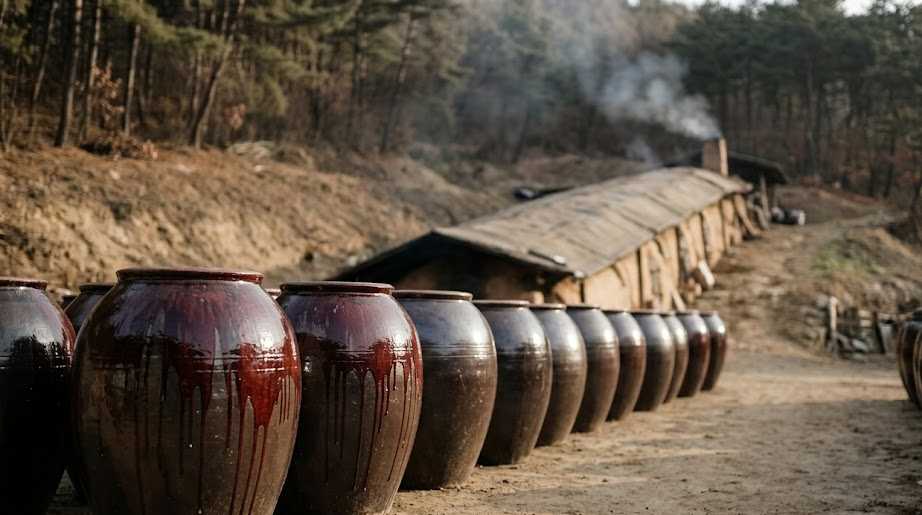
Bang Chun-woong, an onggi potter who has made earthenware for four generations in Galsan-myeon, Hongseong-gun, South Chungcheong Province, has become a holder of the National Intangible Heritage "Onggijang." The Korea Heritage Service recognized him as a holder on June 30. Boseong-gun in South Jeolla Province announced on the 2nd that onggi potter Lee Hak-su had also received final recognition as a holder of the same category.
Onggijang is the traditional craft of making unglazed and glazed earthenware. Glazed earthenware refers to vessels fired with a coating of glaze. The description that always accompanies this category is that it is the foundation of a living culture carried on since the Three Kingdoms period. The jars for fermenting soybean paste, the crocks in which kimchi was pressed down, and the large water vessels called dumeong all belong here.
Holder Bang's family has made its living from onggi since his great-grandfather's generation. He learned the family's onggi work from childhood and has run "Galsan Togi" in Galsan-myeon since 1980. He was recognized as a South Chungcheong Province Intangible Heritage holder in 2008, so he has earned the name of the state eighteen years after being named by the province. This is said to be the first time a holder of National Intangible Heritage has come from Hongseong-gun.
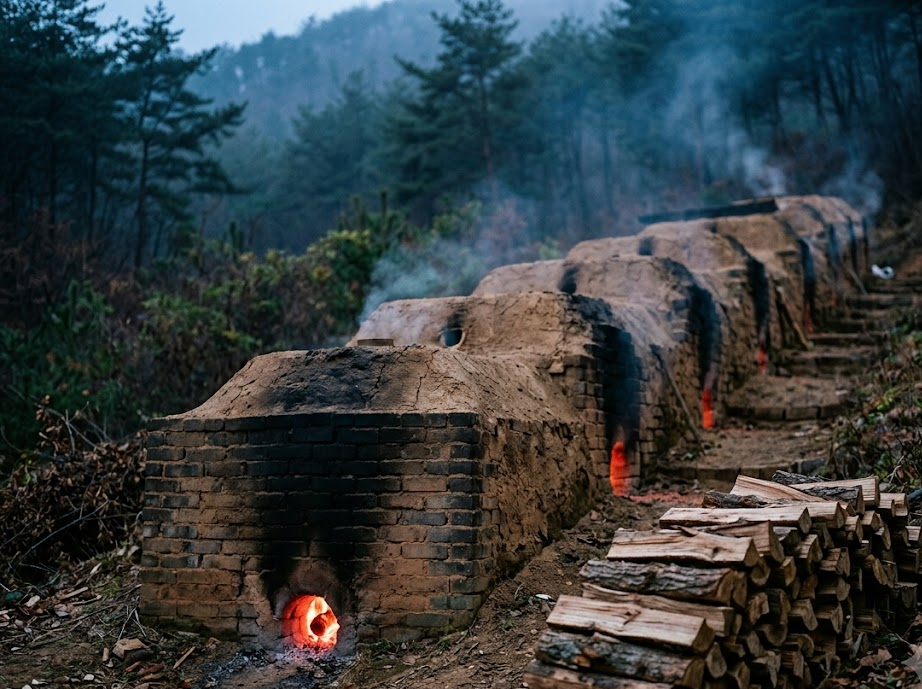
What he has not let go of is the climbing kiln. It is a wood-fired kiln built in chambers along a slope, and the person tending the fire must push in wood through the night while reading the temperature. Unlike the even heat of a gas kiln, the fire of a climbing kiln differs from chamber to chamber and from night to night. The Korea Heritage Service assessed that his skill is outstanding and that he faithfully revives the original form of traditional firing techniques, and it also found his transmission record and commitment firm.
Onggi potter Lee Hak-su of Boseong reached the same qualification by a different road. He is the son of the late Lee Ok-dong, who was a holder of the National Intangible Heritage Onggijang. He began as a transmission scholarship student in 1990, became a certified trainee in 1994 and a transmission educator in 1995, and was recognized as a South Jeolla Province Intangible Heritage Onggijang holder in 2013. It is a career of climbing the steps one at a time for more than twenty years.
The two men's careers share the fact that they went through the stages of transmission over a long period. Onggi is not a skill that can be learned overnight, and even once learned, the kiln cannot be lit if the ware does not sell. Those recognized as holders receive state-level support such as transmission subsidies.
The time after recognition is more demanding. Holder Bang's daughter Bang Yu-jeong and son Bang Yu-jun work as South Chungcheong Intangible Heritage transmission educators. Holder Bang donated the entire first transmission subsidy of 2 million won to the Hongseong Sarang Scholarship Foundation. South Chungcheong Province said it would continue its transmission support, documentation, and projects to strengthen the capacity of practitioners.
The jar inside the museum's glass case is quiet, but the kiln in Galsan-myeon still makes sound. The crack of splitting firewood, the slip of clay water across a palm, the clear, dull ring when a cooled jar is struck. If onggi is not used, the skill cools along with it. When the season for fermenting soybean paste comes, we suggest making your way to Galsan-myeon in Hongseong or to an onggi workshop in Boseong and striking the belly of a jar once with your palm.