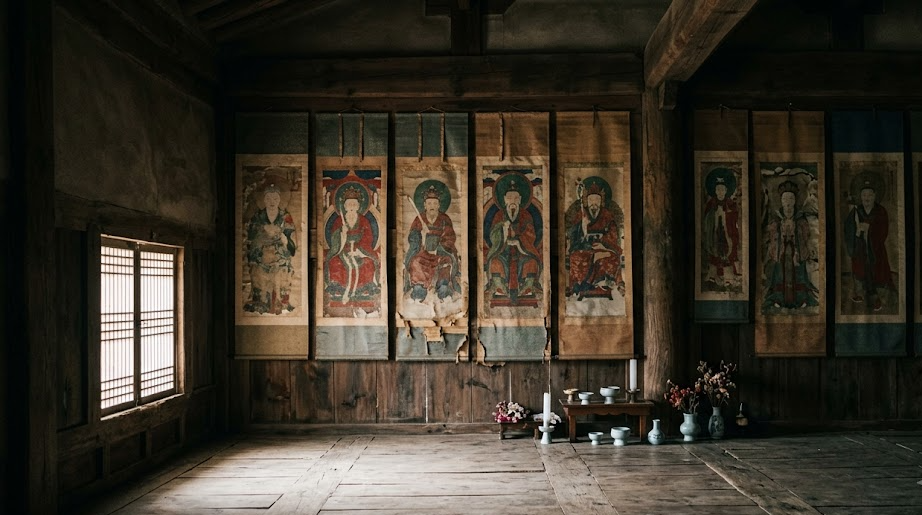
Eight paintings in which a prince who lost his life trying to restore the throne became a deity of a shrine have been entered on the national list. The Korea Heritage Service announced on June 23 that it would designate the "Shaman Paintings of Geumseongdang Shrine in Seoul" as National Folklore Cultural Heritage. Shaman paintings, or musindo, refer to paintings that render on canvas the figures of the deities worshipped in shamanism.
The deities enshrined at Geumseongdang are Geumseongdaewang, the mountain god of Geumseongsan in Naju, and Prince Geumseong (1426-1457). Prince Geumseong was a son of King Sejong (r. 1418-1450), and he is recorded as having met his end while trying to undo the transfer of the throne from his nephew King Danjong (r. 1452-1455) to King Sejo (r. 1455-1468). Cases in which a mountain god of the southern provinces and a figure of the royal house are enshrined together at one altar are rare.
The deities in the paintings show what people of the Joseon period prayed to. The blind Taoist master was believed to help descendants flourish and the fortunes of a household open up, and Hoguassi was a deity who drove away smallpox and other epidemics. Maengin Samsin Manura, Sambulsa Halmeoni, Byeolsang, and Malseonang were also among the eight.
The faces of the figures are round, and the fingers extend long and thick. It is a manner of expression familiar from Buddhist paintings. For this reason a view has emerged that these paintings are connected to Buddhist painting, and the possibility that a monk painter who worked on Buddhist paintings took up the brush is also raised.
The density of the workmanship is also unusual. Compared with ordinary shaman paintings, the three-dimensional quality of the folds of clothing and the details of the patterns are far finer. The Korea Heritage Service cited as grounds for the designation that very few examples of 19th-century shaman paintings are currently confirmed, along with an originality and level of completion not found in other shaman paintings. There is a view that narrows the period of production to the late 19th century.
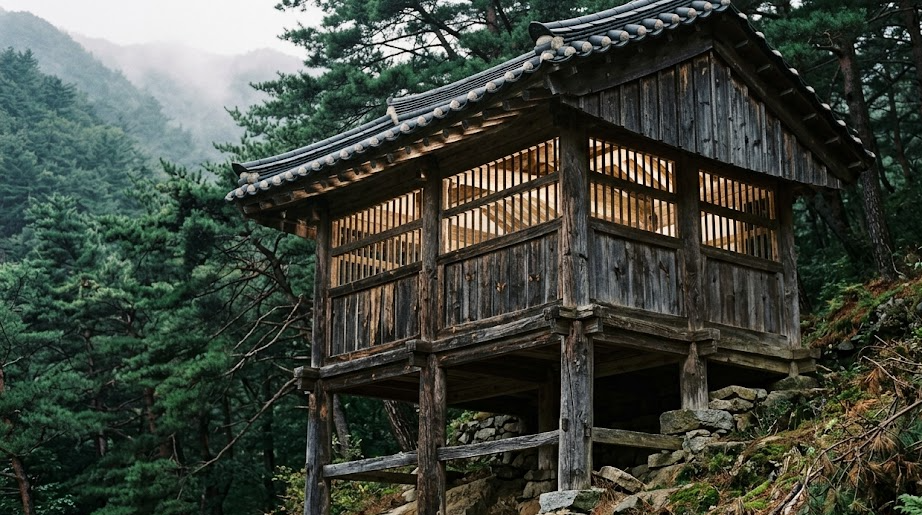
Shaman paintings were originally hung on the walls of shrines and functioned as objects of faith. The moment they are taken down from the wall and moved to a storage facility where temperature and humidity are managed, the deities change status from objects of faith to protected articles. The eight paintings are managed by the Eunpyeong History and Hanok Museum in Seoul, and the shrine building itself became National Folklore Cultural Heritage in 2008.
The building and the paintings entered the system at different times. The house was protected first, and the deities that had hung inside it followed eighteen years later.
Nothing has been decided about exhibition plans or how the paintings will be shown to the public after the designation. Until then, visitors can look over the history of the gut rituals and deities this neighborhood has held in the permanent exhibition of the Eunpyeong History and Hanok Museum.