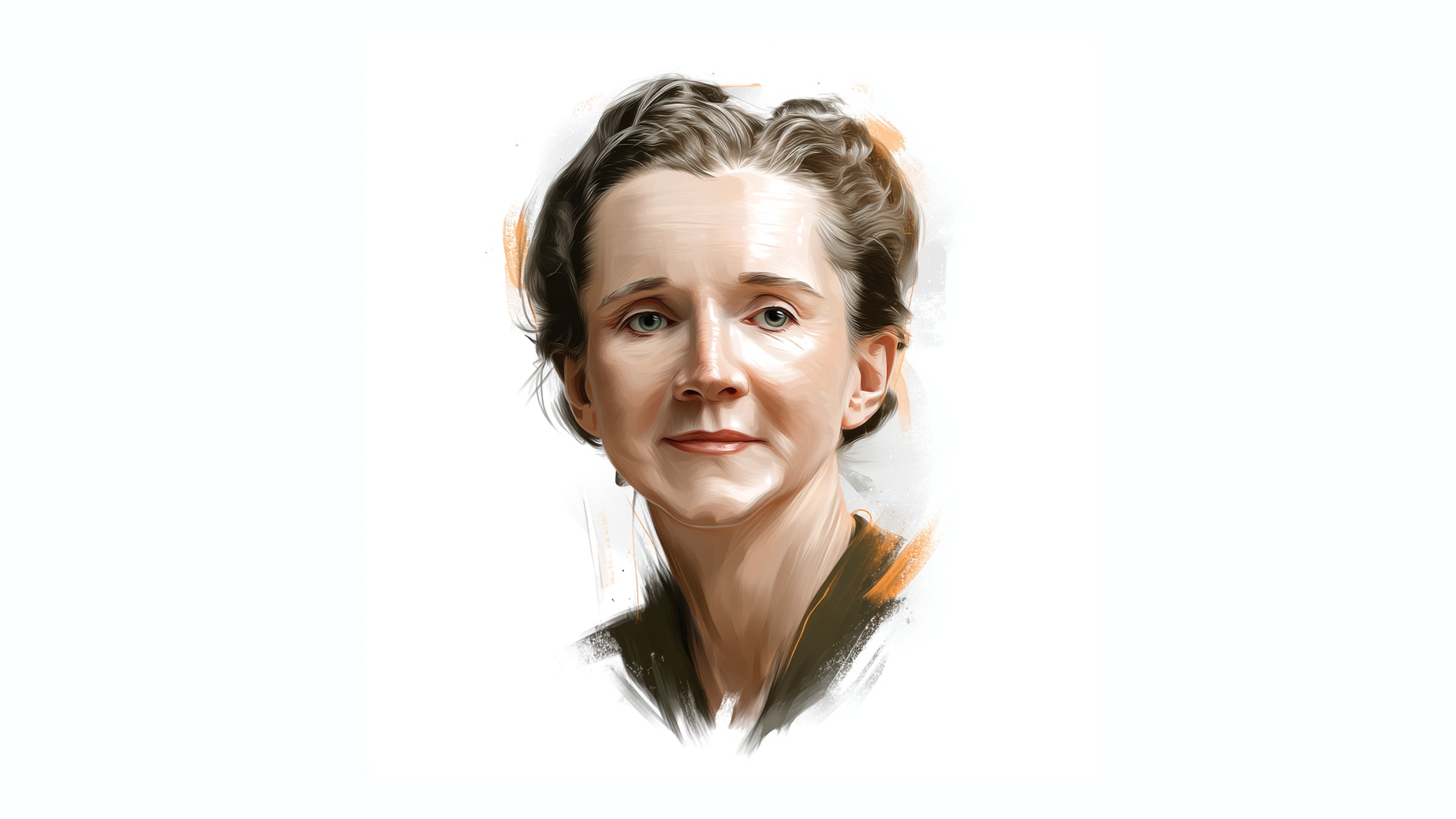
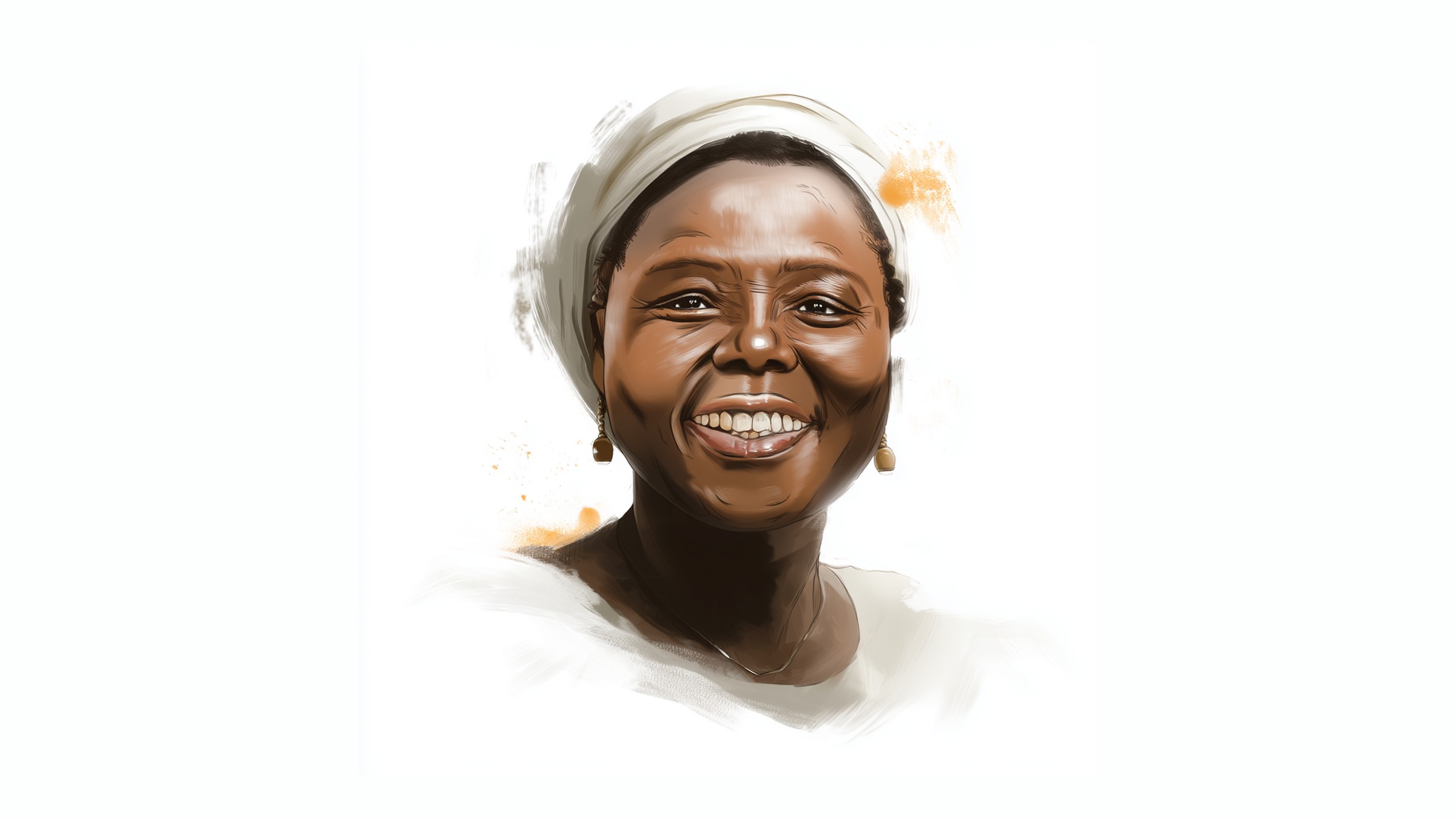
In 1977, a professor of anatomy at a Kenyan university walked out of her lecture hall and dug into the soil. She set seedlings into land where desertification was spreading, and most of the people holding shovels were rural women. The Green Belt Movement she began that way planted 12 million trees, and the trees she planted over her lifetime came to 30 million. We asked her how hands that handled seedlings ended up in prison.
Wangari Muta Maathai was born on April 1, 1940, in a village in Nyeri, in Kenya's central highlands. In September 1960 she went to the United States as one of some 300 scholarship students, earning a bachelor's degree in 1964 from Mount St. Scholastica College in Kansas and a master's degree from the University of Pittsburgh. She received her doctorate from the University of Nairobi, becoming the first woman in East and Central Africa to earn one, and in 1971 she was appointed a professor of anatomy at the same university.
She won a parliamentary seat in the 2002 general election and served from the following year as assistant minister for the environment, natural resources and wildlife. In 2004 she became the first African woman to receive the Nobel Peace Prize, and she died on September 25, 2011.
Q1. What changed between the twenty-year-old who boarded a plane for the United States in 1960 and the woman who returned to Kenya with her degrees?
When I left I was one of some 300 scholarship students. A country whose colonial rule was ending was sending young people out to learn, and I studied biology in the United States and Germany.
When I came back I was a laboratory person. I taught anatomy, and in 1971 I became a professor at the University of Nairobi. What to do with what I had learned was not something a degree answered.
What changed was my conviction that if people made what was broken, people could also undo it. That conviction pushed me out of the lecture hall.
Q2. When you started the Green Belt Movement in 1977, why trees of all things? A scholar would have been more at home with papers.
What the rural women said when they came to me was simple. There is no firewood, the water has moved farther away, there is not enough to feed the children. The answer that took in all of those at once was trees.
Trees hold the soil, bring back the watercourses and give firewood. Planting them requires no degree and no equipment. Seedlings, hands and a few months of patience are enough.
The women raised seedlings and covered the hills. The citation for the prize I received in 1984 said I had turned the debate around ecology into public tree planting. It was work that stopped desertification and work that lifted people up, and I never thought of the two separately.
Q3. In the 1980s your husband filed for divorce, saying he could not handle you, and the court granted it. Did that remain a private defeat?
It was hard to leave it as a private matter. The claim that a woman was too strong to be controlled was accepted in a courtroom. In a country where such a claim works, every woman who speaks up hears the same thing.
I also served as chair of the National Council of Women of Kenya. Even so, I heard for a long time that I should just plant trees, that I had no business meddling in politics. In 1997 I ran as a presidential candidate, but the party withdrew my candidacy.
I have been wrong too. On the day I was announced as a Nobel laureate, at a press conference I went along with a groundless claim about AIDS, and it was a conspiracy theory. Later I restated my view.
Q4. You were jailed several times during the Daniel arap Moi government. The day after you got out of prison, what did you do?
I looked at the seedlings again. That was how I carried on with what I believed was right. What I demanded was fair elections, an end to corruption and a clearing away of politics that set ethnic groups against each other, and coming out of jail did not make the demands any smaller.
The business over Nairobi's Uhuru Park stayed with me a long time. Companies allied with the president wanted to put up a 60-story media complex in that park. I demanded that the construction stop, and the demand was not welcomed.
In the end the park remained. The fact that the green in the middle of the city still belongs to the citizens is what I got for what I paid.
Q5. The Nobel committee named you by tying together sustainable development, democracy and peace. How do trees and democracy fit on one line?
The people who use land carelessly and the people who use people carelessly are usually the same. Follow the places where the forest is disappearing and it becomes clear who made the decision. You can see who asked and who answered, and who was never asked.
So I saw tree planting as a question of how the country is run. In 2003 I founded the Mazingira Green Party, and I served as assistant minister for the environment, natural resources and wildlife. The hand that holds the shovel and the hand that makes the law should be one body.
Peace is the same. When water, firewood and soil grow scarce, people fight. Planting trees is work that reduces the reasons to fight.
Q6. In 2025 corporate advertising built around climate action is everywhere. Counting up planted trees and announcing the figure is common too. How do you see this scene?
Counting itself is not bad. We counted too. But the number planted and the number that survive tell you completely different things.
Tree planting that does not ask who owns the land does not last. Trees live when the people living on that land get something from them. That part is rarely written into the promotional copy.
Nor do I agree with the people who say it is all over. I saw bare hills covered again with my own eyes. Saying it is late is not the same as saying it is useless.
Q7. People have kept planting trees since you left. What do you hope the next generation takes up?
I do not hope for anything grand. One habit is enough: plant a tree today where you live, and go back a few years later to see whether it is alive. Planting takes an hour, protecting it takes a lifetime.
What I had was a degree and a shovel. I simply did not use them separately.
There was a girl who used to walk to a girls' school in Limuru. If one seedling that child planted is casting shade on some hillside now, that is enough for me.
This piece is not an actual interview. It is an imagined interview reconstructed by Breath Journal from Wangari Maathai's life, writings and the records she left behind. The questions were written by the reporter and the answers were drawn from her writings and her actions.