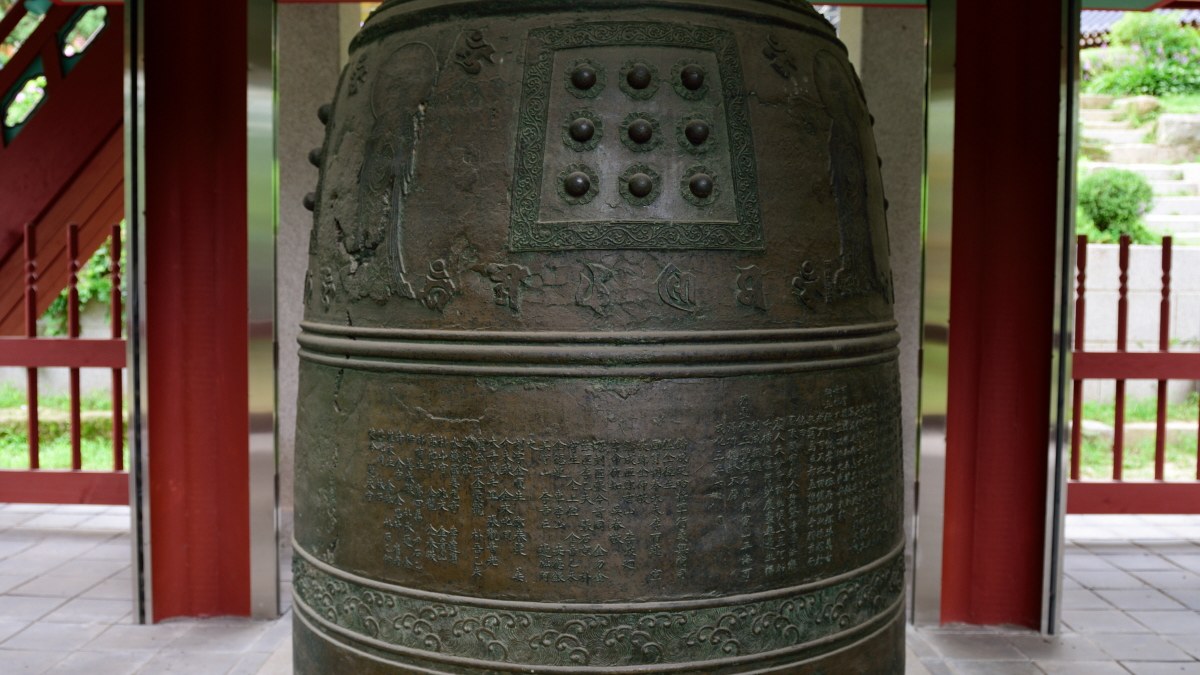
The Korea Heritage Service has given advance notice of the designation of the "Bronze Bell of Bongseonsa Temple, Namyangju" as a National Treasure. The notice was issued as of March 4, and after a 30-day period for gathering opinions it moves on to deliberation by the Cultural Heritage Committee. It is a procedure that raises the grade by one step 63 years after the bell became a Treasure in 1963. If the final designation is made, it becomes the first National Treasure held by the city of Namyangju.
The bell's history begins with one person's mourning. Yejong, the eighth king of Joseon, built Bongseonsa Temple to pray for the repose of his father Sejo, and along with its founding he had this large bronze bell cast and hung. Sejo's reign is recorded as lasting from 1455 to 1468, and Yejong's from 1468 to 1469. The temple sat on land not far from Gwangneung, where Sejo lies.
Its body rises well above a person's height. The height is recorded as 238 cm, and another measurement puts it at about 2.3 m. A mass of bronze with a mouth diameter of 168 cm and a thickness of 23 cm has hung from the crossbeam of the bell pavilion, bearing the same shade for close to six hundred years. The fact that it remains with almost no casting cracks or warping was included in the grounds for the National Treasure designation.
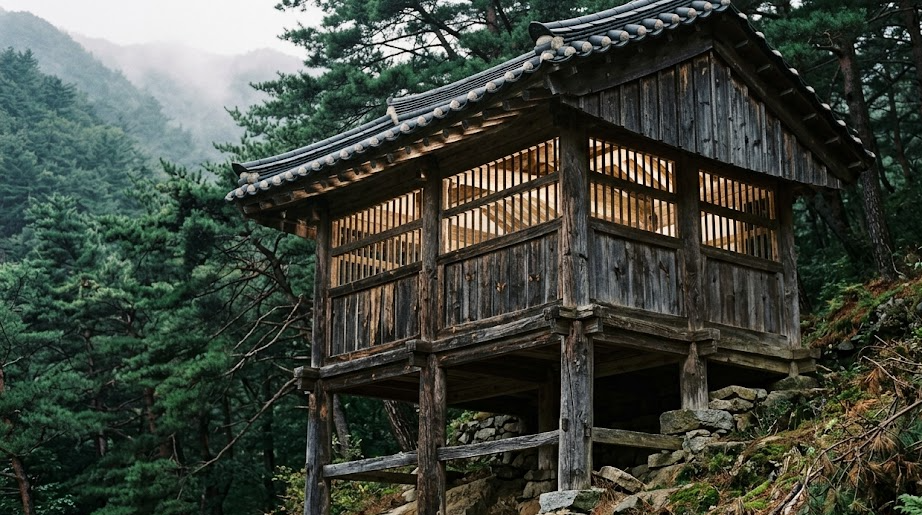
What makes this bell special is that it has never been moved. Among the large bronze bells commissioned by the royal court in early Joseon, it is counted as the only case still hanging in the Bongseonsa bell pavilion, the place where it was enshrined when it was made. Compared with the many royal-commissioned Buddhist bells that lost their original eaves through wars, temple closures and relocations, this is a rare thing.
Its form shows the grammar of the Joseon bell clearly. At the top, the yongtong sound tube found on Goryeo bells is gone, and two dragons face away from each other to form a loop. Two horizontal bands run around the shoulder and three around the middle of the body, and square yeongwak panels and standing bodhisattva figures are placed alternately on the upper part. The broad lower surface is filled with a long inscription.
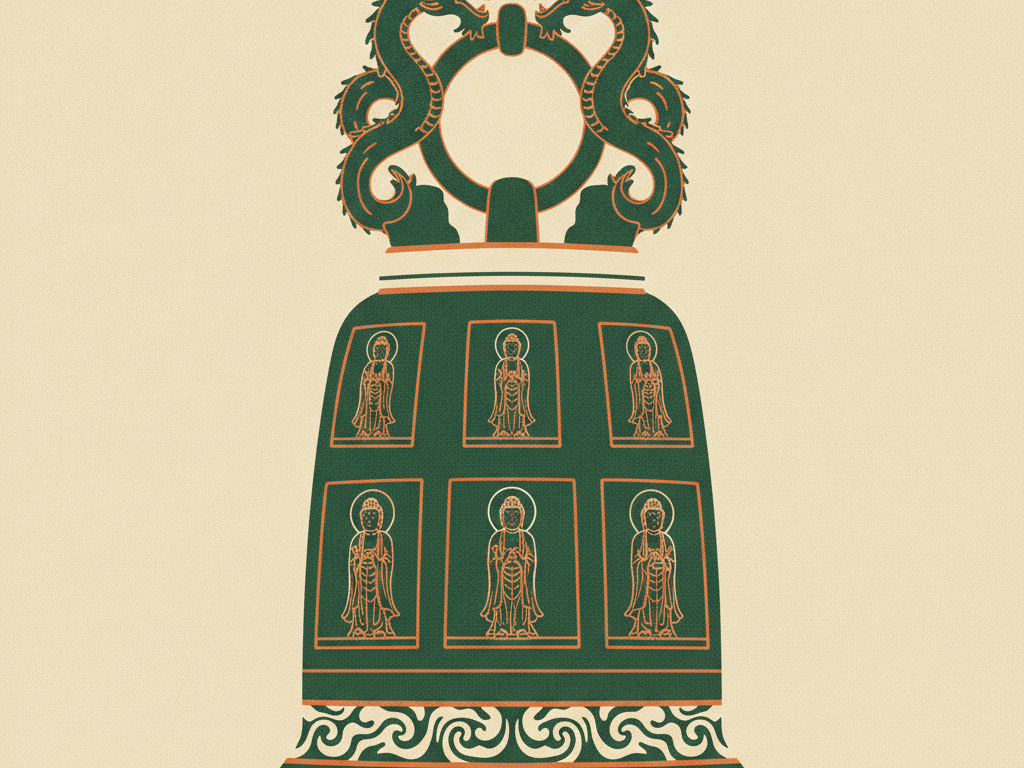
A mouth wider than on Goryeo bells, the bands wrapped around the body, the standing bodhisattva figures and the Six-Syllable Great Bright Mantra all come together in one place. As a work that took in part of the style of Chinese bells while keeping hold of the decorative tradition of Korean bells, the Korea Heritage Service judged that the early Joseon bronze bell style was completed here. An assessment that the Joseon bells that followed took this form as their standard came out along with it.
The inscription is also a record that holds on to the names of the people who made the bell. The bell-casting record was composed by Kang Hui-maeng (1424-1483) and written by Jeong Nan-jong (1433-1489), and it sets down the background and date of production, the place of enshrinement and the artisans who took part. Some of the artisans whose names appear here also lent a hand in making the bronze bell inscribed with the name Heungcheonsa and the old Bosingak bronze bell. It means that the lineage of royal Buddhist bells before the Imjin War was carried on through human hands.
At the same time, "Celadon Dish with Inlaid Twin Dragon and Chrysanthemum Design," a 13th-century Goryeo inlaid celadon, and "Portrait of Yu Hyo-geol and Chest" were also given advance notice of Treasure designation. Yu Hyo-geol (1594-1627) put down the rebellion of Yi Gwal (1587-1624) and rose to second-class Jinmu Merit Subject. The advance notice procedure, issued in the name of Korea Heritage Service Administrator Heo Min, will lead to deliberation after opinions from various quarters are received.
Namyangju Mayor Joo Kwang-deok stated his intention to protect and make use of local heritage in an orderly way. Preservation and use run up against each other especially sharply in a bell. Bronze is most bell-like when it rings, and the more it rings the more it wears. The city, with its first National Treasure in sight, has not yet decided whether to keep this bell as an artifact to be seen or as a sound to be heard.
Once the gathering of opinions ends, a deliberation schedule will be set. Before that, walking the Gwangneung forest path as far as the Bongseonsa bell pavilion is worth recommending. Looking up from under the eaves, the horizontal bands running around the dark blue-green body and the folds of the bodhisattvas' robes slowly come into view far above eye level. Standing at the bell pavilion, the fact that this bell has not been moved once in six hundred years feels a little different.