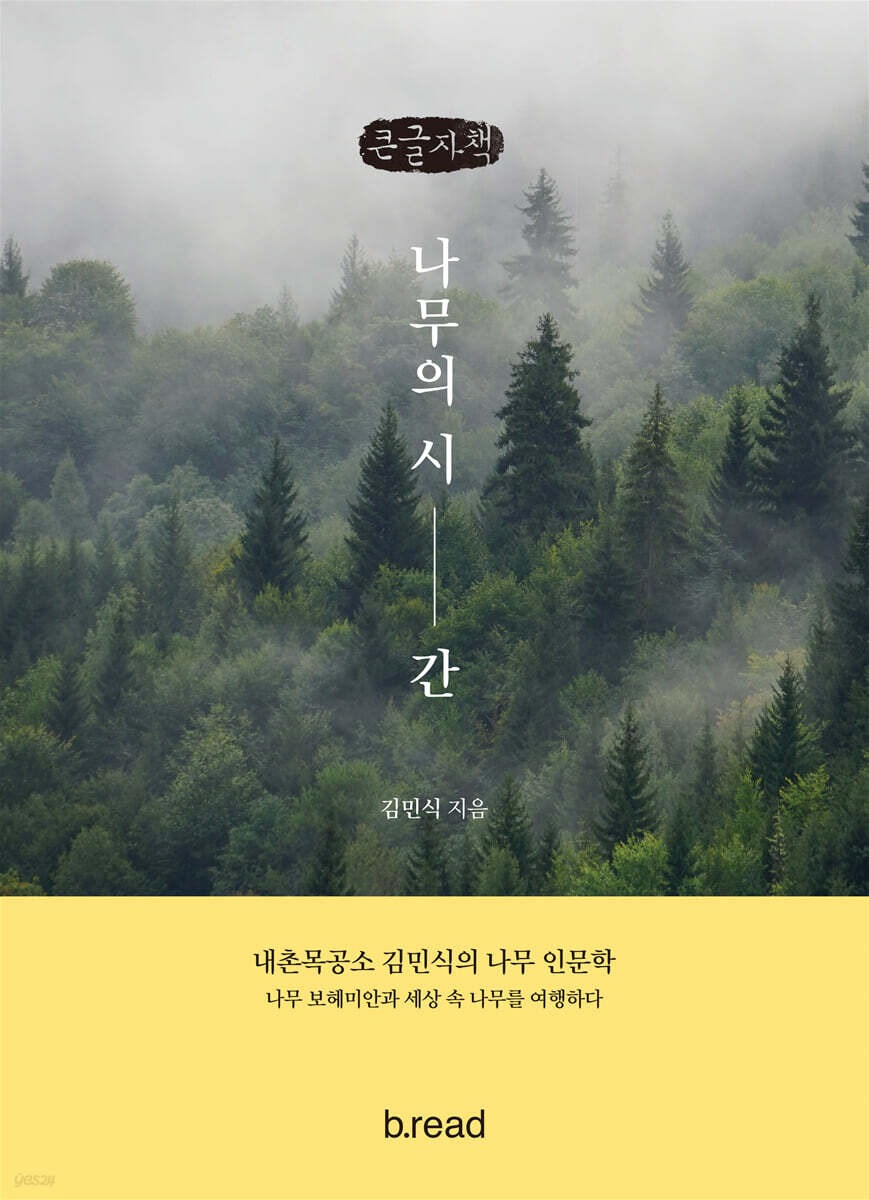
How many things that last a century are we making now. A tree takes decades to grow, and used well it lives several times longer than that. Few materials have such a gap between the time of growing and the time of use. 『The Time of Trees』 (by Kim Min-sik, Br.ead, 2022) looks at that gap head-on.
The book is written at the eye level of someone who handles wood as a material. The processes by which timber is completed as timber, species and place of origin, the way it is sawn and the drying process, form the axis of the account. It is also available as a large-print edition, so the format is roomy, and the writing reads slowly.
Anyone who has touched wood with their hands knows. The smell of a freshly sawn board, the short dry sound of a plane passing over it, the fine unevenness that the surface of an old column leaves on the fingertips. The sentences of this book follow the history of the material without erasing such sensations.
Korean traditional architecture uses timber, and that timber returns to its place hundreds of years later after dismantling and repair. Replace a single member and the whole building goes on living. There is an accounting there different from today's arithmetic of repeated demolition and new construction.
So what this book touches is not a matter of taste. To obtain good timber you must manage forests in units of a century, and to manage those forests you must keep using timber. To preserve you must cut, and to cut you must plant. The author does not smoothly stitch up this tension.
The book's strength comes from staying close to the material. Rather than consuming timber as a symbol of ecological discourse, it holds it fast as a thing that is sold and sawn and dried. When books that speak of sustainability rise up into statistics and policy, this one stays at the height of the wood grain.
There are places where it thins out. As densely as it draws the time of the material, the picture of the industry and institutions in which that material sits is sparse. Readers who want to know more about today's conditions, in which timber supply crosses borders, or about the actual constraints of repair sites, will need one more book.
Those who live while mending old wooden buildings will read this book most deeply. To hands that have replaced the lower section of a column and pried up a floor, the author's way of following the lifespan of a material is not unfamiliar.
Even after being cut, timber goes on undergoing time, drying and warping and enduring. In being a record that holds on to that fact and pushes it through to the end, this book parts ways with other books that speak of the environment.