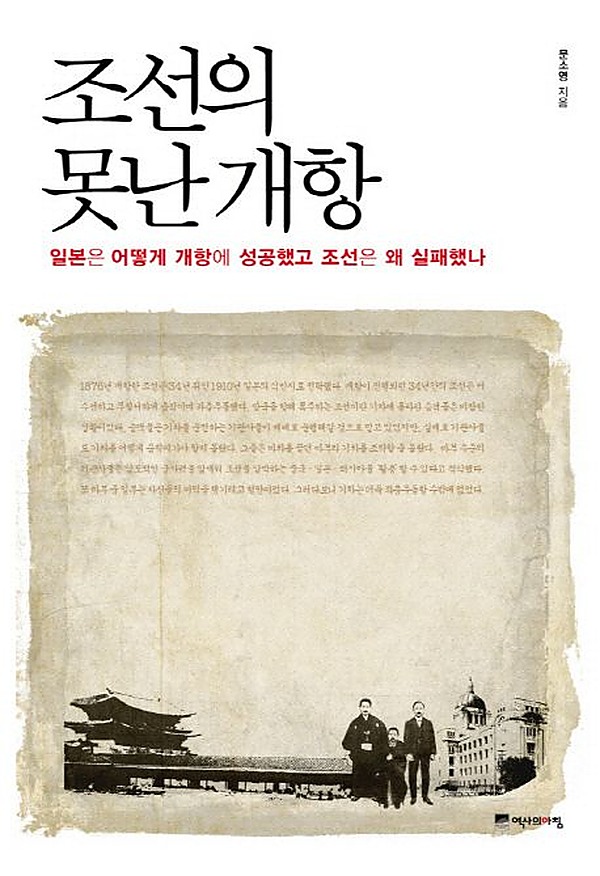
Why does a transition always arrive late? At the moment a door opens no one knows it is a door, and only after passing it do we know it was a fork in the road. Moon So-young's "Joseon's Sorry Opening of the Ports" (Yeoksaui Achim, 2013) is a book that looks inside that lateness. The reason for opening this book again in the month that holds Liberation Day is closer to a review than to a commemoration.
The word "sorry" in the title is closer to pain than to mockery. Instead of arranging the opening of the ports into a scoreboard of wins and losses, it retraces what people tried to protect within it and what they let slip. A book thirteen years old feels less dated because its framing of the problem is aimed at attitudes rather than at events.
Reading a book that came out in 2013 in the year 2026 creates an odd time lag. Readers then would have read it as a story of a hundred-odd years ago, and readers now read it as a story of their own time. In between, we have come into the middle of one more transitional era.
The present transition is a move from coal and oil to something else, and in that process cities that hold ports, industrial complexes and power plants are shaken whole. As the harbors of the port opening period were, today's industrial cities are told to remake themselves to a timetable pushed in from outside. Then treaties set the timetable, now markets and regulations set it. What is alike is the fact that the side that made the timetable and the side that bears it are different.
Seen from the cultural heritage side, this overlap is sharper. The warehouses and customs houses, the rail lines and company housing of the port opening period now mostly stand with the label of modern cultural heritage. The brick has weathered black, the wooden door frames smell of damp timber, and the iron stairs give a low, dull sound with every step. They have two faces, a trace of humiliation and at the same time an accumulation of technology and labor.
The tension between preservation and use begins here. Leave it and maintenance costs run up, touch it and the original form disappears, turn it into a cafe or an exhibition hall and people come in exchange for a thinner story. This book does not offer a solution. It uses the experience of the port opening period to show what comes of letting time pass with the decision put off.
The strength of the book lies in not making the transitional era into a morality play. Instead of sorting who betrayed the country and who loved it, it follows how people made decisions under conditions of scarce information and pressing time. The thin places are clear as well. As much as it chose readability for a general audience, its density in digging into historical sources falls short of a specialist study, and a gap has opened with the research currents of today, thirteen years on.
So it is better used as a tool for thinking than as the standard introduction to the port opening period. It is especially useful for people who have to decide what to keep and what to change in cities that hold modern heritage, and for people who wonder which side pays the cost of a transition. After reading, a walk around the old port districts of Incheon or Gunsan is worth trying. Putting a hand on a brick wall and taking the temperature of that era is the last chapter of this book.
Putting a hand on a brick wall and taking the temperature of that era. The book stops there.