A box full of videotapes is set down in a law firm office. The box, brought in by the farmer Wilbur Tennant, holds a record of dead dairy cows. Swollen organs, blackened teeth, tumors. That is how 190 head died.
"Dark Waters," the 2019 film directed by Todd Haynes, starts from this box. In 1998, Robert Bilott, working as a corporate lawyer at Taft Stettinius & Hollister in Cincinnati, takes up a request from a farmer who knows his grandmother and visits a farm in Parkersburg, West Virginia. Mark Ruffalo plays Bilott, and Anne Hathaway and Tim Robbins play the people around him. The screenplay was written by Mario Correa and Matthew Michael Carnahan.
The genre is a courtroom thriller, but the texture of the screen is far from a thriller. Haynes drains the color and slows the pace. The case moves forward not by gunshots or chases but at the speed at which the document boxes multiply.
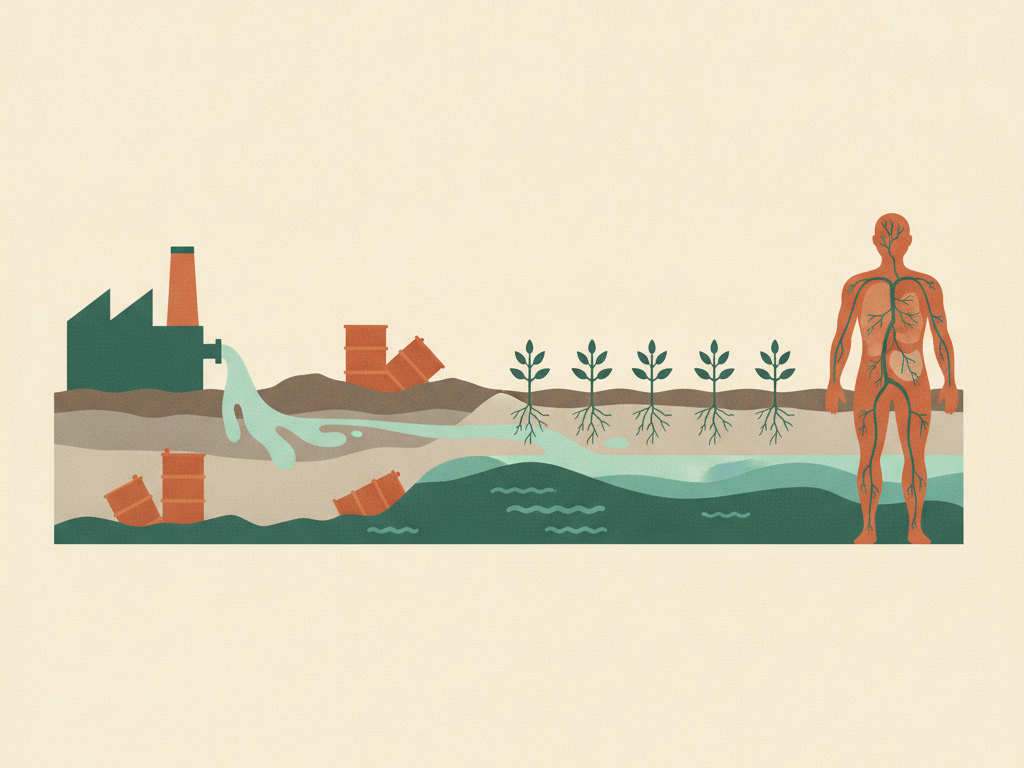
The substance at the center of the film is PFOA, perfluorooctanoic acid. It is the substance DuPont used to make Teflon, which goes into nonstick frying pans and carpet flooring, and it accumulates without leaving the bloodstream. The heart of this film hangs on the scene in which Bilott turns up nothing no matter how far he digs through EPA reports.
Nor was it a substance banned for being dangerous. It was legal because it was not on the regulatory list at all.
This is the point where it meets our pages. An unregulated substance is not booked as a cost on the financial statements. If a company confirmed through decades of in-house testing that it caused cancer and birth defects and did not disclose that, the profits of those years were calculated while sitting on undisclosed liabilities.
In the film, the fine imposed by the EPA is 16.5 million dollars. What that sum recovered is left for each viewer to work out.
The distance between a company that uses ESG as promotional copy and a company that holds out in court for 20 years is the same distance this film takes up. In Parkersburg, the community turns away from Tennant, who reported the contamination. That is because the company is the area's largest employer. Which side the community takes when environmental costs and jobs go on the same scale, the film shows without explaining.
The conclusion of the direction is clear. Haynes does not turn Bilott into a hero. He is a man who used to defend corporations, and in the scene where he faces Phil Donnelly, the lawyer for DuPont, what is left is an argument in place of a victory.
The scene in which DuPont responds to a request for disclosure by sending hundreds of boxes compresses the rhythm of this film. The film conveys without embellishment that pouring out material to wear down the other side, in place of hiding it, is the grammar of actual corporate litigation.
There are places where it loosens. From the moment the substance's harm comes to light, the film moves closer to a chronology than to a narrative. It is a choice meant to make the weight of time felt, but the characters' inner lives thin out by that much.
Bilott's 20 years are recorded in the memoir "Exposure" (2019), and the full picture of the case was put before the world ahead of the film by a 2007 book, a 2016 magazine article and the reporting series that followed. The film stands on that accumulation.
Anyone who has believed in corporate goodwill has nothing to gain from this film. There is no executive who awakens here, no organization that apologizes belatedly. The company moves by the company's logic to the end, and what piles up on screen is only how that logic remains in people's bodies and in the town's water. Viewers who expect a twist or a catharsis will also find the two hours hard to sit through.
For anyone who has wondered when the risks outside the financial statements come back as a bill, there is no room for boredom. Contamination becomes litigation records, and litigation records become costs placed in someone's hands. The reason this film is back on screens ahead of World Water Day lies in that invoice as well.