The film opens in a hearing room shot in black and white. It is 1959, and Lewis Strauss, nominated as secretary of commerce, sits facing members of the Senate. The questioning goes back to a physicist's security hearing five years earlier, and the image soon turns to color and crosses over to a young Oppenheimer in the New Mexico desert.
"Oppenheimer" cuts between these two time frames for all three hours. There is a reason to take this film out again in August. Few commercial films have held so doggedly to the circumstance in which the person who builds a technology and the person who decides its use never end up sitting in the same room.
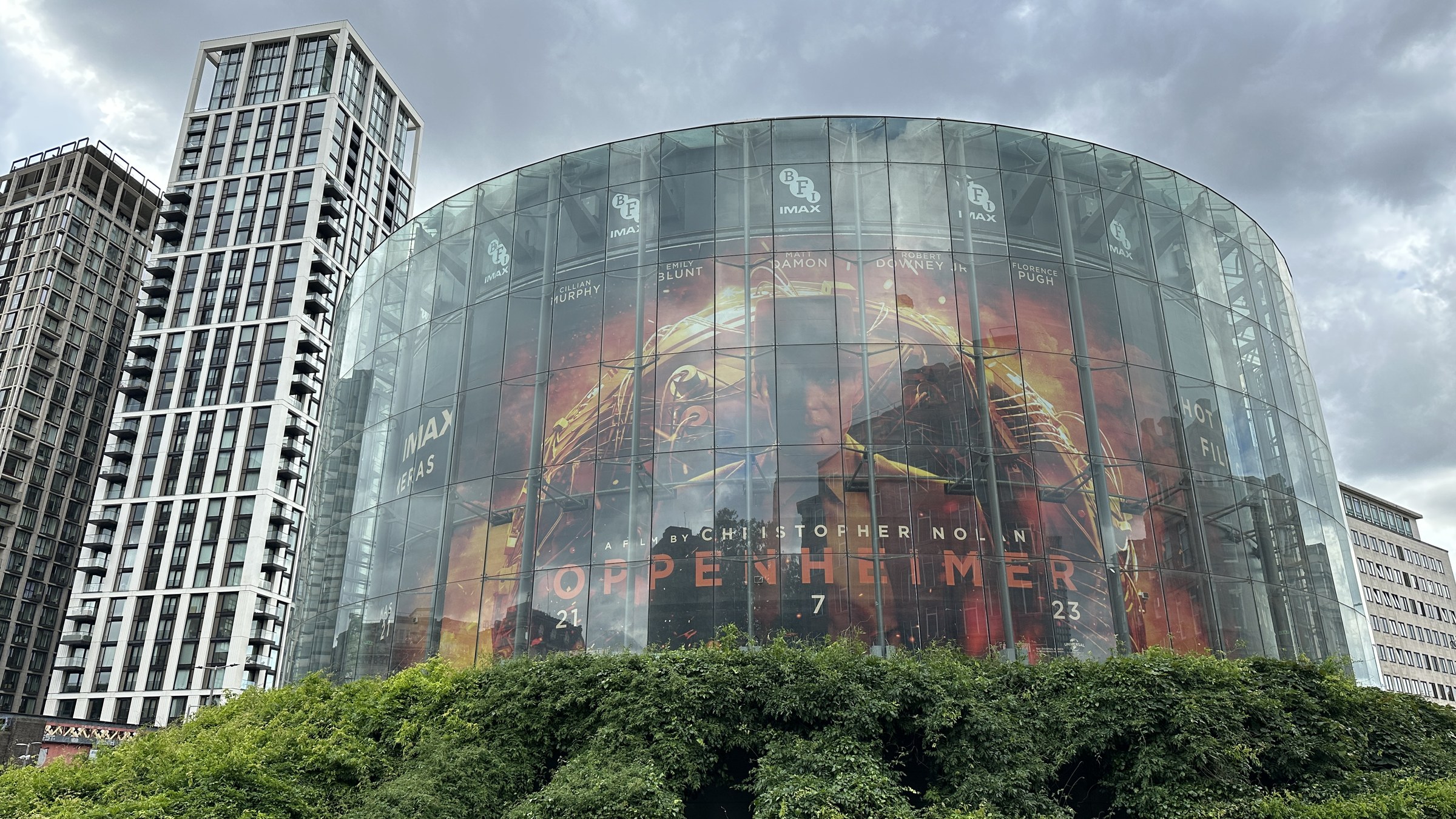
The 2023 work was written and directed by Christopher Nolan. It is based on "American Prometheus," the biography Kai Bird and Martin Sherwin published in 2005. Cillian Murphy plays Oppenheimer and Robert Downey Jr. plays Strauss, a member of the Atomic Energy Commission, with Emily Blunt, Matt Damon and Florence Pugh filling out the cast around them.
Cinematographer Hoyte van Hoytema shot on a mix of IMAX 65mm and 65mm large-format film, and the black-and-white IMAX stock was made anew by Kodak for this film. This is the first film to shoot IMAX scenes on black-and-white film.
The opening runs quickly through the scholar's career. Oppenheimer, who finished his doctorate at Göttingen in the 1920s, meets Isidor Rabi and Werner Heisenberg in Europe, then returns to the United States and builds a center for quantum physics at Berkeley. His relationships with students and colleagues who are Communist Party members, and with Jean Tatlock, accumulate in this period. In 1942 Leslie Groves brings him in as head of the Manhattan Project, and the Los Alamos laboratory rises in the desert.
Rabi declines to join, saying he does not want to build a weapon of mass destruction. This is about as far as a plot summary should go. The test of July 1945 and what follows are better seen on screen.
The frame of this film is color. The color scenes are a subjective record seen through Oppenheimer's eyes, and the black-and-white scenes an objective record seen through another character's eyes, Nolan explained. There is no need to take that explanation down as it stands.
Something else is at work on screen. It is the sense that the time of the people who build and the time of the people who administer run at different speeds.
In the color desert, calculations pile up, people gather, and something moves toward completion. In the black-and-white hearing room, a finished matter is reopened as paperwork, and the same facts become a different charge. The 1954 hearing revoked Oppenheimer's Q clearance by a vote of 2 to 1, and in 1959 the Senate rejected Strauss's confirmation as secretary of commerce. The film sets these two hearings facing each other like mirrors, creating a circuit in which the power that judged a technician is judged five years later in the same room.
It is worth following the logic the film builds here. In July 1943, Groves ordered that security clearance be granted without delay, irrespective of any information concerning Oppenheimer. The bomb was needed. Ten years later, in December 1953, Strauss notified him that his clearance was suspended on the basis of the same record.
A physicist who opposed development of the hydrogen bomb was no longer needed. What the film shows is not Oppenheimer's innocence or guilt. It is the fact that a technician's trustworthiness rises and falls according to how much power needs him. This logic is not locked inside the 1940s.
The compartmentalization rules at Los Alamos sit in the same context. The scientists calculate only their own share without knowing what the others are doing. Very few see the whole, and the room for an individual researcher's conscience to operate is narrow in proportion. Whether to use the bomb is decided in a meeting room in Washington, and for the scientists the conclusion is an outcome that arrives afterward.
Organizations building large artificial intelligence models today also have data collection, training and deployment split across different teams, and it is hard for the person handling each stage to know the final use in full. When the work of building a capability is separated from the work of deciding that capability's use, responsibility scatters along with it. The film shows this separation through a case from 80 years ago, but the frame has not aged.
The strength of the direction comes from sound and rhythm. Ludwig Göransson's score and Jennifer Lame's editing build a beat that tightens as the calculations advance, and the audience feels tension even knowing the outcome. The production said the Trinity test scene was shot with real explosives instead of computer graphics.
The finished film, however, contains hundreds of shots made by around 160 visual effects workers, and digital compositing was used in the explosion scene as well. This gap between the makers' account and the actual result happens to resemble the film's own subject.
As for the weak points, the conversation with Einstein that serves as the film's axis is a scene that did not actually happen. The person Oppenheimer consulted about the possibility that a chain reaction might ignite the atmosphere was Karl Compton of MIT. Nolan places this invented conversation at the beginning and the end of the film and lets its closing line deliver the conclusion. A biographical film has entrusted its most important moment to an invented scene, and this choice gives up the force of fact in exchange for the film's persuasiveness.
Second, Hiroshima and Nagasaki are not on screen. Nolan chose to show only what his protagonist experienced, and as a result the time of those who suffered the damage remains outside the film. Takashi Hiraoka, a former mayor of Hiroshima, said the horror of nuclear weapons was not depicted sufficiently.
The film opened in South Korea on Aug. 15, 2023, and drew 3.23 million viewers. For anyone who watched it on Liberation Day, no explanation of where that blank lies is necessary.
Something looks different now. On Dec. 16, 2022, seven months before the film came out, U.S. Energy Secretary Jennifer Granholm vacated the 1954 revocation of the clearance. The reason was that the commission had broken its own rules in a flawed process.
At the time of release, the film was read as the tragedy of a scientist who had been falsely accused. Seen after the restoration of his name, what the hearing scenes point to moves from an individual's grievance to the habits of an institution. The habit of covering over suspicion when it is convenient and pulling out the same suspicion once a person's usefulness is spent did not disappear after the decision was corrected 68 years later.
The film won seven categories at the British Academy awards in February 2024, including best film, best director and best actor, and at the 96th Academy Awards it took best picture, director, actor, supporting actor, cinematography, editing and score. Its worldwide box office passed $980 million, third among films released in 2023.
Move the gaze outside the screen and the New Mexico desert remains. As the film drew attention back to the Trinity test site, the issue of nearby residents and uranium mine workers who had been exposed to test fallout yet left out of compensation went up to the U.S. Congress. The discussion was about expanding the 1990 Radiation Exposure Compensation Act, and the New Mexico legislature passed a resolution in support.
The people the film never showed crossed one threshold because of the film. The place the technology that left Oppenheimer's hands reached 80 years later was that desert, not a hearing room or an awards hall.