In 1909, a man crosses the frozen Tumen River as if crawling. It is the opening scene of 「Harbin」. The camera turns aside from the hero's resolve and looks for a long time at a body collapsing on the ice.
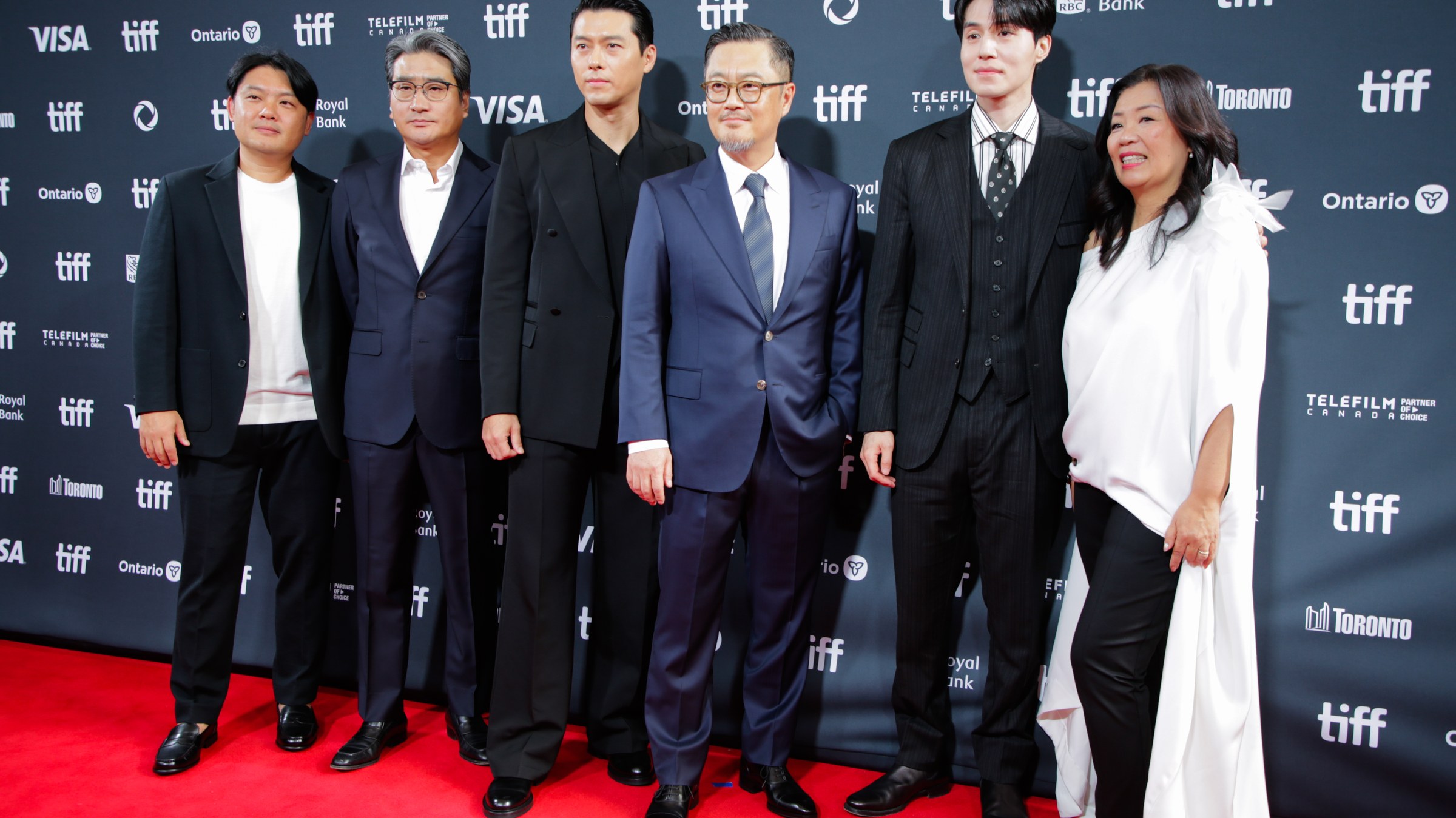
It is director Woo Min-ho's sixth feature. It was shown for the first time in the world in the Gala section of the Toronto film festival on Sept. 8, 2024, and opened in theaters at home on Dec. 24 of the same year. Hyun Bin took the role of An Jung-geun, lieutenant general of staff of the Korean Righteous Army (대한의군 참모중장), and Park Jung-min, Cho Woo-jin, Jeon Yeo-been, Yoo Jae-myung and Lee Dong-wook divide among them the faces of his comrades. The casting that seated Lily Franky in the role of Ito Hirobumi is a choice not to draw the enemy as a monster.
The opening is not a record of victory. An Jung-geun let the captured Japanese officer Mori Tatsuo go without executing him, and Mori, who returned alive, led his unit back and wiped out the comrades with artillery fire. Those who remained doubt their leader's whereabouts and his heart, and the man who comes back has his command doubted.
What can a man who kept his conviction and lost people do with conviction again. The film starts here.
The production conditions themselves were on a scale that would take on that question. Production costs came to 30 billion won, and the shoot moved among Mongolia, Latvia and Korea over six months. Word came from the production team that they picked only places with snow and cold to shoot, and the temperature on location fell to 40 degrees below zero. It is also the first Korean film made in the IMAX format.
A commercial film that handles historical fact does not transcribe the records. It fills the time the records left empty, the few days of crossing the river and the nights of doubting one another, with the actors' faces. Faces filled in that way stay longer than a textbook illustration. That is the reason for taking this film out again in August, after Liberation Day has passed.
The images push that filling forward honestly. Hong Kyung-pyo's cinematography holds to the end the texture of white fields and black coats, old wood and wet earth. The 61st Baeksang Arts Awards gave this film the best film award and gave Hong Kyung-pyo, who was in charge of the cinematography, the grand prize in the film category, and the Blue Dragon Film Awards' cinematography and lighting award went to the same images.
The placement of the figures is interesting as well. Ito Hirobumi is set at the peak of the drama, while the actual threat is carried by Mori Tatsuo. In putting a dogged individual rather than a huge name in the pursuer's place, the film does not let the fact that the empire works through people out of its sight. Hyun Bin, who made an An Jung-geun who does not orate, received the best actor award and the popular star award together at the Blue Dragon Film Awards.
There are regrets too. After piling up the physical substance of winter with such care, it passes thinly over the histories of the individual comrades. Names like Gong Bu-in, who supplied the weapons, and Choi Jae-hyung and Lee Kang, who held up the Daedong Gongbo, are consumed briefly on screen compared with the weight of the real figures. Measured against a geographic ambition that drew in even the Russian finance minister Kokovtsov and Qing bandit bands, the density of the figures does not keep up with the density of the scenery.
The results moved along that gap. After the release it took first place at the box office for two weeks running and gathered 2.07 million viewers during the month of January the following year to hold first place for the month, but the final cumulative audience stopped at 4.91 million. The break-even point was known to be 6.5 million. By the arithmetic of a big production that leads with spectacle it falls short, and by the arithmetic of a film that leads with faces it becomes a different story.
Even so, the temperature this film leaves behind belongs to people who waver, not to a statue of a hero. A historical film grows duller the more exactly it reproduces and moves further from fact the more dramatically it is adapted. 「Harbin」 chose to adapt the blank spaces between the events instead of touching the skeleton of the events, and that choice largely succeeded.
Since it went up on Netflix in April 2025, more viewers have met this film in conditions stripped of the theater's darkness and the IMAX screen ratio. The mark left where the comrades' faces were pushed into the background in the end is not erased even when the screen grows smaller. Even so, the sound of the footsteps crossing the frozen river stays long after the screening ends. This film holds on to what a man lost and still kept walking through, rather than what he accomplished.