The sea is not a backdrop in this film. The waves that fill the screen are a passage that carries things, and a place where whatever does not return stays. Mati Diop's "Atlantics" opens its story by watching that water for a long time.
Made in 2019 as a Senegalese-French-Belgian co-production, the work is the director's feature debut. Diop rewrote the documentary of the same name that she made in 2009 as a fiction film, and worked mostly with unknown actors. It entered the competition at Cannes that year, leaving a record as the first Black woman director with a film in competition, and won the Grand Prix.
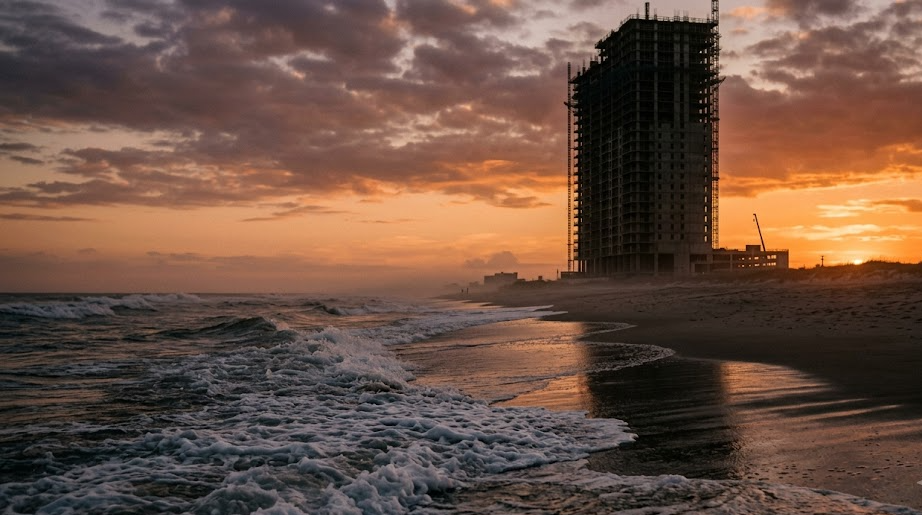
The setting is the Atlantic coast on the outskirts of Dakar. A high-rise tower with a futuristic look is about to open, and the laborers who built it have gone months without pay. Souleiman, one of them, is in love with Ada, but Ada is facing marriage to another man at her parents' wishes. One night the laborers board a boat bound for Spain.
The reason they leave is not war, nor persecution. They were not paid for their work, and no way to be paid was in sight. Those who set out on the route from the West African coast toward Europe are generally the youngest and healthiest people in their villages.
Climate and the economy are tangled here in ways that are hard to separate. When fishing grounds shrink and farming falters, people come to the city, and the city's construction sites absorb them. When wages fall behind at those sites, the next destination is across the sea. The order "Atlantics" shows is exactly this route.
The film does not treat the vanished young men as statistics. It follows the time of the people left behind. While the wedding goes ahead, while the newlywed home burns, while the police search for the arsonist, those who left come back to the village in another way. Even as it uses devices of fantasy, the texture of the screen keeps its feet on reality to the end.
The strength of the direction comes from letting the screen move slowly. In place of explaining events, Diop holds at length on the coast at night, the stained sky, the room where sleep will not come. As that silence builds, the dry phrase "unpaid wages" turns into something the body feels.
By contrast, the stretch in the latter half that follows the police investigation scatters some of the tension the earlier scenes had built. In keeping to the rules of the genre, there are passages where the density of the gaze thins out.
The placement of the characters is also worth noting. The builder who held back the wages is not drawn as a monster, and the young men who left do not become heroes. What the film takes aim at is the way money fails to flow, more than individual malice. Thanks to this balance, the work comes closer to a question the audience has to answer than to an accusation demanding that someone be punished.
For viewers who have settled on the ending in advance, this film can be frustrating. For anyone waiting for a scene in which the person behind the exploitation is punished, two hours of nothing but the night sea and sleepless rooms are hard to sit through. The same is true for those who want a story that sorts out cause and effect clearly. What Diop holds onto is the time the people left behind pass through, and for anyone with no intention of enduring that time with them, this work never opens its door.