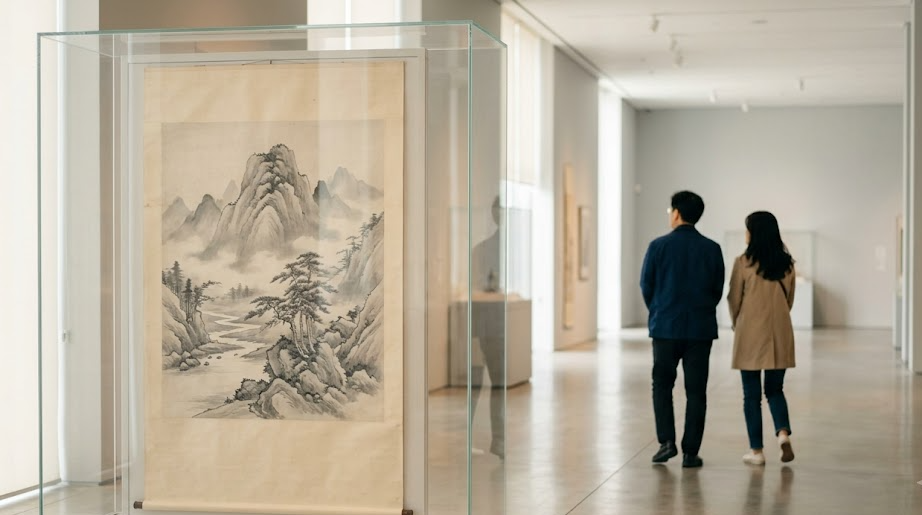
The British Museum has opened a large-scale special exhibition of Korean art. It has been 42 years. Since "5,000 Years of Korean Art" in 1984, Korean art has not been gathered in London on this scale. The exhibition moves from ancient artifacts through Joseon-era painting to reach Nam June Paik, and was presented under the frame of "2,000 years of Korean art."
The scale of the works presented is 100 items. Among them are 10 National Treasures and 13 Treasures. Holdings of the National Museum of Korea and the National Museum of Modern and Contemporary Art crossed over together, and donated pieces from the Lee Kun-hee Collection were included as well.
The relationship between the British Museum and Korean artifacts has been built up since 2000. That is how long it has run a Korean gallery with works borrowed from the National Museum of Korea. Holding a special exhibition again at a place where the permanent Korean gallery runs steadily is different from adding one more exhibition. It is closer to laying a new sentence on top of a relationship kept for a long time.
What stands out is the arrangement rather than the roster. Jeong Seon and Lee Jung-seob and Nam June Paik, along with Do Ho Suh, have come inside the hall of the same exhibition. Divided by period, they are far from one another. Bound by the phrase continuity of creativity, the distance reads differently.
Jeong Seon's "Inwangjesaekdo" traveled as far as London. It is a painting that pressed the wet masses of granite after the rain onto the surface in ink. Paintings laid on paper and silk cannot endure light for long.
Adjusting the exhibition period by totaling illuminance and exposure time falls to the conservator, and the more a painting ranks as a national treasure, the tighter that calculation becomes. For a visitor booking a flight to London, which painting hangs during which period is a practical variable.
Conservation and use collide in many cases. Sending an artifact beyond the border adds costs for packing, transport and environmental control, and the risk of damage does not become zero. The reason the choice is still made to send it out is that there is an interpretation that arises only in the exhibition hall.
Princess Anne viewed the exhibition, and the museum said that interest and expectations are high. Samsung Electronics Chairman Lee Jae-yong spoke of Korea's creativity spanning 2,000 years in an interview on the exhibition. Jessica Harrison-Hall, who is in charge of the Asian collection at the British Museum, explained the exhibition.
Behind the royal visit and the business leader's interview, a claim remains that the curators must carry. Can the hands that shaped earthenware and the hands that handled electronic signals be joined in one flow. The exhibition answered that they can, and the arrangement of 100 items is the ground for that answer.
If you have occasion to go to London, it is worth walking as far as the Korean gallery after seeing the special exhibition. If the special exhibition compresses 2,000 years and shows it, the Korean gallery shows the traces of lending accumulated since 2000. Admission conditions and the exhibition schedule can be checked in the museum's notices.