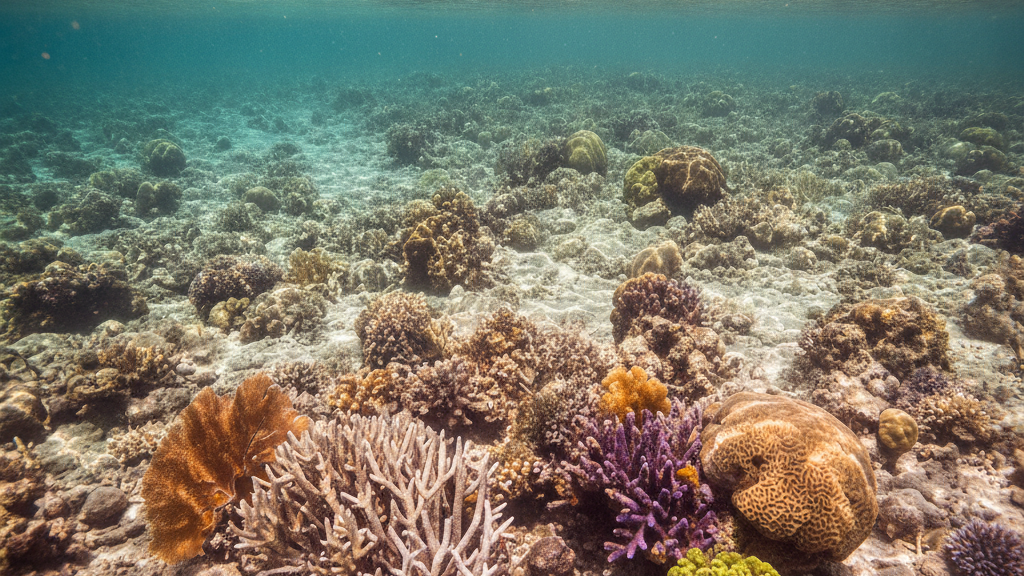
Ninety-six percent of the world's coral reef ecosystems have been rated 'critically endangered.' On October 22, the International Union for Conservation of Nature (IUCN) released the results of its first assessment to look at the planet's coral reefs all at once. Critically endangered is the highest risk category in the IUCN classification. The assessment also carried a warning that the risk of nearly all shallow-water coral reefs collapsing by 2075 because of climate change is 'extremely high.'
The IUCN, which conducted the assessment, is an organization recognized worldwide as an authority on threatened wildlife.
The year 2075 is 49 years from this year. That is less than half a century. The IUCN rated the risk that most tropical shallow-water coral reefs will collapse by then as 'extremely high.'
Corals are vulnerable to heat. The assessment also noted that as human-caused climate change warms the oceans, bleaching, in which corals lose their color and turn white, occurs more often and more severely.
The temperature outlook is not bright either. A UN report released around the same time projected that the world will cross the threshold of 1.5 degrees of warming above pre-industrial levels. Protecting corals requires holding down seawater temperatures, but the global average temperature that determines those temperatures is set to rise above the threshold.
Critically endangered is a risk category assigned by the IUCN, and the remaining 4% were not classified as critically endangered. Restoration work that transplants corals is useful, but if seawater keeps warming, newly planted corals are exposed to the same heat. Whether restoration succeeds also depends on how much the greenhouse gas emissions that warm the oceans are reduced.
Tonight, try changing the temperature setting on your boiler or air conditioner by just 1 degree. Only when the 1 degree changed in each household adds up can the 1.5-degree threshold be held.