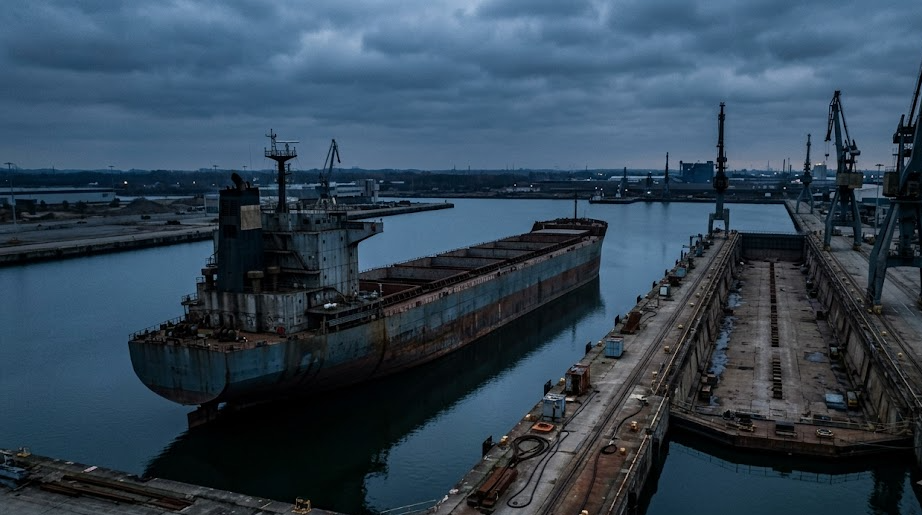
At a forum on fostering Korea's ship repair (MRO) industry on September 3, 2026, a figure was presented showing that 90% of large ships built in Korea are repaired overseas. The figure came without the organization that produced it, the counting criteria or the period it covers. A push to build a 1.5 trillion won MRO hub aligned with MASGA (the Korea-U.S. shipbuilding cooperation project) was also mentioned at the same forum, but nothing was said about whether the government or the private sector would fund it, or when the money would be spent.
MRO is defined as an industry that supports a ship's entire life cycle, including maintenance, upkeep and repair. If newbuilding is a business that sells a ship once, MRO is revenue that recurs throughout the more than 20 years the ship stays in service. Participants at the forum pointed out that while Korea's shipbuilding industry is doing well in winning newbuilding orders, it has not built competitiveness in the repair sector.
Why is this gap a problem now?
As the International Maritime Organization (IMO) tightens marine environmental and decarbonization regulations, more ships already in service will need work. Typical examples include converting ships that run only on heavy fuel oil to dual-fuel specifications and installing ballast water treatment systems (BWTS). This is demand for repairing and continuing to use ships already at sea instead of building new ones. The forum did not present any estimate of the scale of retrofits or of Korea's share of the global ship repair market.
Experts cited maritime decarbonization, MASGA and the development of the Arctic shipping route as opportunities to expand Korea's MRO industry. If the Arctic route opens, shipping routes will change, and if routes change, the maintenance hubs where ships call will also change. The key question remains whether Korea has the capacity along those routes.
The view of ship repair as an outdated industry was also rebutted at the forum. Speakers explained that the industry is becoming technology-intensive with the arrival of fuel conversion, energy efficiency improvements and predictive maintenance using AI and digital technologies. This refers to a shift from fixing ships after they break down to predicting failures and fixing them in advance. In that case, data and skilled workers must be secured along with docks.
Several hurdles must be cleared before the 1.5 trillion won figure can become reality. A site must be selected and a construction start date set, and docks large enough to take large ships must be secured. Retrofit work tends to bunch up around the dates regulations take effect, so if the timing of facility readiness and the arrival of demand do not match, the work will go abroad again.
The September 3 forum stopped at the stage of bringing the issue into public debate. Follow-up data must show how the 90% ratio was calculated and who will spend the 1.5 trillion won and when, before the discussion can move to the next stage. Until then, the matter remains a stated intention with no timetable.