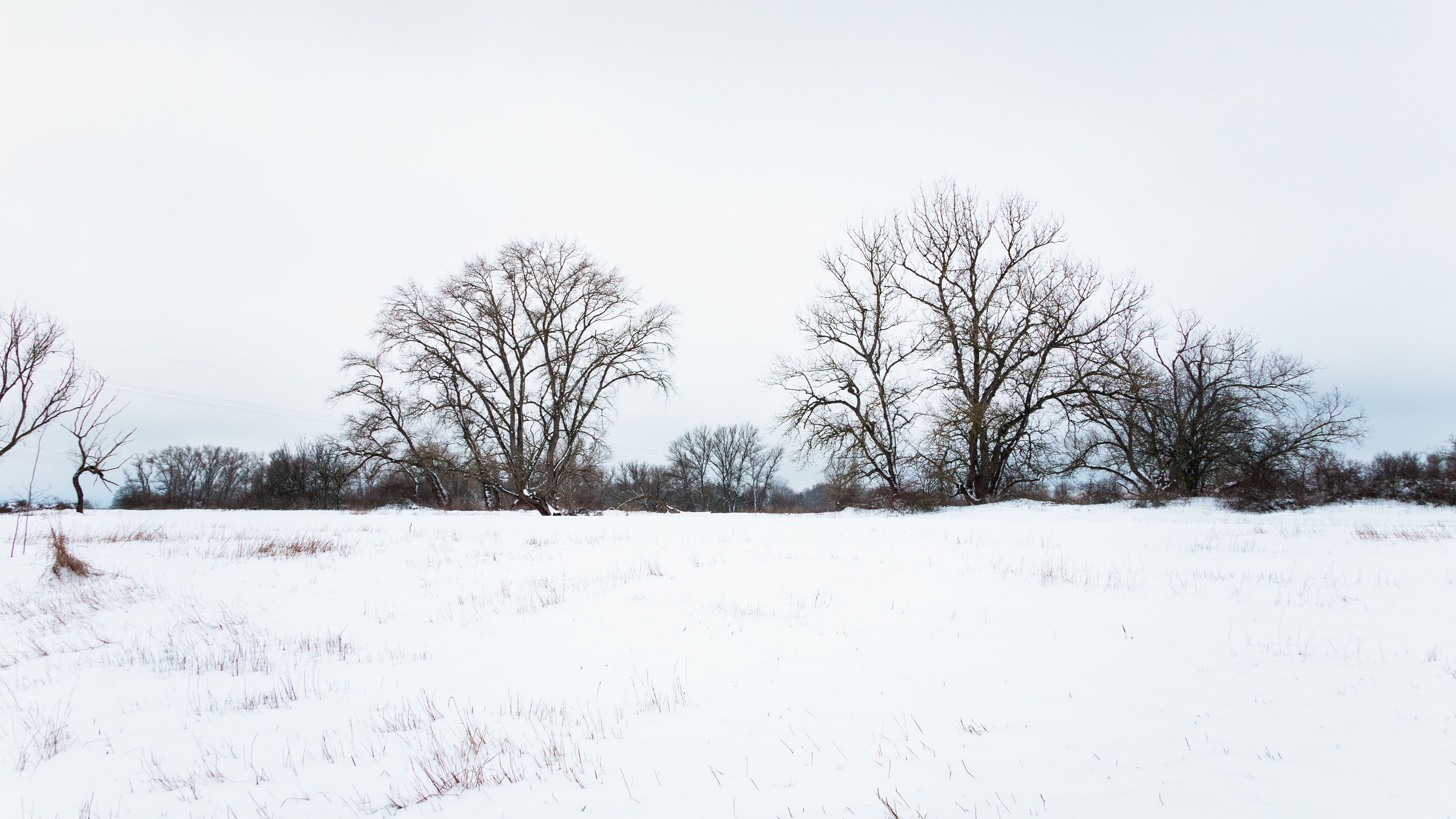
Two bare-branched trees spread wide above a white field. There is not a single leaf. The sky hangs low and milky, as if snow is about to fall again, and that gray-white is separated from the white of the snowfield only by the line of brush around the base of the trees. The snow lies shallow, and dry grass juts out here and there like red needles.
Winter trees look dead, but they are in fact alive in a very honest way. They drop their leaves to save water, and under the frozen soil the roots secure their share for the next season. In the season when the city turns the heating all the way up, these trees have chosen to endure with the minimum.
Look at the left edge again. A thin line crosses the sky at an angle. It is a power line. The tree beneath it stands with its top snapped off, and the two things together become a sign that this field lies inside the range of human life.
So this winter becomes our business. Leaving a standing tree as it is costs far less and goes far faster than planting a new one. Not burning the dry grass, not pushing back the line of brush, choices like those come back as leaves in spring.
Below the line of brush, the space between the two trunks is unusually dark. In that shade, where the snow could not settle even shallowly, a few footprints are dug in, perhaps left by an animal passing through, and beside them dry stalks are laid flat to one side. It seems the power line was not the only thing that crossed this field. The place that looks darkest was in fact the busiest passage all winter.
Look once more at the red tips of grass dotted across the white ground.