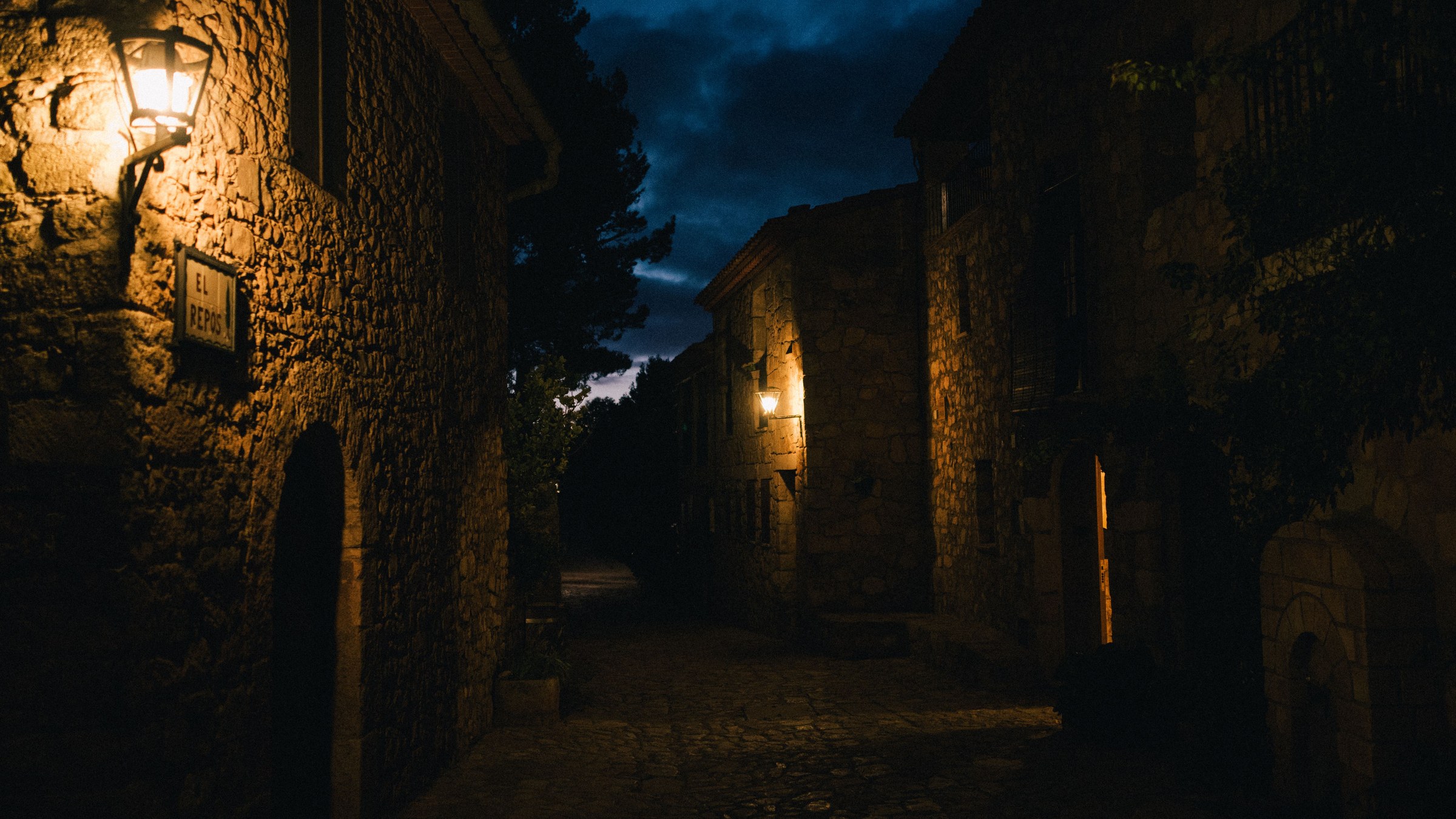
A lamp hung on the stone wall is lit high on the left side. Below it a white nameplate is fixed slightly askew, with two lines of lettering too far off to read. The wall is built of stones large and small fitted together, so wherever the light lands the surface shows up rough. The sky is dark blue, and a thin remnant of the day's glow lingers in the break between clouds.
Farther into the alley there is one more lamp. The two are far apart, so the gravel lane between them is nearly black. People walk it all the same. Those who live here must know the width of that darkness by foot.
Lamps do not turn themselves on. Someone checks the wiring, replaces the bulbs that have dimmed, and moves the lighting time a little earlier as the days grow shorter. Hands like those usually move after dark.
Work that begins at six in the evening, and the care that continues after day care centers and schools have closed, fall across much the same hours. They differ from work done in daylight only in that they are seldom seen.
I look at the right side again. Between wall and wall, a door stands open about two finger joints, and from it a long vertical orange light spills down to the ground. A color redder and lower than the yellow of a streetlamp.
It is a sign that someone is inside. Light that is maintained and light that is lived in are burning in different colors in one alley.
Below and to the right of that, a low arch is carved into the wall. It is the size an adult would have to stoop to enter, and now it is empty and pitch dark. There must have been evenings when someone sat there waiting for someone. Looking at the photograph again, the black stretch between the two lamps seems a little shorter than it did at first.