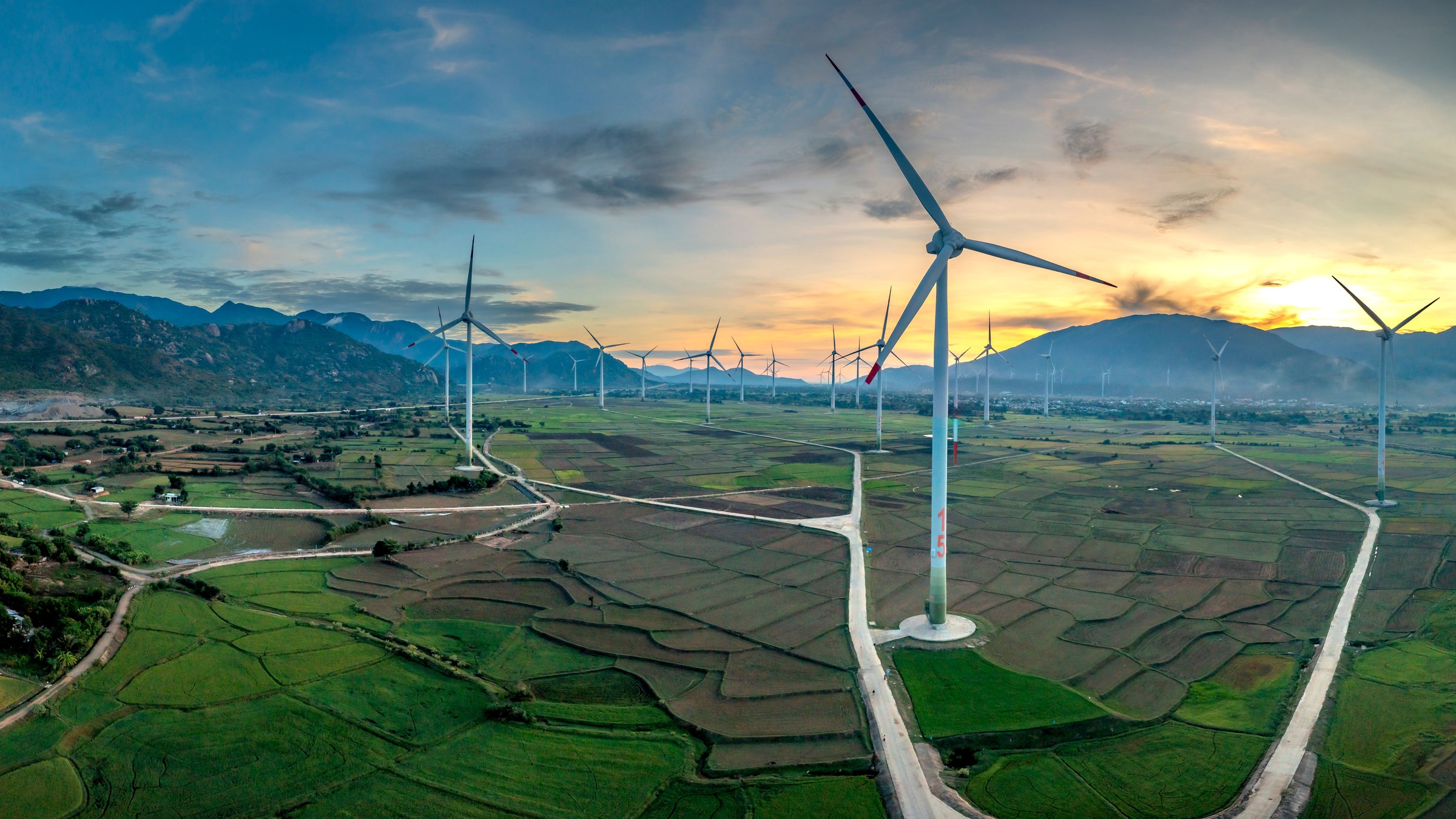
The clouds are dark blue on the left and ripened to orange above the ridge on the right. It is the color of the moment just before the sun drops behind the mountain. Below it the paddies, divided piece by piece into green and brown, fill the lower half of the frame.
There is one white column in the center, two in the field to the left, and a dozen more growing fainter toward the ridge. A red band is wrapped around each blade tip of the largest column. Though it looks stopped, that red is slightly blurred. It is turning.
A household that shares the land and the sky has come into a single frame. The rice uses the soil, and the white columns use the wind a hundred meters above the soil. The evening's electric lights come on without burning anything, and while that happens the paddies ripen in their own way. Farming and power generation roll along in the same field without pushing each other out, and this evening sky shows that scene.
Lower your eyes toward the bottom of the frame and a white gravel road cuts across the paddies, splitting into two branches, three axes. Beneath the largest column a gray concrete footing is laid out in a square. The light comes from the sky on the right, but the shadow lies long across the green on the left.
It is a sign that there is no electricity that comes for free. A few plots of paddy disappeared in the making of the road and the pouring of the foundation, and that trace is left white inside the photograph.
Still, the green grows right up against the edge of the concrete. Look once more before the orange cools. There is almost no gap between the columns and the rice. The wind keeps blowing outside the photograph.