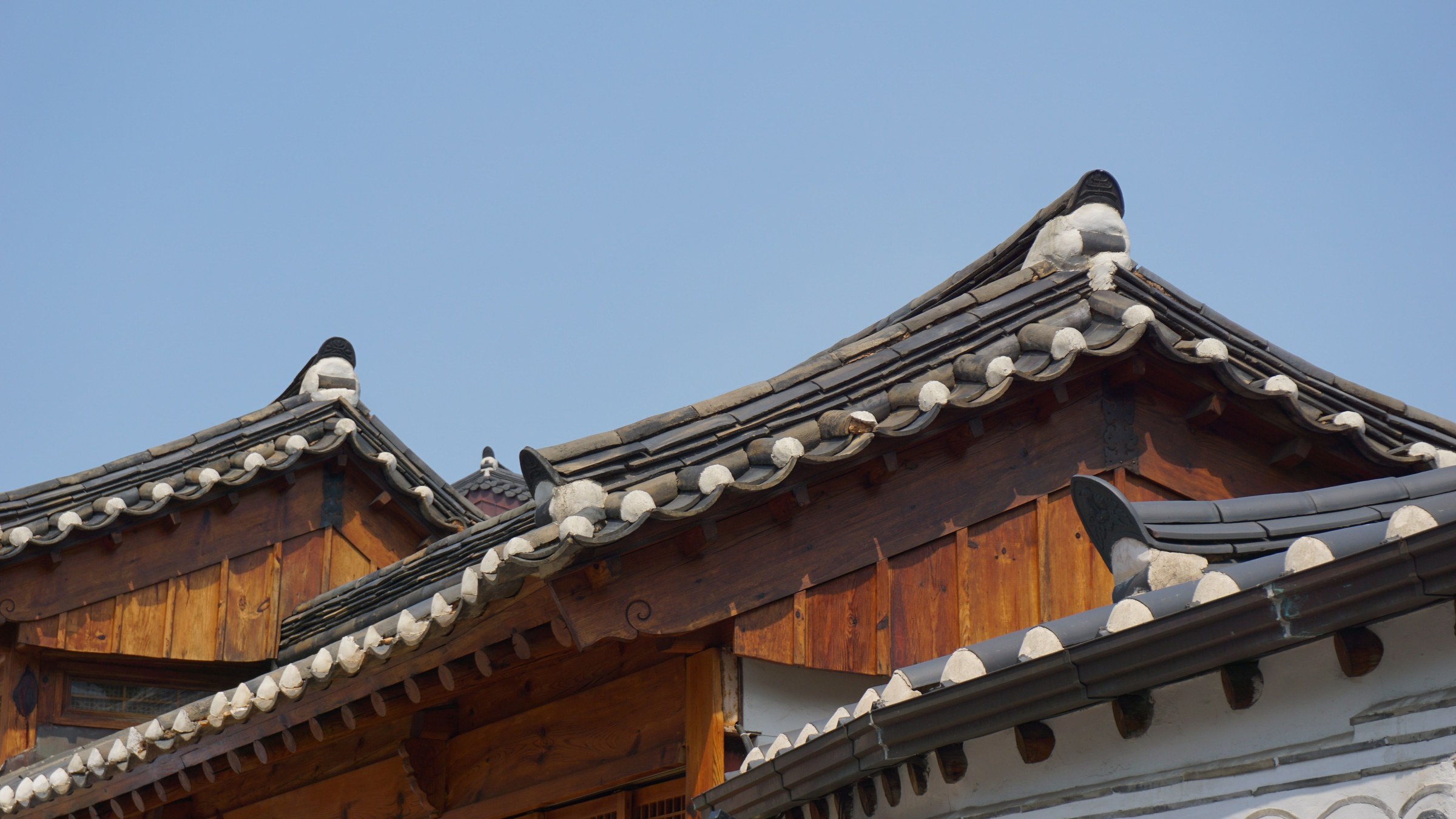
Three roofs are gathered in the bottom third of the frame. Above them there is only a single layer of pale blue, with no clouds and no birds. The tiles are ash-gray and a lump of white plaster is set into each of their ends, so the eye running down the black grooves keeps catching on the white dots.
The shade under the rafters is short. Light close to midday comes down at a slant from the upper right.
The line of the tiles runs straight and then lifts slightly at the eaves' edge.
That lift would have come from the hand rather than the drawing. The hands of people who kneaded and fired the clay, laid the tiles one by one interlocked, and finished the ends by sealing them with plaster. It is also noticeable that the color of the wood on the three houses differs from one another.
The left one is reddish brown, the middle one a yellow close to honey, the right one a black band on a white plaster wall. It means that even standing in the same alley, the years in which they were repaired were different. The roofs record in color the fact that a tradition is not finished in one go and keeps being painted over.
At the center of the frame, low down, a lamp hangs in the shade of the eaves. It is a small lamp with lattice set in the glass, and it is unlit now. On the white wall to the right, black semicircle patterns repeat like a band and are cut off at the edge of the photograph.
When you picture the hour that lamp is lit, the curve of the roof moves from something to appreciate toward daily living. Someone passes beneath it and opens a door and goes in.
Looking up again, the sky takes up two-thirds of the frame. The blue grows paler toward the top, and because it is empty the roofs stand out more. Count the white dots. Somewhere past ten you will stop counting.