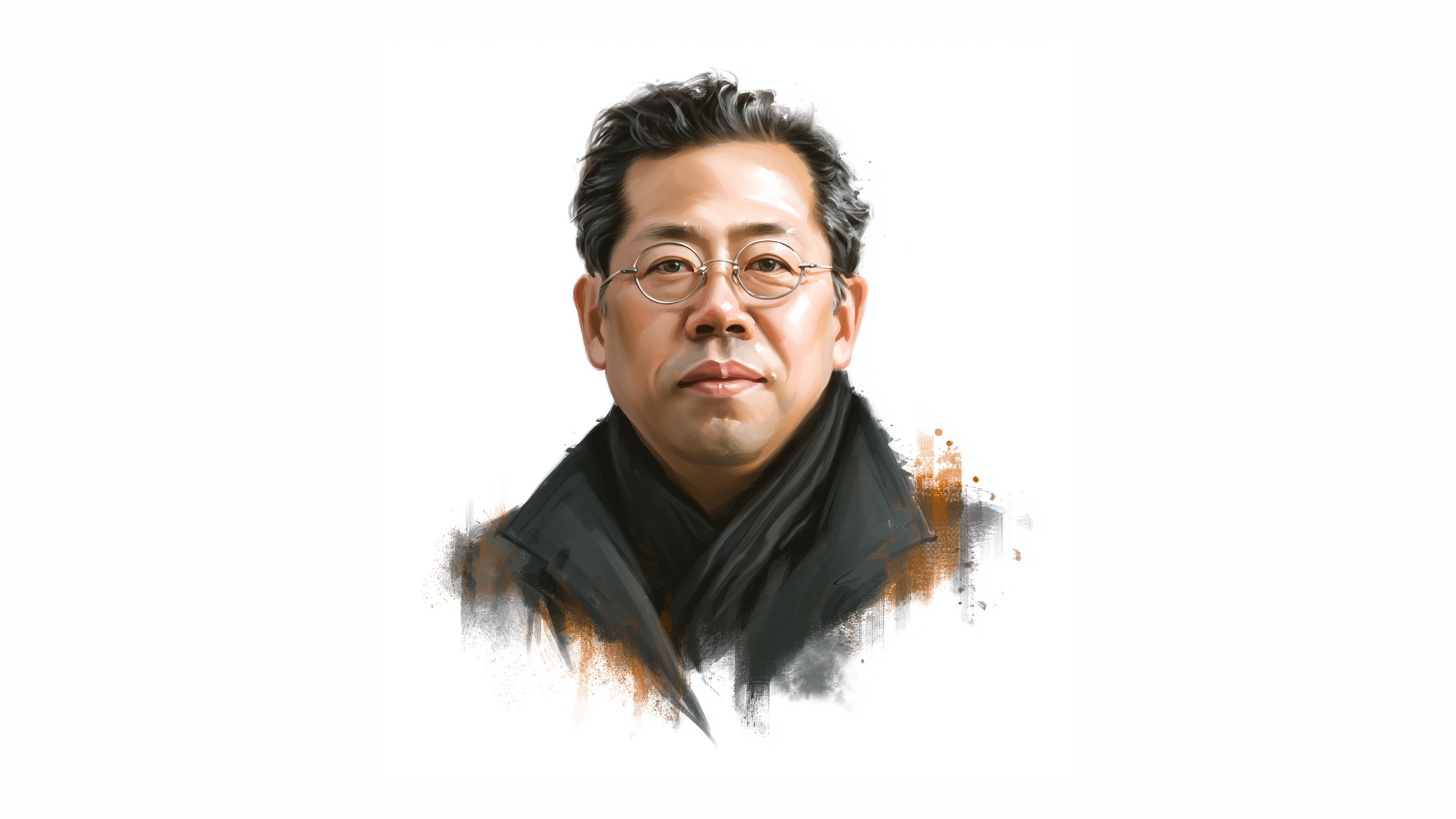
Rubber shoes were always on his feet as he walked the yard of the institute. Students came here on school excursions, and people called him the rubber-shoe doctor. It was also he who had a well dug at the experiment station, where water was short. The well is named Jayucheon, the spring of freedom.
U Jang-chun (禹長春) was born in Tokyo, Japan, on April 8, 1898, and died on August 10, 1959, an agricultural biologist and horticultural breeder. His father was U Beom-seon, who took part in the Eulmi Incident and fled into exile in Japan, and his mother was Sakai Naka, a Japanese woman. He lost his father at the age of five and was raised by his mother after time in an orphanage and a temple. In April 1916 he entered the practical agriculture course at Tokyo Imperial University, and on May 4, 1936, he received a doctorate in agriculture from his alma mater for his paper on the synthesis of species.
He began as a junior staff member at the agricultural experiment station of Japan's Ministry of Agriculture and Forestry and became a technical officer, and on March 8, 1950, he crossed over to Korea to take charge of running the Korea Agricultural Science Institute. In 1958 he became head of the horticultural experiment station of the Office of Rural Development under the Ministry of Agriculture and Forestry, and the following year he died at the age of 62 from a chronic gastroduodenal ulcer. The theory of the synthesis of species that he proposed appears in modern genetics textbooks as well. There is a memorial hall in Busan honoring his achievements, and on April 21, 2003, he was inducted into the Science and Technology Hall of Fame.
Q1. You boarded a ship on March 8, 1950. Your wife and children were in Japan, and here the name of your father U Beom-seon had arrived ahead of you. Why did you decide to board that ship?
A request came asking me to take charge of an institute. It was the Korea Agricultural Science Institute, established in 1949. I am a man who works in the fields. I took it as my work to go where the fields are.
I also knew that my father's name had arrived before me. That name was the burden of my life. One can walk even while carrying a burden. When those who did not trust me blocked my departure, I still opened the greenhouse door and went in.
Q2. You crossed Japanese native napa cabbage with cabbage to create a head-forming napa cabbage suited to the environment of this land, and you also improved the Gangwon-do potato, which was weak against viruses. Was there a single idea running through both works?
The synthesis of species. I did not see evolution as happening only through the accumulation of beneficial mutations. Different species meet and a new species is made, and I joined napa cabbage and cabbage and confirmed it in the field. My study of double cropping, harvesting rice twice in one year, came from the same idea.
Napa cabbage becomes kimchi only when the leaves curl inward and pack firmly. A potato must withstand disease before it can be planted again as seed potato. It was work of composing species anew to fit the climate, the soil and the table of this land. The double-flowered petunia, the citrus and rapeseed I recommended for Jeju, and the cosmos I asked people to plant along the roads all came from the same hands.
Q3. The seedless watermelon was created in 1947 by Kihara Hitoshi, yet for a long time people regarded you as the first. How did it feel to live alongside that misunderstanding?
I never called it my invention. It was promotional material made to introduce to farmers the various seeds developed by the association. To show people who do not come out to the fields what breeding is, there had to be one thing they could see with their eyes.
That watermelon made my name larger than it really was. I did not find that proper. The head-forming napa cabbage and the potato were far greater work, yet people remembered the watermelon. When a single piece of promotional material becomes the face of a discipline, the work that took long years in the field is hidden.
Q4. During your years in the orphanage and at Hoeunsa temple in Tokyo, your meals were potatoes, and other children pushed you away because you had a Korean father. When did that time recede?
It is hard to say that it receded. Still, the time at the temple beside Zen master Arai and the novice monks was not bad. My mother came for me after three years, and taught me not to be ashamed of the roots that came from Joseon.
When my mother died I could not cross the sea. Relations between the two countries were rough, and those who found me untrustworthy blocked the sea route. I held a memorial rite in the auditorium of the horticultural experiment station, and with the condolence money that came from all over the country I had a well dug. Without water the seedlings die.
Q5. You created a double-flowered improved variety so that petunias could be grown as ornamental plants. What value does spending several years holding on to a single flower have in science?
Even making one flower into the shape you want takes several years. Most of that time goes into finding out why it does not go as intended. Dr. Terao, who looked after me at the experiment station, bought me that time. Once you have the answer, the same hand is used for napa cabbage and for potatoes.
Breeding goes one generation a year. You plant in spring and harvest in autumn, and with those seeds you plant again the next spring. Not missing the roughly thirty chances that come around in a person's lifetime, that is the whole of this discipline.
Q6. Now the climate is shifting, growing regions are being pushed northward, and buying seed from outside has become common. Do you have anything to say from your experience of recomposing head-forming napa cabbage and the potato to fit this land?
A seed must be one that has lived several years in that land. There is no guarantee that a seed that grew well in someone else's land will grow well here. Only a seed that has been through the diseases and the cold of that land will not betray the farmer the next year. When I fixed the Gangwon-do potato, I started with Gangwon-do soil.
When the climate changes, the species must change too. There must be people inside the country to do that work, and they must be able to wait for several years. If you press for quick results, breeding does not happen. One greenhouse, one patch of field, and a mind ready to endure ten years are enough to begin.
Q7. In 1957 you received the science prize of Busan's first Culture Awards, and in 1959 the Cultural Medal, after Ahn Eak-tai. What do you consider you are leaving to those who come after?
The prizes belong to the seeds and to the farmers who planted them. My grave is on Yeogisan in Suwon, and below it there are still fields.
It is enough if there continue to be people who put on rubber shoes and open the greenhouse door. It is enough for that person to plant one row in spring.
This piece is not an actual interview. It is an imagined interview reconstructed by Breath Journal on the basis of U Jang-chun's life, his writings and the records he left. The questions were written by the reporter, and the answers were drawn from his writings and his deeds.