The Seoul Metropolitan Government announced on June 26 that it had newly recognized Kim Yoon-sun as holder of the Seoul Intangible Heritage "saeksil nubijang" (colored-thread quilting craft) and Shin Sun-i as transmission educator for "ipsajang" (silver inlay craft). Saeksil nubijang was designated as a category in 2024 and now has its first holder.
Under the Seoul system, a holder refers to a person who has fully mastered the skills of the field in their standard form and can realize them. A transmission educator is the agent of transmission who passes the skills to the next generation through instruction.
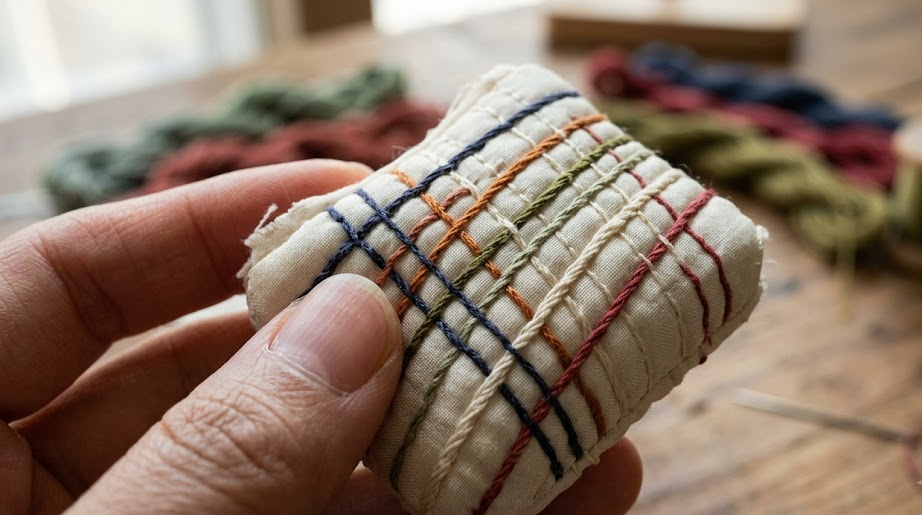
Saeksil nubi is a quilting technique in which hanji cords are rolled between two layers of cloth and stitched densely with colored thread to produce three-dimensional patterns and decorative effects. In the late Joseon period it was used mainly for household items such as tobacco pouches, eyeglass cases, thimbles and purses. These are objects that fit in the palm of the hand.
Holder Kim Yoon-sun has spent more than 40 years restoring this skill and making it her own. From a time when academia had not even settled on the official name saeksil nubi, she visited museums and antique shops in person to trace the stitches. It began in 1980, when she came across a tobacco pouch left behind by her grandfather.
What has come from her hands includes restorations that revive old objects just as they were, such as eyeglass cases and needle cases, and creative works newly made with a contemporary sensibility, such as ear pouches and "honseon." She has won awards at the Korean Traditional Crafts Competition twelve times. Alongside this, she has published books for general readers, taught at the Korea Traditional Craft and Architecture School and trained apprentices at her workshop in Bukchon.
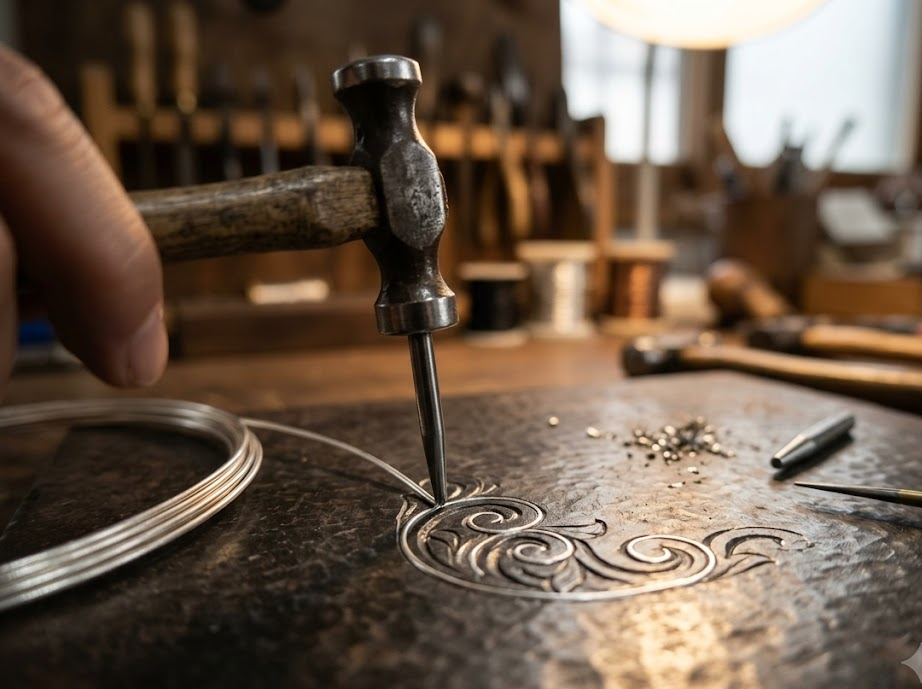
Ipsa is a metalcraft technique in which grooves are carved into a metal surface and gold or silver thread is precisely hammered into them for decoration. It was used mainly on costly objects such as candlesticks, tobacco boxes, incense burners and braziers. Patterns emerge only by striking the chisel one stroke at a time. Because it requires fine handwork, takes long hours and costs a great deal, the transmission base for this category has contracted.
Transmission educator Shin Sun-i is the leading disciple of Choi Kyo-jun, holder of the Seoul Intangible Heritage ipsajang. She entered the field in 2009, became a certified trainee in 2015 and was recognized as a transmission educator this year. In that time she took part in repairing a reproduction of an iron silver-inlaid candlestick for a project reproducing interior furnishings of palace halls, and her silver inlay work placed among the final 30 for the Loewe Foundation Craft Prize.
The originals of the artifacts she revived are not in Korea now. The "iron silver-inlaid candlestick with gilt-bronze lotus bud and phoenix ornament" is held at the Peter the Great Museum of Anthropology and Ethnography in Russia, and the "silver-inlaid hexagonal water brazier" is at the Grassi Museum of Ethnology in Leipzig, Germany. Works held abroad have been remade by hands here.
The demand to master the standard form in full and the reality that survival depends on finding a use for today collide on one person's worktable. That Kim Yoon-sun's creative works and artifact restorations are exhibited together, and that Shin Sun-i moves between reproduction and creation, are the results of not avoiding that tension. Heo Hye-kyung, head of Seoul's Cultural Heritage Conservation Division, described the two as artisans who have preserved the beauty of traditional crafts and cultural identity, and said the city would work to keep transmission going steadily.
The support to follow recognition has not been finalized. But whatever the system provides, the work of colored thread biting into cloth and silver thread being driven into iron rests in the end with the two people at the worktable.