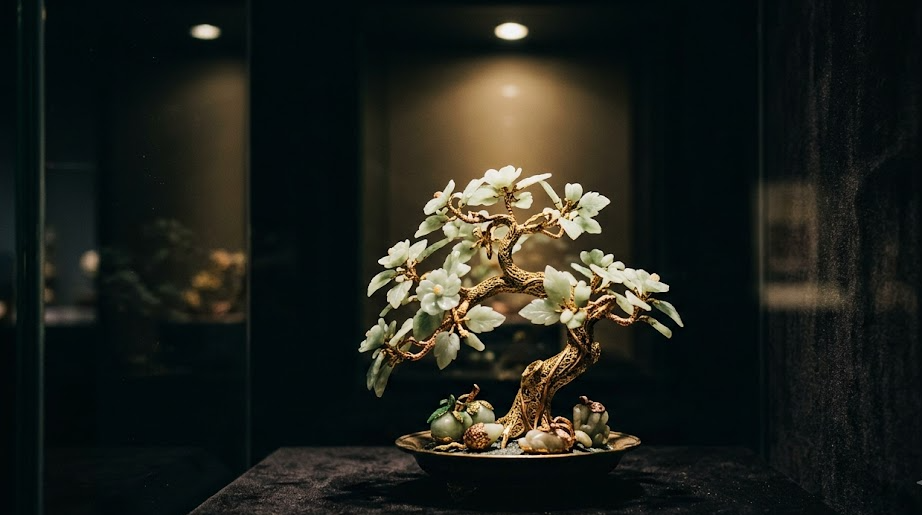
Banhwa (盤花), a Joseon royal court craftwork whose name means planting flowers on a dish, goes on view to Korean audiences for the first time today. It is a restoration of a diplomatic gift that Emperor Gojong presented to French President Sadi Carnot in 1886. The fact that it was produced with sponsorship from Sulwhasoo, the Amorepacific beauty brand, became known a day earlier on June 2, and the venue for its unveiling is the special exhibition marking the 140th anniversary of Korea-France diplomatic relations, "Gifts and Records, 140 Years of Korea-France Friendship."
Banhwa is a composite craftwork in which metal, wood, and jewels are bound into a single body. The stems extend in metal and the petals and fruits are carved from stone and set in place, and together they form a small garden on a shallow dish. An object whose materials are joined with differing properties is vulnerable to shaking. This is why the choice was made to create a new piece rather than fly the original over.
The original is in the collection of the Musée national des arts asiatiques-Guimet in France. It crossed the sea around the time Joseon concluded a treaty with France, and has been held in Paris ever since. Accounts differ over the circumstances of the gift's transfer, with one describing it as a present commemorating the establishment of diplomatic relations and another as a gift following the conclusion of the Korea-France Treaty of Amity and Commerce. There is no disagreement that the year was 1886.
The hands behind the restoration were those of Kim Young-hee, holder of the National Intangible Heritage title of jade artisan (玉匠). It means a person who works jade traced back a vanished royal court decorative craft through traditional techniques. Only a single original survived inside a display case in a foreign land, and the work involved following its form and texture, selecting the same kinds of stone and grinding them in the same manner. Which techniques were reproduced and to what extent has not been disclosed.
Sulwhasoo supported this production after signing an agreement with the Royal Palaces and Tombs Center of the Korea Heritage Service and the National Palace Museum of Korea for the preservation and use of royal cultural heritage. On the year the agreement was reached, there are records giving 2024 and records giving last year. The scale of the sponsorship and the scope of the support have not been disclosed. Nor do the accounts converge on how to divide up what the company did, what the artisan did, and what the state institutions did.
The banhwa that was made did not go to the reception room of an individual or a company, but was handed over to the National Palace Museum of Korea and to Deoksugung respectively. Ownership has to remain in public hands for it to lead to exhibition, research, and education. Whether sponsorship ends as publicity or remains as heritage usually turns on this point.
The exhibition is being held at two venues. At Special Exhibition Gallery I of the National Palace Museum of Korea, the history of diplomacy between the two countries is examined through the Korea-France Treaty of Amity and Commerce and the diplomatic gifts the two exchanged, running through August 2. At Dondeokjeon Hall in Deoksugung, an exhibition titled "Banhwa, an Auspicious Heart" unpacks the techniques used to make banhwa and the symbolism it carries, running through August 30. Whether the two exhibitions divide up a single special exhibition or are each independently organized has not been clarified.
A restoration is not the original. But when the original cannot come back, relearning the technique and producing the same object is a kind of recovery different from moving a relic. The one piece in the storage rooms of Paris is still in Paris, and in Seoul there are now hands that know how to make it.