Six gigawatts a year. That is the current domestic production capacity for solar modules. The government has unveiled a plan to raise this to more than 10GW a year by 2030, and wind turbines from 0.8GW to more than 3GW. A target to lift renewable energy exports from 4.2 trillion won last year to 20 trillion won by 2035 was attached alongside it.
With the expansion of renewable energy to 100GW and tighter siting rules for solar being pursued in the same week, a dispute over policy discord has arisen. The detailed standards for the regulation and the date it takes effect have not been released. The question remains whether the hand setting the expansion target and the hand narrowing available sites are looking at each other.
The industrial picture is relatively clear. The core is raising the share of domestically produced solar modules used from around 55% in 2021-2025 to more than 80% in 2031-2035, and wind turbines from 39% to more than 60%. The use of domestic modules and inverters will be expanded in public projects and planned-siting projects, and domestic production standards will be created and tied to financial support. In sunlight income villages and in solar installations at schools and public parking lots, mandatory use of domestic equipment will be pursued.
The technology side also has a timetable. Tandem cell and perovskite development will be supported, with commercialization of tandem cells targeted for 2028. In offshore wind, government-led support for the development of 20MW-class ultra-large turbines will be expanded, while for the 15MW class the route chosen is a joint venture with an overseas turbine maker to receive a technology transfer. Given that the world's floating offshore wind farms amount to only 278MW, building a demonstration base is an option that cannot be delayed.
The rules for selling the electricity generated are also changing. An amendment to the RPS abolishing the REC spot market and consolidating it into a long-term contract market passed a full meeting of a National Assembly standing committee, with the Legislation and Judiciary Committee and plenary session procedures remaining. The existing spot market was a system in which only certificates changed hands without affecting the system marginal price. It is an attempt to shift a system that left power producers directly exposed to price swings toward long-term contracts.
The Korea Power Exchange is running a pilot project for a renewable energy bidding system on Jeju. Once the system is in full operation, renewable energy will also enter the day-ahead market and go through the same bidding and settlement procedures as centrally dispatched generators. Industry observers say discussion of introducing it on the mainland will get under way in earnest after the local elections on the 3rd of next month.
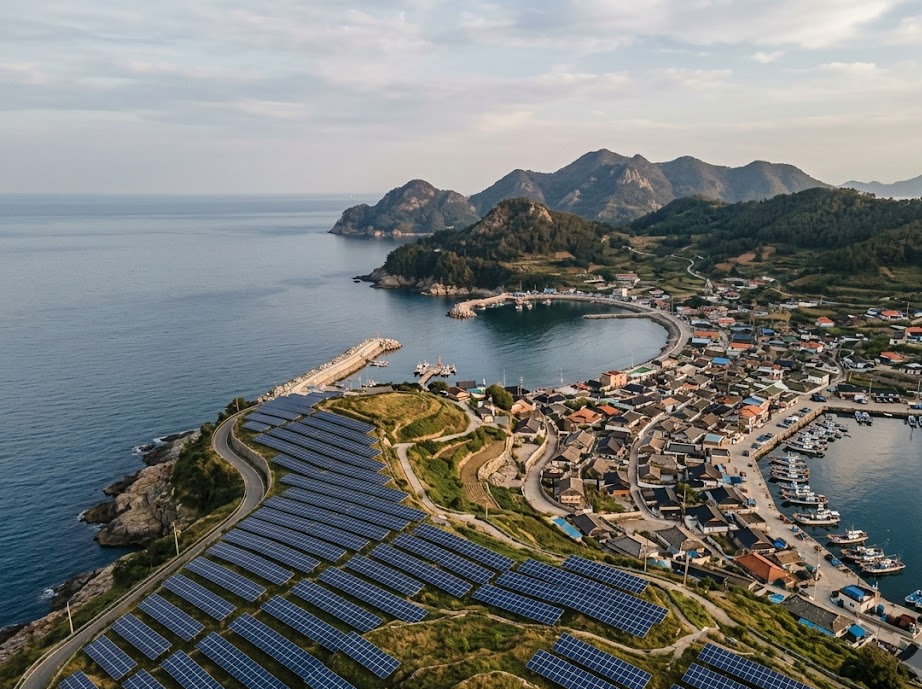
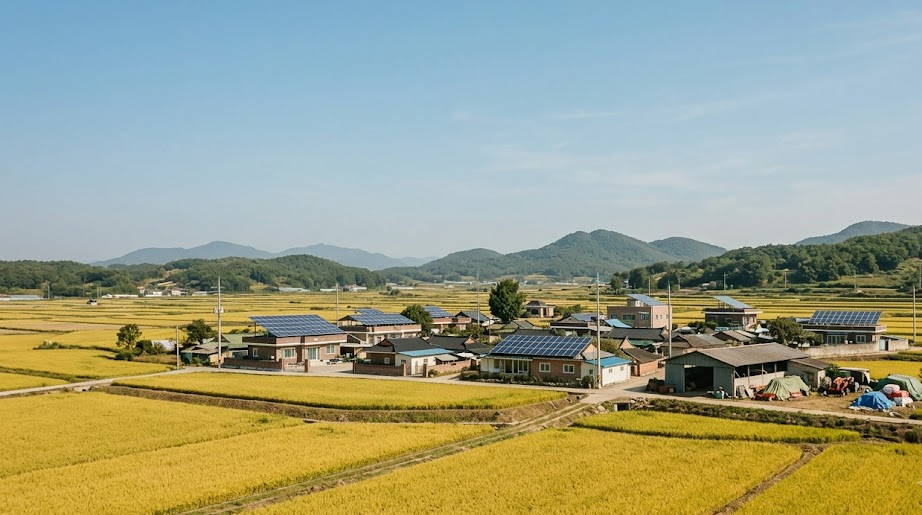
A case where the system reached people is in Shinan. After distance restrictions on solar power plants were partly lifted in 2018, more than 2,000 applications for generation business permits poured into Shinan County. On April 26, 2021, the county began paying a sunlight pension to residents of Anjwa Island and Jara Island, the first in the country, and the payments continue for the 20 years or more of the plants' operating period.
As of April 2026, some 20,300 people receive this pension. Per person per quarter, the amounts run from 170,000 to 680,000 won on Anjwa and Jara islands, 110,000 to 600,000 won on Jido and Saok islands, 100,000 to 210,000 won on Imja Island, and 100,000 to 160,000 won on Bigeum Island. Shinan County's population has grown for three years running. It is a rare outcome in which generation facilities filled a village rather than emptying it.
What Shinan's experience tells us is simple. Securing sites is not resolved by deregulation alone, nor by compensation design alone. Because a revenue-sharing mechanism followed after the permits poured in, residents came to accept the facilities as being on their side. As long as the 100GW target stands, where to set the siting hurdle has to be calculated together with this sharing design.
In onshore wind, a public-led competitive bidding scheme will be newly created, and a bidding plan containing targets for the share of domestically produced turbines used will go into a medium- to long-term roadmap due within the first half of this year. Loan support will be expanded when aging inverters are replaced with domestic ones, and new security verification standards for communications equipment will also be prepared. Quite a few plants have reached the replacement cycle for inverters, which have a lifespan of 6-7 years.
If there is solar on your roof or rooftop, it is worth checking the year the inverter was installed. If it has passed six years, it may qualify for replacement support, and it also connects to the move to create security verification standards. Targets are made in announcements, but 100GW is ultimately filled by such individual installations stacking up one by one.