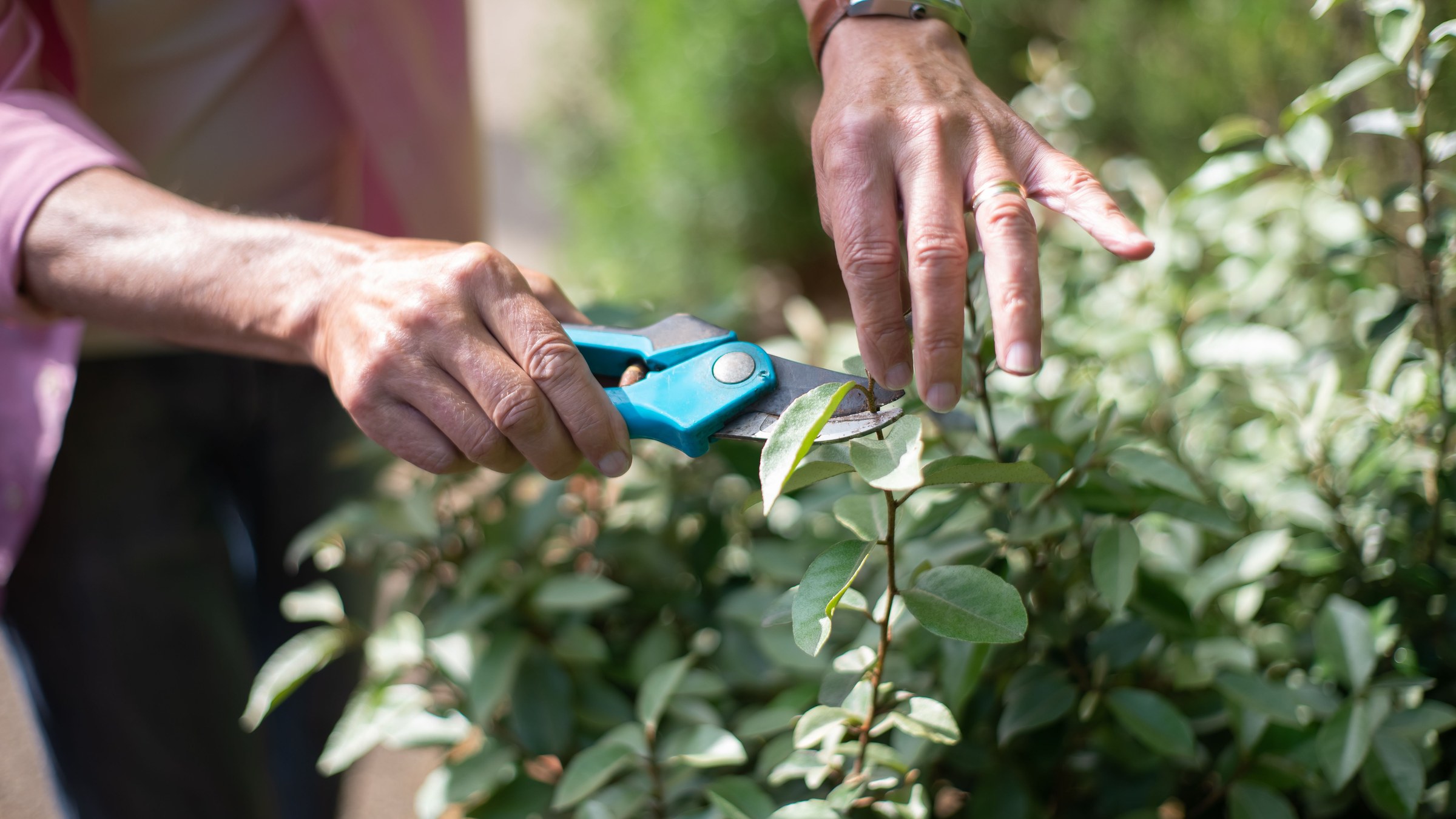
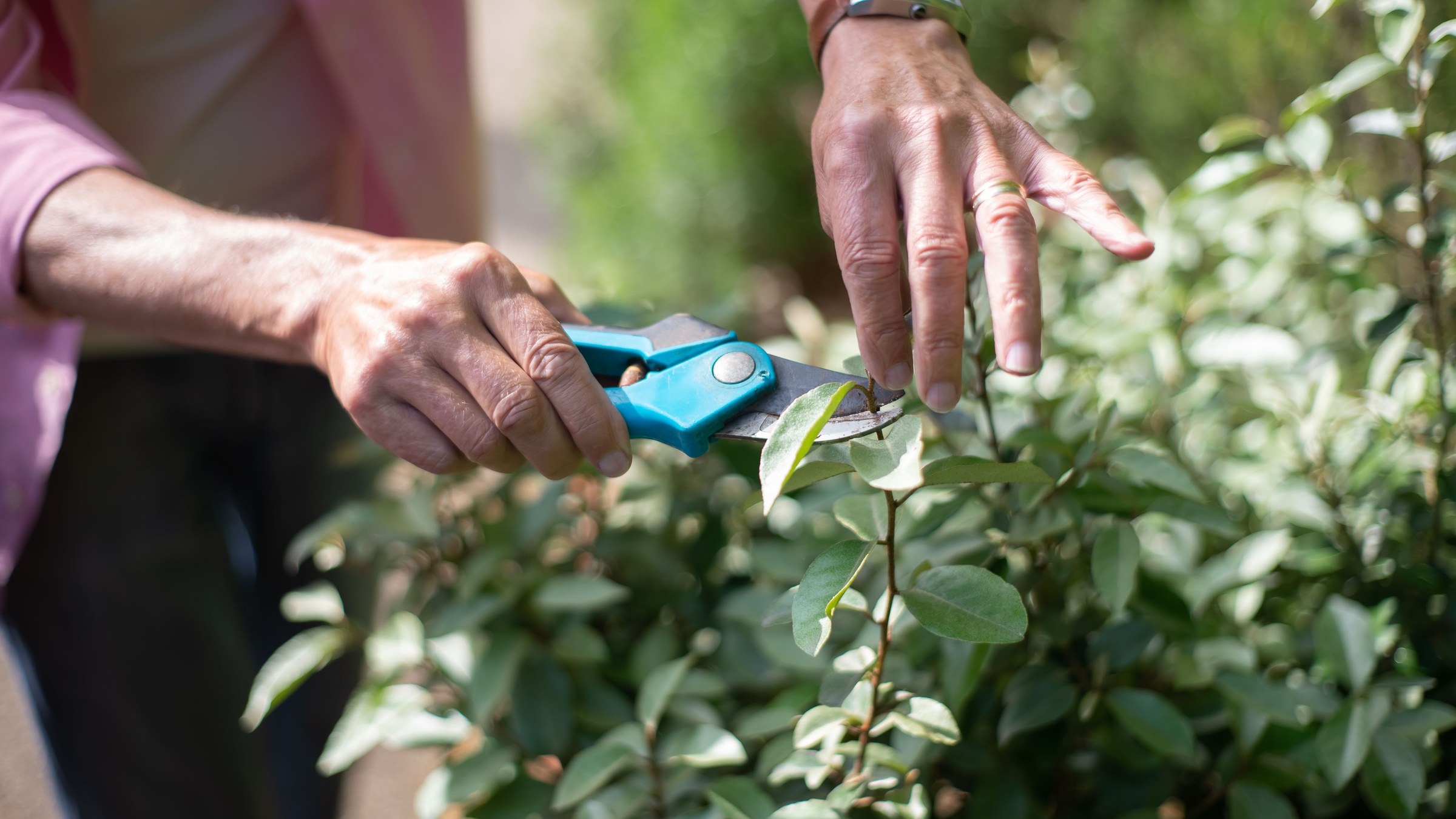
A pair of pruning shears with sky-blue handles cuts across the middle of the frame. Only one leaf is caught between the blades, and beside it the untrimmed leaves crowd thickly in every direction. The right hand holds the shears, and the left hand has lifted a small branch slightly, holding it between the index and middle fingers.
The tendons stand out on the back of the hand, and a silver watch sits on the wrist. Midday light lies white over the pink shirt sleeve and the leaves.
Look at a scene like this long enough and the shoulders come down on their own. The hand holding the shears makes it so. While choosing the one branch to cut, the fingertips必 slow down, and the focus of the eyes narrows to the size of a single leaf. Eyes that take in all the leaves at once cannot do this work.
The point where a person tending a garden grows tired is often not that there are many branches. When the feeling that it all has to be finished today runs ahead of the hands, nothing comes into view properly.
Beside a desk or by a window, it would be fine to pick just one leaf from a potted plant now in view and wipe both sides with a damp cloth. Lower left, the leaf with the most dust on it is even better suited. Three minutes is enough, and the rest of the leaves can be left as they are. This work ends with feeling, once, the veins of the leaf catch against the fingertips.
Take the same motion over to the sink, and while wiping the back of one plate you can look at the force gathered in your jaw. Over the few seconds the water passes across the back of your hand, you can also see whether your shoulders rise toward your ears or come down. It does not mean anything has to change, it is simply a matter of watching.
The shears have not yet cut the leaf, and the light still lies where it was.