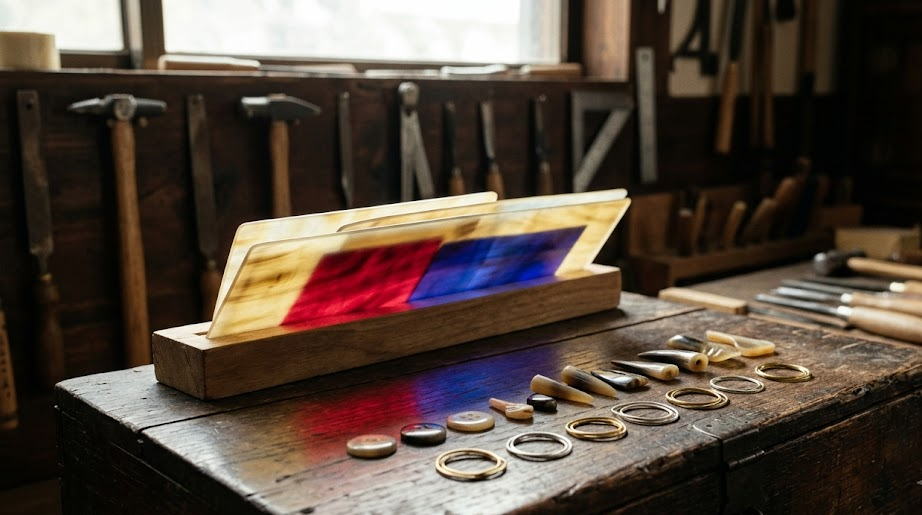
On April 8, 2026, the Korea Heritage Service announced its plan to recognize Han Ki-deok, 52, as the holder of the national intangible heritage hwagakjang (華角匠). On the same day, it said it had recognized Seung Kyung-ran, 65, as the holder of ipsajang (入絲匠). One is the skill of applying color to a transparent sheet made by flattening ox horn and using it to decorate wooden furniture, the other the skill of carving patterns into a metal surface and driving gold and silver threads into the grooves.
For hwagak, ox horn is boiled and pressed, sliced as thin as paper, and pigment is laid on the back. Seen from the front, the color rises softly through the translucent grain of the horn. Because the material is hard to obtain and the process is demanding, it has long been used only on costly objects.
Han Ki-deok is the son of the late Han Chun-seop, who was the holder of Gyeonggi Province's hwagakjang. He learned to handle horn while helping with his father's work from around his middle school years, and became a Gyeonggi Province certified successor in 2002 and a Gyeonggi Province transmission educator in 2005. The Korea Heritage Service said he has contributed to inheriting and reviving the traditional techniques and tools needed for hwagak work. In 2023 he was chosen as artisan of the year at "Ubomanri: A Long Walk Toward Pure White," an exhibition held jointly by a cultural foundation and a fashion brand.
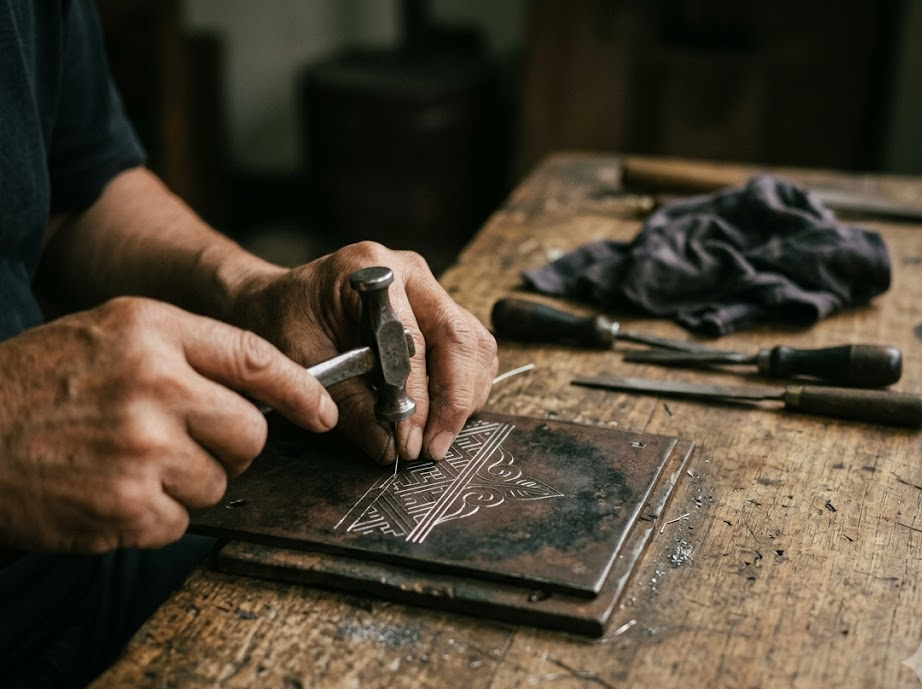
Ipsa is a skill remembered by its sound. A chisel pecks the iron surface closely to create a rough texture, and fine silver thread is laid on top and hammered in. The sound of metal striking metal has to repeat thousands of times before a single pattern is finished.
Seung Kyung-ran entered training as a student through her connection with Hong Jeong-sil, the holder of ipsajang. She became a certified successor in 1997 and rose to transmission educator in 2005. The Korea Heritage Service announced its plan to recognize her as holder this past February after a recognition survey confirming her transmission skills and her transmission activities, and confirmed it this time through a final review by the Intangible Heritage Committee.
Also announced the same day was the plan to recognize Hwang Eul-sun, 91, the holder of gungjung chaehwa (宮中綵花), as an honorary holder. It is the technique of shaping flowers used in royal court entertainments and rites out of plants, pollen, and beeswax. Hwang was credited for her work in transmission education after being recognized as holder in 2013, and her son Choi Seong-woo, 66, carried on the line as holder of the same item last year.
Similar moves followed in the regions. Jangsu County in North Jeolla announced on April 8 that artisan Ko Tae-bong had been newly recognized as the holder of "Jangsu Nokbanseok Byeorujang," an intangible heritage item of Jeonbuk Special Self-Governing Province. The item was designated a provincial intangible heritage on May 2, 2025.
On Jeju, on April 7, Song Hui-sun, 86, who has been making burial garments for 74 years, received her certificate as holder of "Jeju Hosang-ot," a Jeju Province intangible heritage. Both cases are city and provincial intangible heritage, so they sit at a different designation level from national items.
Designating a skill is different from putting an object in a glass case. The temperature at which horn is boiled and the force with which silver thread is hammered do not transfer onto paper. They cross over only while someone stays beside another person and follows their hands.
This is also where preservation and use collide. A skill that does not sell cannot draw people who want to learn it, and cutting steps from the process to make it sell shaves away the very skill that is supposed to be protected.
The recognition of the hwagakjang holder and the gungjung chaehwa honorary holder will be confirmed by a final review of the Intangible Heritage Committee after opinions from various quarters are reviewed during a 30-day announcement period. The end date of the hwagakjang announcement period and the review schedule have not been made known. Whether Han and Hwang are recognized will be settled only after that review.
A hwagak box looks like an ordinary red wooden box under fluorescent light. Only when it is carried to a window and tilted with the light behind it does the color trapped inside the horn come alive. Hwagak boxes and silver-inlaid incense burners are on display in the permanent exhibition halls of the National Folk Museum of Korea and regional craft museums. Lower yourself a little in front of the glass and change the angle, and you can see with your own eyes what a single line of designation notice cannot carry across.