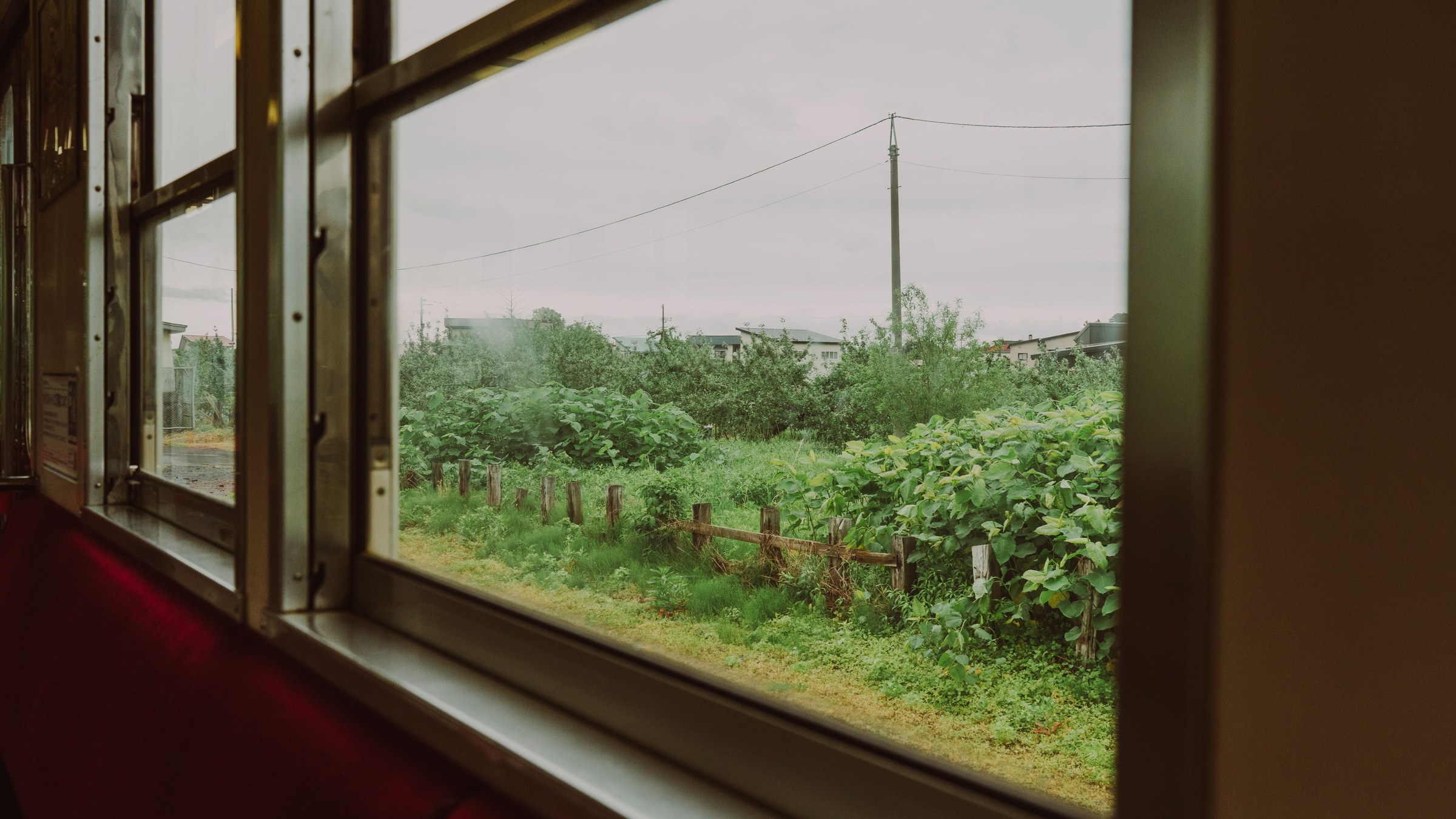
An old wooden window frame divides the picture horizontally. Beyond the glass, a cloudy sky and a single utility pole, thick green brush and a low wooden fence go past. Inside, red velvet seats lie in the dimness, and the light is weak and even, like late afternoon.
Sit by a window like this and your eyes get busy first. You count the fence posts as they pass, one by one, and pull your focus in to read a roof far away. Meanwhile your shoulders have risen, and your fingertips resting on the window frame have tightened.
It is the urge to hold on. The habit of treating anything that flows past as a loss keeps tilting the body forward.
Let your focus rest loosely about a hand's width in front of the glass, and let the passing green simply pass. While you count to three you can breathe out and let your shoulders drop toward the window. What about allowing yourself about three minutes when you don't have to remember what went by.
The same looseness can be called up at night as well. With the lights off, lying flat under the covers, you come to quietly confirm that the two feet that pressed against the floor all day are now pressing on nothing. You just watch how much the center of each sole sinks into the bedding, and how the left foot and the right foot make contact differently. You can leave what you noticed unsorted.
The train keeps going, and the green keeps coming.