The Korea Heritage Service has set "the complete transmission and creative succession of intangible heritage" as a key task among its major 2026 initiatives and put forward a plan to improve the transmission system as a whole. The average age of intangible heritage holders in Korea was 75.8 as of last year. That is up nearly two years from 73.9 in 2021. It means the system is not moving as fast as the people who carry the skills in their bodies are aging.
There are some 170 holders in all. Of those, people in their 70s and 80s account for more than 70%, and more than ten are in their 90s. In some categories the holder's position has been vacant for a long time, leaving transmission in danger of being cut off, and the Korea Heritage Service said it will pursue measures for future transmitters targeting categories under national emergency protection. Detailed plans covering budgets and implementation timing have not been released.
Set the statistics aside, and the traces of a vanishing tradition remain in far quieter places. Things that survive on a list but have disappeared from the kitchen. Jang making is one of them. This culture is inscribed on UNESCO's list of the Intangible Cultural Heritage of Humanity, but the households that set meju in brine in the first lunar month can be counted on one hand.
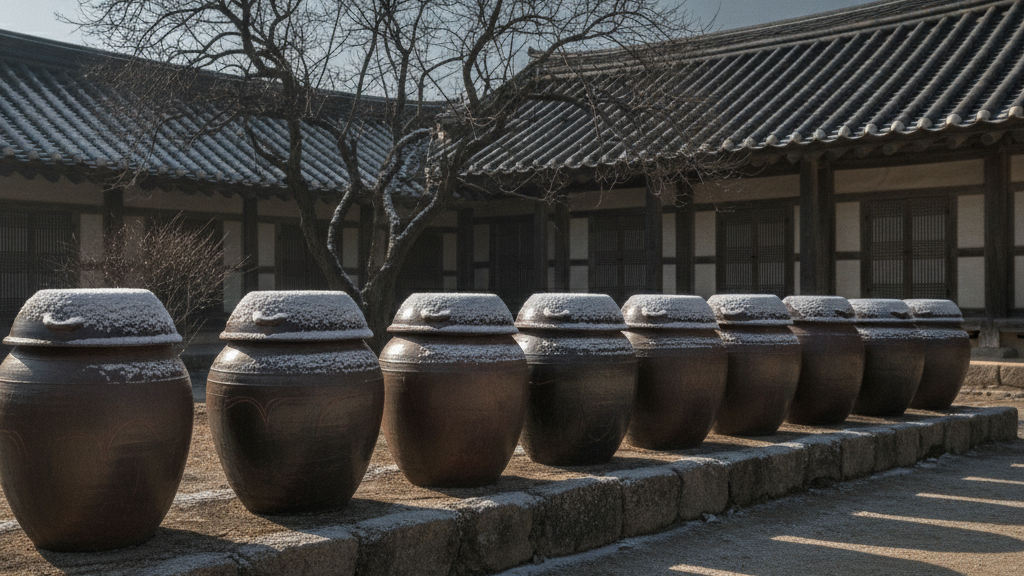
The Sejong Traditional Culture Experience Center held a special lecture, "Jang Making in the First Lunar Month, Laid Down by Me and Shaped by Time," at its temple food experience hall. Venerable Yeogeo, a first-class temple food master and abbot of Geungnaksa Temple in Yongin, taught the class, and 60 citizens took part in two sessions, morning and afternoon. The musty smell rising from meju submerged in salty brine, the sound of a wooden paddle scraping the earthenware wall, the dark red color of soy sauce settling, were things absorbed by growing up alongside them rather than learned and mastered. Now people submit an application and meet them in a classroom.
The jang laid down that day will be aged and fermented for about a year in the center's jangdok jars before being handed to each participant. Learning takes two hours, and completion takes a year. This gap in time shows why transmission is a different word from education.
Ulju County in Ulsan announced on February 1 that it will support hyanggyo and seowon. The support covers projects for the succession and teaching of traditional culture and arts, including instruction, character education, etiquette, ritual and cultural arts, projects for traditional rites including ancestral rites and community ceremonies, and projects for facility improvement and environmental maintenance. The county is also pursuing the enactment of an "Ordinance on Support for Revitalizing Hyanggyo and Seowon," proposed by council members. When the ordinance bill will be handled has not been made known.
Ulsan City has designated two hyanggyo as tangible cultural properties, and one of them, Eonyang Hyanggyo, Tangible Cultural Property No. 8, is in Ulju County. The seowon number five: Seokgye Seowon in Ungchon-myeon, Bangu Seowon in Eonyang-eup, Chisan Seowon in Dudong-myeon, Wongang Seowon in Samdong-myeon, and Jaam Seowon in Ungchon-myeon. Hyanggyo were the local public schools of the Goryeo and Joseon periods, and seowon were private educational institutions that enshrined past sages and taught Confucian scholars. The two lineages, once divided between the state and the people, are now held together in a single support list.
At Seokgye Seowon, the "2025 Memorial Rite for Chungsukgong Yi Ye" was held on October 29 last year. Yi Ye is said to have crossed to Japan some 40 times as an early Joseon envoy to Japan, bringing back 667 Joseon captives and taking part in the conclusion of the Sampo Treaty, and he was named the Ministry of Foreign Affairs' "Person of the Year Who Brightened Diplomacy" in 2010. Eonyang Hyanggyo opened its 2026 lifelong education classes. It is evidence that the two functions of ancestral rites and instruction are still breathing.
Support is always met by two opposing forces. One side says to keep the buildings in their original form, the other says to use them as spaces people come and go through. Instruction continues only if worn floorboards and broken roof tiles are accepted, and if the doors are locked to prevent damage, what is preserved becomes a shell. Ulju County's tying of facility maintenance together with education and rites in its project categories reads as a choice not to settle that tension on one side.
The time it takes for the system to reach out and the time in which people grow old are different. The time left to ten holders in their 90s is shorter than the budget cycle. If declarations and ordinances are a late response, how substantial that response is will become clear when the budget figures and the design of the future transmitter system are released.
Eonyang Hyanggyo's lifelong education classes opened this term, and Ulju County's five seowon still hold their ground today. Inside the jangdok jars at the Sejong experience center, the jang of 60 citizens is slowly changing color toward this time next year. There is also a kind of succession that begins with opening a winter jangdok lid once.