
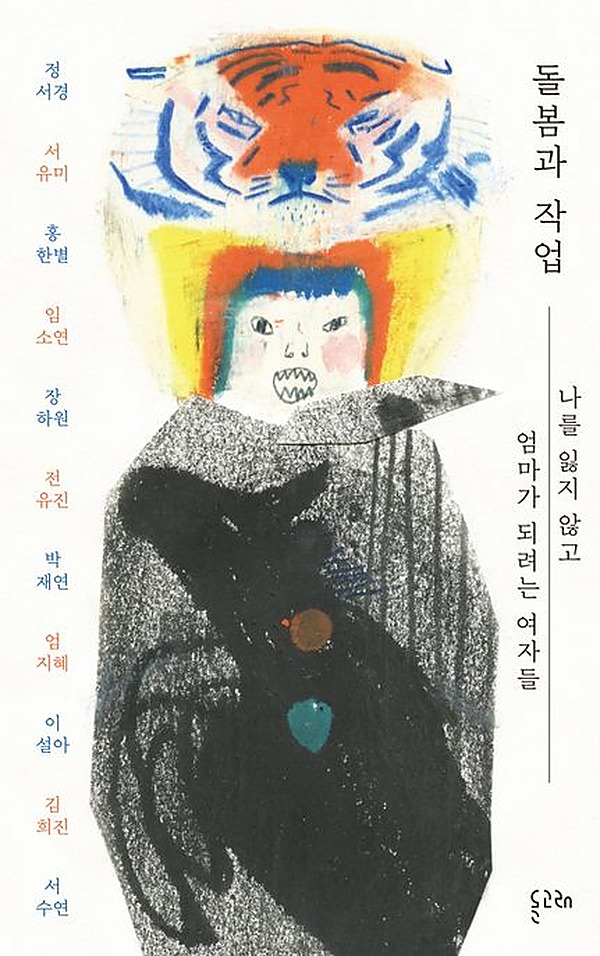
If you spend an hour on care, what is taken away? This kind of arithmetic becomes especially hard to bring up during Family Month. The language of May leans toward gratitude and love, and within it, words that count hours sound stingy. 『Care and Work』 (by Jeong Seo-kyung, Dolgorae, 2023) is a book that proposes going ahead and doing that stingy calculation.
The book handles care and work together. The fact that the two words in the title are joined by a single conjunction shows the book's stance exactly. It starts from the premise that care does not get in the way of work, work does not push out care, and the two run at the same time inside one person's day. Published in 2023, the book is bound as a two-volume set, which asks for the kind of pace where you close one volume and pick the reading up again.
The texture of the reading is calm. It does not raise its voice to denounce institutions, and it does not hold caregivers up as saints. Instead it writes plainly about how the day was divided up and what traces that dividing left on the work. Because it does not put emotion out front, it is the kind of writing that stays with you longer.
Breath Journal's reason for taking up this book in May is clear. Care is a welfare issue and a labor issue, and at the same time an education issue. The hours of raising a child and the hours of sitting beside a sick family member are not recorded in the household ledger, but they are firmly deducted from someone's career. The moment the name love is attached, no price is set on those hours.
The strength of this book lies in turning that unpriced time back into time. It does not draw the caregiver as someone in need of help, and sees a person who designs and adjusts a day. It makes you ask what is needed to keep working while caring, and whether that need is being filled by individual will. It is also a question that always gets pushed back when systems such as parental leave and family care leave are discussed.
There are places where it thins out. Since personal records stand at the center, the analysis of where and how the system breaks off is left to the reader. The conditions of people whose capacity to take on care is itself different, shift workers or freelancers or single-person households, lie outside this book. The virtue of a book that honestly writes down private experience and the range that experience cannot represent come together.
Even so, the difference this book holds among books on care is distinct. It handles care neither as a heartwarming story nor as a tragedy, and treats it as a condition of a working person. Where many books on care start from the language of emotion, this one starts from the schedule. That difference in starting point is held to the end.
It is recommended for anyone who has cut back on work or left work because of care. The same goes for those who watched that decision from close by, and for those charged with designing care policy. The first two gain words to explain their own hours, and the last can see what sort of day lies behind the statistical tables.
Once Family Month passes the carnations wilt, but the timetable of care stays the same in June. If one thing is changing, it is that more people are speaking of care as an allocation of time in place of proof of love. This book stands on the side that brought up those words early.
For readers who want to read care as a narrative of love, this book may be uncomfortable. There are no sentences honoring devotion here, and no scenes that close with tears. Instead, what was done at what hour and what could not be done because of it is recorded on and on. If you have no intention of bearing that dryness, you may close the book.