

What do we base our decisions on when we design a system? Budgets and criteria alike start from numbers. If those statistics contained only half the picture from the start, who is the system built on them for?
There is a book we find ourselves opening again ahead of International Women's Day in March. "Invisible Women," written by Caroline Criado, was published in Korea by Woongjin Think Big in 2020. It digs into how the world's default values were set, surveying the groundwork of design that runs from cities and labor to health care and welfare.
The tone of the reading is not impassioned. Rather than leading with anger, the author chooses to point out the missing boxes one by one. So as the pages turn, what changes is not the reader's emotions but their perception.
The point where this book meets our pages is clear. Setting who qualifies for welfare benefits, calculating the workload of care workers, and building transit networks around commuting times all rest on statistics. If the statistics take only one group's patterns of life as the standard, those who fall outside the standard are pushed outside the system. Before it is a question of charity, it is a question of design.
Care work is the area where those gaps pile up thickest. Labor that is not counted becomes labor that does not exist when budgets are drawn up, and labor that does not exist has no grounds for support attached to it. In a level tone, the book confirms again and again that there are people who disappear into the blanks between labor statistics and welfare statistics.
The same principle operates in schools. What we decide to measure determines what we support, and difficulties that are not among the measured items remain personal circumstances even inside the school. The people who make the indicators are the people who make the priorities.
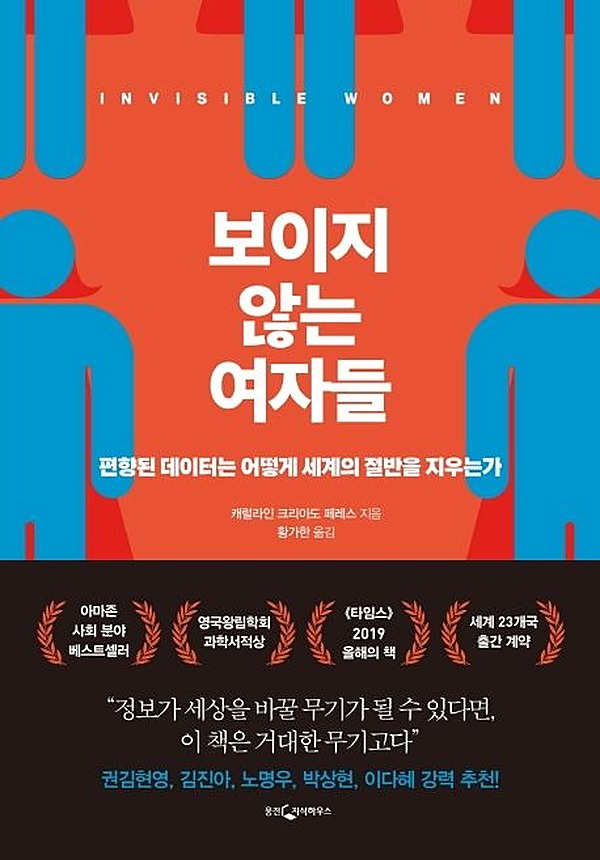
Its strength is that it moves sexism out of the realm of attitudes and into the realm of infrastructure. The explanation that bad outcomes arise even without bad intentions provokes less defensiveness in readers encountering the subject for the first time. Where introductory books on women's studies have approached through relationships and experience, this book approaches through statistics and blueprints.
It has limits as well. The cases span a wide range, so applying them directly to Korea's institutional landscape leaves room for translation. Which items are empty in the domestic statistical system is a part readers have to fill in on their own. The diagnosis is sharp, the prescription thin.
Even so, the readers to recommend it to are clear. Civil servants and researchers who design indicators, welfare practitioners who have to determine who a program serves, and people who have wondered why their own experience never shows up on any form. It is closer to a casebook than a difficult work of theory, so there is no harm in starting from whichever chapter interests you.
Some things are changing now. Calls for sex-disaggregated statistics are coming from both academia and administrative practice, and discussion of taking another look at what gets counted has begun to come up in budget review as well. Finding the blanks becomes the starting point of policy.
Because the range of cases is so wide, some chapters stop at an introduction, and readers thinking about domestic application have to walk the last few steps alone. Still, the eye for reading the blanks in a statistical table as blanks in a life remains after the book is closed. That changing how we count changes who we see, that alone makes this casebook worth its keep.