
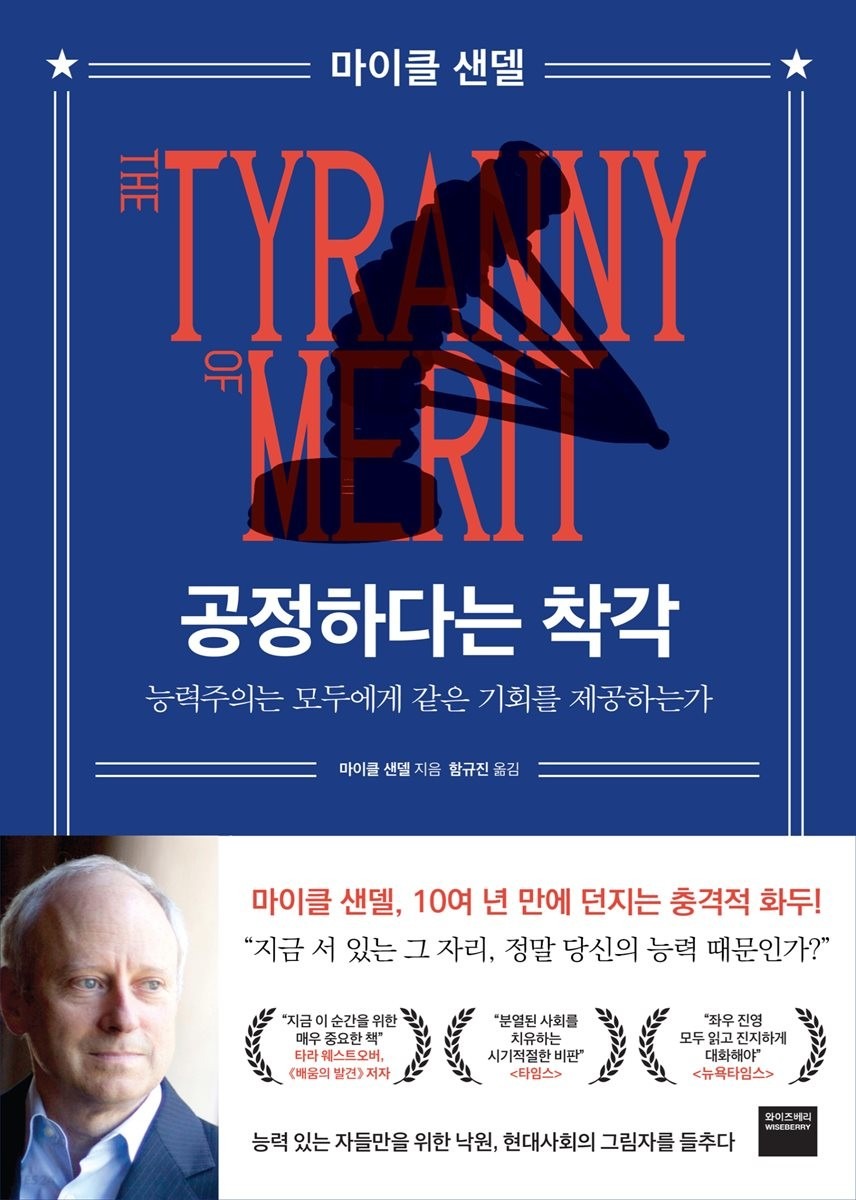
Did the person who passed really pass by their own strength. Did the person who failed really fail through their own fault. Every time you walk past a university district or a job posting board in February, this question comes back year after year. It is the problem Michael Sandel digs into in 'The Tyranny of Merit' (Wisebury, 2020).
What Sandel takes aim at is meritocracy, the common assumption that a system distributing rewards according to talent and effort is fair in itself. The book's focus falls less on the failure of meritocracy than on the shadow that appears when people believe meritocracy has succeeded. The argument is calm, the conclusion uncomfortable.
In a meritocratic society, winners regard their achievements as entirely their own. Parents' income, the region where one was born, a teacher met by chance, a stretch of time when the body was not sick. How much these conditions intervened in the outcome is not recorded on a transcript.
So winners grow arrogant, and losers blame themselves. Along with the income gap, Sandel digs into the process by which humiliation piles up on the losers.
This passage reads as especially painful for Korean readers. Faced with the lines that divide early admission from regular admission, open recruitment from rolling hires, permanent from non-permanent employment, we have always demanded 'a fairer selection method.' Refining selection procedures is necessary, but that alone does not answer why the life of a person passed over in selection has to get that much worse.
The book opens up widest when it deals with labor. When degrees and credentials become the measure that prices a person, the labor of those working outside that measure is treated as lesser. We too have lived through the experience of work in care, transport, cleaning and manufacturing being called essential while receiving nothing like that treatment in wages and respect. How a society distributes the dignity of work, this is what carries the latter half.

The book is strong on diagnosis and thins out on prescription. It does not go as far as how to design institutions, how to fund them and what resistance to get past. Parts of the background to the discussion also come apart when applied directly to Korea's admissions system or hiring practices. Balance requires reading it alongside books that handle inequality through statistics and policy design.
Even so, the reason this book is needed is clear. While much of the discussion of inequality concentrates on the size of the distribution, Sandel takes issue with the language of social evaluation that operates before distribution. Before weighing who deserves to succeed, it makes us look again at the words we use for lives that did not succeed.
Discussions criticizing meritocracy usually stop at weighing how evenly opportunity has been opened. Sandel holds that even if opportunity were perfectly even, the very language that separates winners from losers splits the community apart. Proposals to make competition fairer, and the work of doubting the habit of converting competitive outcomes into a person's worth, are different jobs. This book chose the latter, and that choice is where it parts from discussions handling similar material.