
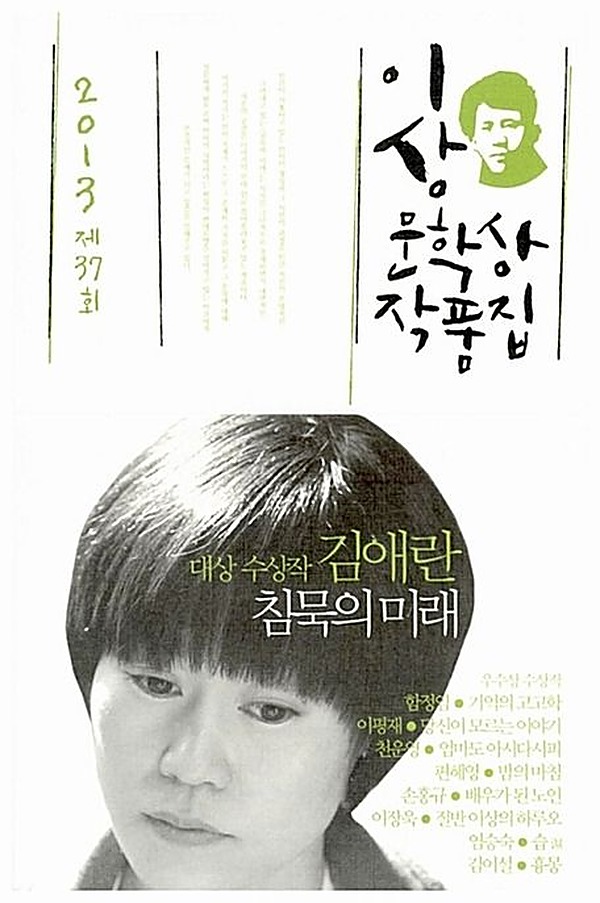
When the last speaker of a language draws a final breath, what disappears from the world? Word lists and grammar tables can be set down on paper. But where are the valley names called only in that language, the jokes that held only in that language's intonation, to be kept? Kim Ae-ran's The Future of Silence (Munhaksasang, 2013) holds on to this question for a long time and does not let go.
The book was published as the collection for the 37th Yi Sang Literary Award. The title story places at its center a vanishing language, and the time of the people who held on to that language to the last. The writer, long read for her precise sentences, does not falter in this work either. That precision is chilly rather than sharp.
The sensation the novel produces is close to touch. The rasp of dry paper, the smell of dust in a room long shut, the lingering sound of a space where no one answers have soaked into the sentences. Instead of explaining the extinction of a language with statistics, it follows how that extinction settles on one person's body. After reading, the mark left where the sound drained away stays for a long time.
Here the novel meets the matter of cultural heritage head-on. A region's speech lives together with its place names. When the words that pointed to the bends of a waterway, the side the wind comes from, the kinds of wild greens disappear, one whole way of reading that terrain closes. A building can be repaired and a bowl can be pieced together, but speech stops working the moment no one uses it.
The novel does not gloss over the tension between preservation and use. Recording, exhibiting and storing vanishing words is necessary. But between recorded speech and living speech there is a gap that cannot be crossed.
The novel does not try to stitch that gap shut, and instead lets the reader look into it directly. The ethics of this work come from the admission that preservation is not itself salvation.
Its strength is clear. The skill of narrowing the vast subject of extinction down to one being's senses, without swelling it into abstraction, is rare. If nonfiction on minority languages persuades with cases and figures, this novel does not persuade but makes the reader undergo it. In place of making a concept understood, it chose to move the temperature of loss into the body.
There are points where it grows thin. As dense as the feeling is, the social and institutional conditions under which language extinction occurs remain outside the novel. For a reader who wants to know why certain words are pushed aside while others become the standard, how that power works, this one book is not enough. It is better to open it with the understanding that literature's share and the share of records and research are different.
The book came out in 2013, but it fits reading now. With Hangeul Day a couple of weeks off, the novel quietly reminds us that what we commemorate is, together with the script, the countless manners of speech and regional tongues the script has carried. Dialects blurred in the shadow of standard Korean, and the words of fishing and mountain villages setting with the elderly generation, come to mind together.
The world in which this 2013 novel sits has changed several times since. Around the time of publication, losing one's speech still sounded like an old person's memory or the story of a distant tribe, but now machines learn people's manner of speech and give back only sentences close to the standard. The sense that words vanish without anyone even knowing they are vanishing reaches much closer than the fact that there are words disappearing.
So on opening it again, this novel reads as closer to a record of observation than to a eulogy. The scene in which one being senses its own speech thinning resembles what people who at some point folded away their hometown accent have gone through. The reason this book comes to hand again with Hangeul Day a couple of weeks off lies in that resemblance.