In March, a bundle of documents will arrive at the secretariat of the Intergovernmental Committee of the UNESCO Convention for the Safeguarding of the Intangible Cultural Heritage. It is the application for taekwondo's inscription on the Representative List of the Intangible Cultural Heritage of Humanity that the Korea Heritage Service is preparing. Instead of a South Korean application on its own, the agency is giving priority to a format that puts the name on the list jointly with the North, so this document does not stop at the procedure of adding a single element to the list.
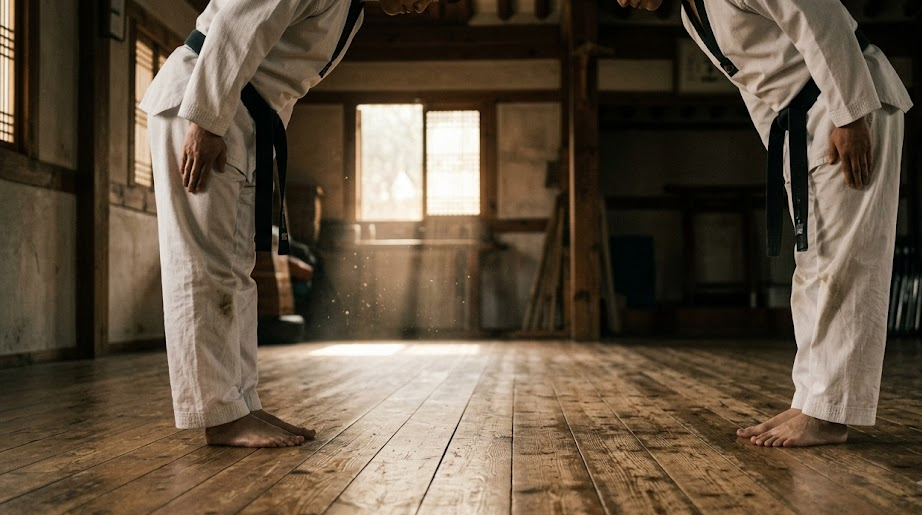
The dry cotton sound of dobok lapels brushing together, the dull friction of bare feet pushing off a wooden floor. The physical substance of taekwondo comes from between a person's body and the floor, not from elaborate equipment. What is being asked now is whether that plain material can be set down under the same name on the official documents of two systems.
It was North Korea that opened the path. In March 2024, North Korea applied for inscription under the name "Taekwondo, traditional martial art of the Democratic People's Republic of Korea," and that review is now under way. The decision will be made at the 21st session of the Intangible Cultural Heritage Committee, which opens on November 30 and closes on December 5. The venue is Xiamen, China.
At its first meeting this year, the World Heritage Subcommittee of the Korea Heritage Service's Cultural Heritage Committee chose taekwondo as the next element to be nominated. It will first consider a plan for the South and the North to be inscribed together at the December session, while also leaving open an extension route in which South Korea is added to the list afterward if the North's inscription is confirmed first. An official at the Korea Heritage Service said the agency would carry out the process with every possibility left open.
What is interesting is the shift in stance. Around the time the North's solo application became known, the government held to the line that it had neither discussed nor pursued a joint inscription, and said only that it would provide support in line with domestic procedures. It then moved its policy toward joint inscription through consultations with related organizations. Whether there has been any actual contact between the South and the North, and whether the North has agreed to this format, has not been confirmed.
The precedent is ssireum. At the 13th session held in Port Louis, Mauritius, in Africa in 2018, the committee combined the ssireum applications submitted separately by the South and the North into one and placed it on the Representative List. It moved the scheduled review order forward to table the item, and the 24 member states are said to have raised their hands unanimously. The committee framed the significance of the move as an unprecedented decision and a step for peace and reconciliation.
What the format of joint inscription touches becomes clear at this point. Intangible heritage is not nailed to a single spot the way a fortress wall or a royal tomb is. The satba belt of ssireum and the kicks of taekwondo have each been carried on in their own way on both sides of the armistice line, and so the moment ownership is weighed, the character of the heritage itself is damaged. To keep preservation from becoming a confirmation of ownership, there is no choice but to write two names in the name field of the list.
Of course, the shared nature of intangible heritage is not protected by declaration alone. An inscribed element soon becomes a tourism resource, a teaching text, and a justification for international competitions. The higher the enthusiasm for putting it to use, the more room there is for the dispute over whose taekwondo is the original form to revive. It is also worth remembering that the eight years since the ssireum inscription have not fully released that tension.
The committee is composed of 24 countries elected at the general assembly of the states parties to the convention, and meets once a year to vote on applications. The number of elements South Korea has placed on the Representative List so far is 23. Classified as a country holding many elements, it is reviewed once every two years, and in 2028 ginseng culture goes up for evaluation. If taekwondo is inscribed jointly by the South and the North, it will be the second such case after ssireum.
An interval of nearly ten months lies between the March submission and the December vote in Xiamen. In that time it will emerge in turn how the official name of the nominated element is set, and which format is chosen between a joint application and an extended inscription. Sparring is a gesture that holds only when there is an opponent, and if you cannot read the opponent's breathing, not even one exchange continues.
Go to a neighborhood dojang in the evening hours and you can see that rhythm for yourself. The sound of feet on the floor splits in two and then falls back into one, again and again. Whether the paperwork can catch up with that beat will be known at the end of the year.