The Korea Heritage Service has issued a bid notice for a research service on the theme of "Comparative Study of the State of Intangible Heritage Transmission in Korea and China and Establishment of a Basis for Its Use." The notice, posted through the Public Procurement Service's Nara Jangteo (나라장터), became known on the 16th, and the bidding process will be wrapped up this month through proposal evaluation, bid opening and contracting. The research period is 10 months. The core of the task is to examine, by the same standards on both the Korean and Chinese sides, the state of transmission of intangible heritage that has been cited as a target of the so-called "cultural project" (문화공정), and to produce baseline data.
Under the statement of work, the research team will determine the state of transmission within China through field surveys and other means, and analyze the commonalities and differences in the two countries' transmission processes. What it means to place at the end of that is the clarification of origins and cultural identity. The Korea Heritage Service said it will follow verification procedures, including expert consultation, so that the data does not lean to one side. Hanbok, yut nori and seasonal holidays are mentioned among the heritage items to be covered, but a confirmed list has yet to be announced.
"Cultural project" has been used to refer to claims that one particular culture is the origin of another culture, or to attempts to distort another country's traditional culture and absorb it as one's own. Claims that call hanbok "hanfu," or cases in which kimchi is labeled "pao cai," are cited as representative examples. At the National Assembly Culture, Sports and Tourism Committee's audit in October 2024, material was released showing that 101 items of Korean intangible heritage, including Arirang and pansori, have been designated as Chinese intangible heritage. A breakdown was presented along with it showing that 20 of these are at the national level and 81 at the provincial level.
Each item on the list is not an abstraction. One such example is the controversy that arose when it belatedly came to light that Jilin Province had entered dolsot bibimbap on its provincial intangible heritage list under the name "Korean-Chinese dolsot bibimbap cooking technique." The sound an iron pot makes as it heats up, the smell of rice grains scorching, the moment sesame oil spreads, all of this is the content of the cooking technique. Those sensations do not disappear whichever register they are written into, but the register changes who manages them.
There is a point where things diverge here. Putting a name on a register is the domain of administration, and transmission belongs to human time. If the latter thins while people quarrel over the former, what remains in the end is only two files of paperwork. The Korea Heritage Service's decision to put "the state of transmission" at the front of this study reads as a design that is conscious of that difference.

The tension between preservation and use is not something to gloss over either. A report dated the 15th of this month said that China's Western Xia Imperial Tombs are drawing renewed attention through technology-based, experiential forms of exhibition since their inscription as a World Heritage site. The more refined the way a heritage site is shown, the more widely that heritage's narrative spreads along with it.
The situation at home is no different, and over the course of 2025 the number of people who visited Gyeongbokgung, Changdeokgung, Changgyeonggung and Deoksugung palaces, Jongmyo Shrine and the Royal Tombs of the Joseon Dynasty was counted at 17,814,848. It is the first time the figure has exceeded 17 million, and the highest on record.
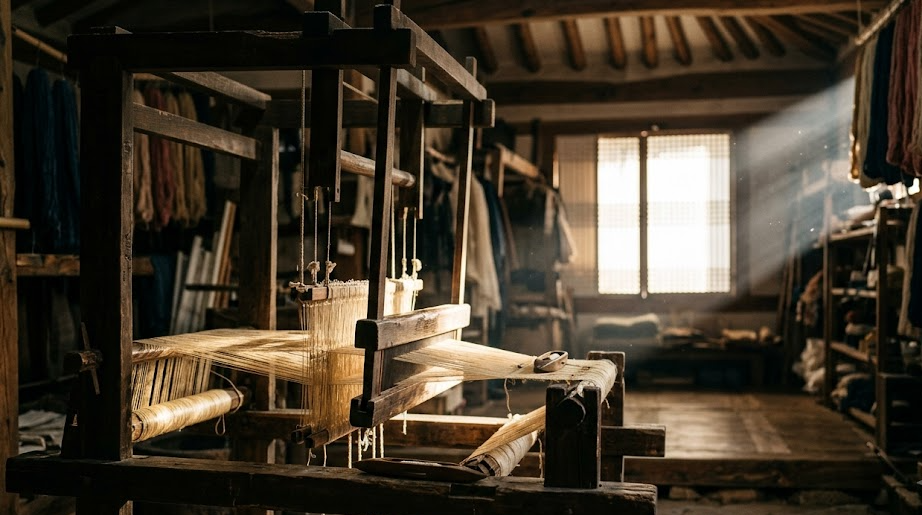
Visitor numbers do not in themselves mean the thickness of transmission. The footsteps of 17 million people walking palace courtyards and the time of a bearer who spends a year sitting at a loom flow in different units. Use sometimes feeds preservation, and exhibition sometimes turns a technique into a mounted specimen. If this study casts light on the density of transmission on our side along with the situation on the Chinese side, the product of the 10 months can serve as a checklist instead of stopping at material for a response.
A comparative study begins with checking the other side's list, but the answer comes out of the workshops on our side. Stronger evidence than a document proving who came first is the fact that the technique is still crossing from hand to hand even now. If the contract is signed within this month, the results will show themselves 10 months after that. At that point, rather than counting the number of entries on China's register, we should check how many lines in our own roster of bearers have been filled in over those ten months.