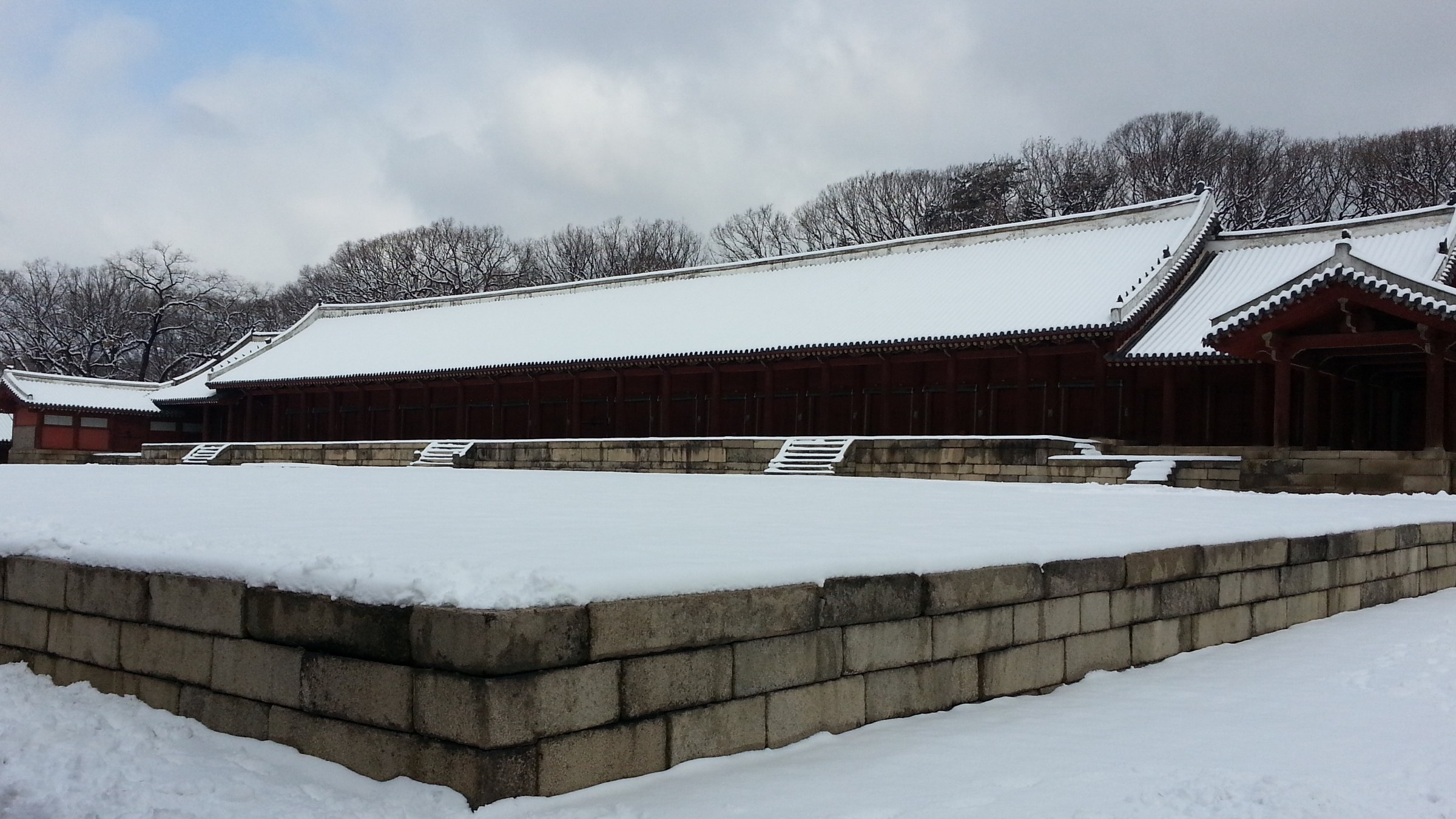
What is in dispute is the sky spreading out behind the building rather than the building itself. On the 8th of this month the Seoul Metropolitan Government issued an official statement asking the Korea Heritage Service to let it go up onto the Sangwoldae of Jongmyo Jeongjeon and photograph a landscape simulation, and to weigh the results together. The Korea Heritage Service did not permit photography on the Sangwoldae. Before arguing over how the 145m building in front of Jongmyo looks, the two agencies split over how it should be looked at.
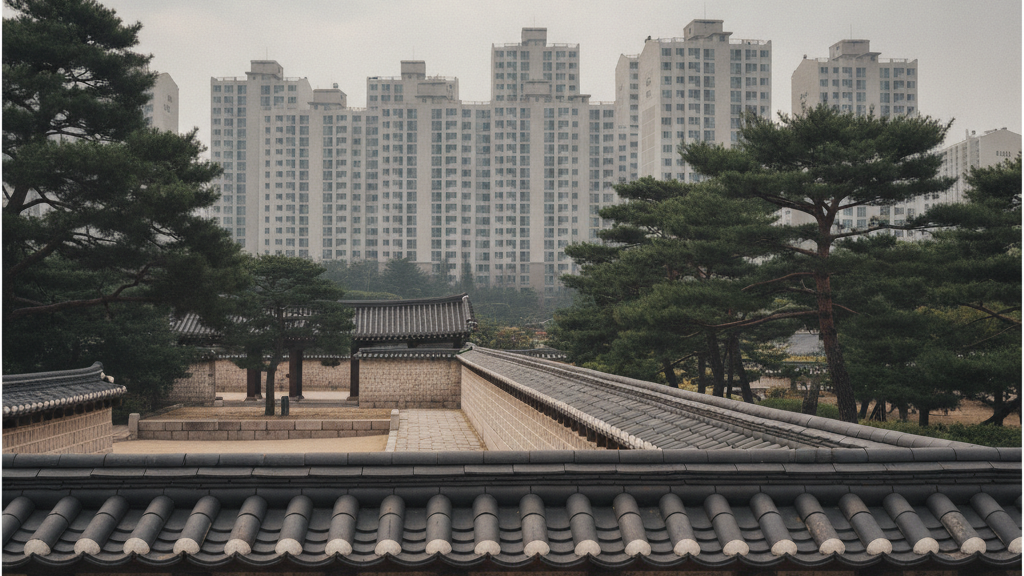
Jeongjeon is long. A single-story wooden building of nineteen bays joined side by side carries a low roofline, and in front of it a woldae paved with rough stone slabs spreads out wide. The Sangwoldae is the upper tier of that woldae, the place where the king stood during the rites. For 600 years the design principle of this space lay in what was not built rather than in what was built, and so the empty sky above the roof became part of the architecture.
Turn the clock back two months and the sequence becomes visible. On December 26 last year the Seoul Metropolitan Government applied for photography permission, listing 10 people as entering. The Korea Heritage Service said it had confirmed that the event was in fact an on-site briefing of some 50 people presided over by the head of the Urban Space Bureau, and in a rebuttal on the 7th of this month it explained that this had been an unavoidable administrative measure following the gap between the application and the actual scale. From another quarter it is reported that the ground for refusal was a judgment that the event would hinder the preservation and management of the World Heritage site, and the explanations for the same decision diverge.
There are three ways of counting the people. The 10 on the application, the some 50 the Korea Heritage Service says it confirmed, and the 13 officials of the Seoul Metropolitan Government and SH Urban Housing and Development Corporation who are said to have finished photographing from various angles while facing Jeongjeon. Citing these 13, the Korea Heritage Service said it has never refused objective verification.
From the Seoul Metropolitan Government's side came an explanation to the effect that the briefing itself did not come off because photography on the Sangwoldae was blocked. If there are photographs already taken, is that enough, or must it be the scene viewed from that one spot where the king stood. The substance of the argument lies here.
In December last year the Seoul Metropolitan Government floated an advertising balloon at the same height as the Sewoon District 4 building and went through a procedure of checking directly on site. The city said the height and the view seen with the eye at that time were no different from the simulation it had released earlier. No procedure verifying this result separately from outside the city government has been made public. Before that, questions of reliability were raised over the simulation looking straight south from the Sangwoldae that was released at the city council.
[Illustration: a sectional composition in which the gaze of a person standing before a long building with a low roofline stretches out into the sky, a scene in which a tall rectangular mass catches at the end of that gaze | Caption: depending on the point from which it is seen, the same height reads differently]
The figures were fixed on July 21 last year at the Seoul Metropolitan Government's Urban Redevelopment Committee. For Sewoon District 4, around 85 Yeji-dong, Jongno-gu, the maximum building height rose from 71.9m to 145m and the floor area ratio from 660% to 1094%. At the seventh meeting of that year of this body, which is chaired by the Second Vice Mayor for Administrative Affairs and made up of 4 public officials, 4 city council members and 12 outside experts, 12 of the 20 members took part. The city announced the plan on October 30 last year.
The stenographic record of that day preserves what one member pressed for. Voicing concern that Jongmyo might be given a warning as a 'World Heritage in Danger,' the member asked whether opinions from experts in the cultural heritage field had been heard, and a city official answered that there had been both opinions expressing concern and opinions that there was no problem. The Korea Heritage Service has been demanding a World Heritage Impact Assessment, raising even the stripping of World Heritage status in the worst case. Together with the Ministry of Culture, Sports and Tourism, it has also cited UNESCO's recommendation to suspend approval of the project as grounds for opposition.
It is only recently that the conflict has crossed the fence of administration. On the 8th of this month residents of Sewoon District 4 took to the streets calling for the photography to be permitted. For those who have been waiting for redevelopment, a delay in verification is a delay in daily life.
And on the morning of the 14th, the Ven. Jinwoo, president of the Jogye Order of Korean Buddhism, said at a New Year press conference held at the Korean Buddhism History and Culture Memorial Hall in Gyeonji-dong, Jongno-gu, that he opposes the high-rise development in front of Jongmyo. The remarks came against the background of a tally showing that 32.9% of registered national heritage is Buddhist cultural heritage, and they were the order's first official position on the matter.
Between the two agencies there is a channel for discussion, the preliminary coordination meeting set up last year. Even so, what lies before them now are different figures and different written grounds. The Korea Heritage Service is demanding a prompt answer from the Seoul Metropolitan Government, saying the deadline for returning the materials requested by the UNESCO World Heritage Centre passed long ago, and whether that reply comes will decide the next phase.
Jongmyo receives visitors from nine in the morning every day. Standing face to face with Jeongjeon, one cannot go up onto the Sangwoldae, but from the stone slabs anyone can measure with the eye in what proportion the roofline meets the empty sky above it. Gauging roughly where 145m would fall is possible without a simulation. The two agencies, faced with the same scene, have failed to agree on the value to be placed on it.