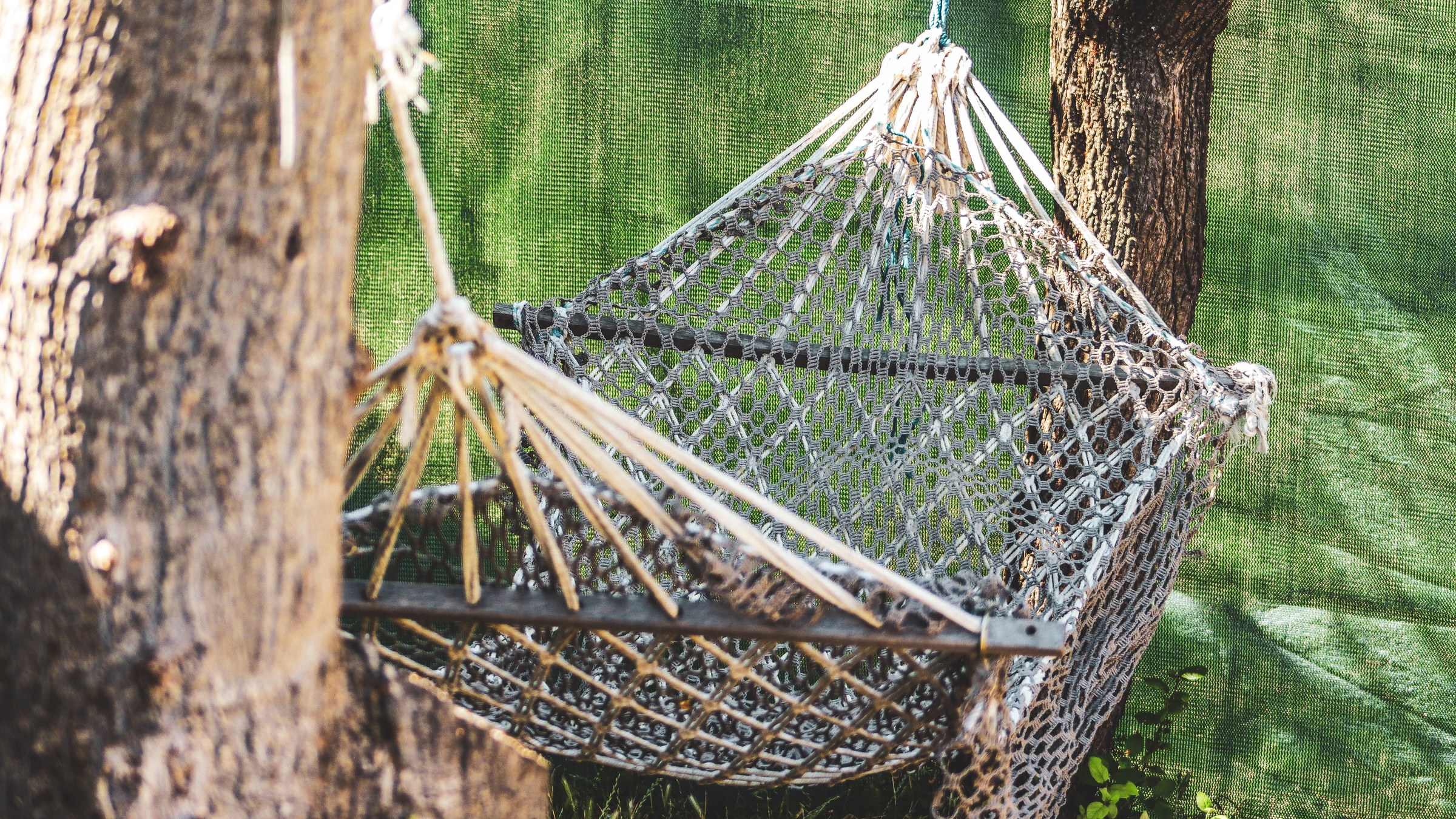
A net hammock hangs between two trees. Behind it a green shade cloth spreads wide as a barrier, and against that green the gray mesh hangs in a dense weave. The ropes holding the hammock have faded in the sun into yellow cords, and two spreader bars hold the top and bottom of the net stretched taut.
The bark on the left tree has risen up rough enough to catch a fingernail. Dry grass lies thin across the ground, and in the lower right corner a few small leaves have pushed up green. Midday has tilted a little, and shade and sunlight sit on the net in equal halves.
The middle of the net sags into the shape of a single person. No one has lain down, yet the mark remains. Following that curve slowly with the eyes, the focus loosens on its own, and the shoulders drop a hand's width.
The soles press the ground less. The force held in the jaw quietly leaves too.
Closing the eyes during the day strangely comes with excuses. The thought of looking lazy stays awake later than the body does. There is nowhere fitting to ask permission to rest, so mostly one just keeps sitting and holding out.
Put your back against the chair and let the eyelids fall. There is no need to sleep. Set fifteen minutes but allow yourself to stop after only three, and the eyelids hold out less.
Leave the hands resting on the knees. It would be fine to leave the darkening time empty once a day.
The same closing of the eyes can be moved to the end of the evening dishes. Rest the shaken-dry hands on the edge of the sink and, standing, cover only the eyes. What to observe then, one finger is plenty.
While the eyes are closed, quietly check only whether the fingertips curl in or open out on their own, that movement alone. For some days nothing at all comes through, and even the fact that nothing came through is left as it is.
The net is empty again today, and between mesh and mesh the afternoon sun leaks down bit by bit onto the grass.