
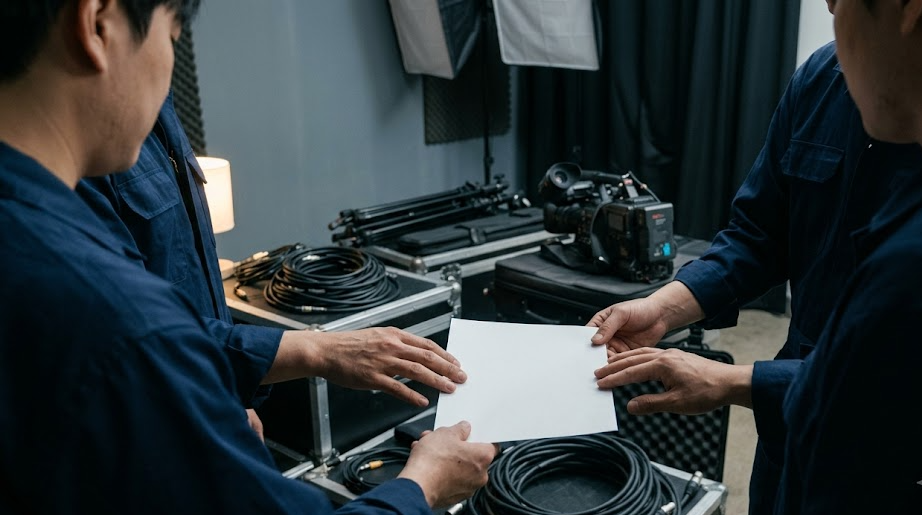
Broadcast crew members, performing artists, writers and extras gathered at the Franciscan Education Center in Jung-gu, Seoul, on the 5th. It was one day after the government announced that it would protect them. What they said when they took the microphone was a demand for withdrawal. The Freelancers' Union, formed jointly by the Broadcast Staff Branch of the Hope Solidarity Division of the Korean Public Service and Transport Workers' Union, the Performing Arts Workers' Union, the Writers' Union, the National Extras Union and the Film Industry Union, together with the Culture and Arts Labor Solidarity, held the press conference.
On the afternoon of the 4th, a day earlier, Minister of Employment and Labor Kim Young-hoon reported the second-half work plan to President Lee Jae-myung at Cheong Wa Dae. Along with youth employment, expanding protection measures for non-standard workers in the AI era was placed among the key tasks. 8.69 million. That is the figure Kim gave for the number of labor providers, covering specially employed workers and freelancers.
The government presented a timetable to complete legislation on the 'Basic Act on Working People' and a worker presumption system by December this year. A plan to create a new body called the K-Labor Welfare Chamber was also included. It added that rights protection and mutual aid programs would be attached for freelancers whom labor law does not reach.
Anyone who works becomes subject to the law regardless of employment status. On the employer side, items such as equal treatment, fair contracts and the prevention of sexual harassment are added, and some of them are obligations that must be guaranteed while others are obligations to make efforts. The worker presumption system regards a person who works as a worker in the first place when a dispute arises, and hands the proof that this is not the case to the employer.
The assessment of those who stood at the press conference was different. They defined the two policies as cementing the situation of workers outside of rights and instead pushing them into the blind spot. Ahn Myung-hee, policy committee chair of the Culture and Arts Labor Solidarity, is a former publishing house editor, and she said she had opposed this law since before the Lee Jae-myung government took office.
The focus of the objection lies in the 'separate name.' They take issue with the very method of creating one more new category in place of the worker defined by the Labor Standards Act and the Trade Union Act.
On the 5th, Kim explained the character of the new body again. He said the K-Labor Welfare Chamber is not a testing ground for forming unions, and that it is being conceived as a channel for delivering public welfare to the 8.69 million. He added that an announcement would come soon. Even the body's name is being used in two ways within the government, as 'K-Labor Welfare Chamber' and as 'K-Labor Chamber.'
Other items were also included in the second-half work report. The 183 companies that have had more than two accidents of the same type, such as falls or entrapment, over the past ten years will draw up company-by-company safety measures and receive close management. If it happens again, supervision on a par with a special inspection follows. The separate wage payment system, which applied only to publicly ordered construction sites, will widen to private construction and shipbuilding from January 2027, and the Labor Ministry will revise subordinate regulations in the second half.
On the youth side, the 'K-Youth Guarantee' aimed at first-time job holders is newly created, and the 'K-New Deal Academy,' vocational training led by large companies, will grow to 10,000 people this year. In the case of middle-aged and older workers, the standard for workplaces that must provide reemployment support services is 1,000 or more regular employees, and this threshold will be lowered in stages. Legislating an extension of the retirement age was pushed back past the June 3 local elections after being targeted for passage within last year, and it will be pursued again in the second half. The effectiveness of the system requiring public institutions to hire youth for at least 3 percent of their quota will be revised as well.
Those directly involved take issue with the name by which the safety net calls them. Being named as a recipient of mutual aid and welfare, and being recognized as a worker able to contest contracts and wages, are different.
The legislative deadline the government has set is December this year. Kim said in advance that he would make public the design plan for the K-Labor Welfare Chamber before then. Whether the demands made at the Franciscan Education Center are contained in the design plan will be confirmed in the membership conditions and the funding items. The 8.69 million written in a single line in a policy document is 8.69 million contracts, one for each, to the people who stood at the press conference.