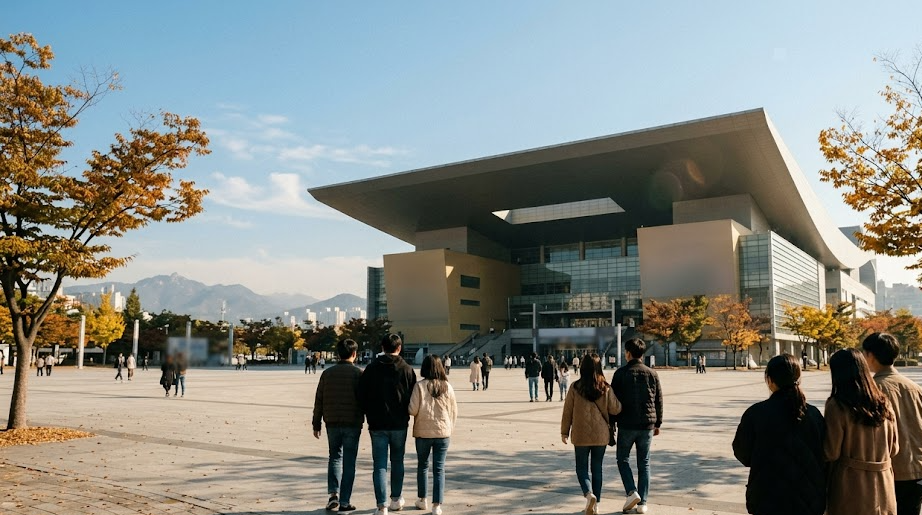
The National Museum of Korea renovated the Korean Empire gallery on the first floor of its permanent exhibition hall and reopened it on the 30th. The gallery had been closed for about nine months. The space, left empty to host last year's special exhibition "Our Yi Sun-sin," was handed over directly for the renovation. Sixty-five artifacts are newly on display, seven of them designated Treasures.
The list of Treasures includes the state seal "Chingmyeongjibo," used for royal edicts, calligraphy by the patriot An Jung-geun, and the Denny Taegukgi. "Portrait of Emperor Gojong," attributed to Chae Yong-shin, is hung alongside them. It is the first time in seven years that the original portrait has been shown to the public. Three imperial seals are placed together.
The Denny Taegukgi measures 262cm wide and 182.5cm high. It is the oldest and largest Taegukgi remaining in Korea. Gojong presented it to Owen Nickerson Denny (1838-1900), an American who served as a foreign affairs adviser to Joseon.
The exhibition is divided into three parts. Part 1 covers the 1897 proclamation of the empire and the aspiration toward a modern sovereign state. Part 2 shows the reorganization of the administrative system, the expansion of modern education, and the spread of newspapers and magazines.
The Daehan Maeil Sinbo and the Independent are on display, along with a map of Hanseong made by the French legation in the 1890s and a ceremonial sword worn with Western-style formal dress. Part 3 deals with the loss of national sovereignty and resistance. Artifacts of Min Yeong-hwan (1861-1905), who took his own life in protest against the Eulsa Treaty, are here.
The museum explained that this renovation focused on interpretation. It intends to read the emperor's enthronement and the push for modernization as an effort to defend sovereignty during a period when imperialism was pressing in. Before the renovation, the space had been inside the permanent exhibition hall since 2016 and measured about 27 pyeong. The new gallery has been expanded to about 40 pyeong.
A bronze ridge-beam inscription and a silver cornerstone plate, unearthed when the Japanese Government-General building was demolished in 1996, were also shown to the public for the first time. The silver plate is inscribed with the words "New construction of the Government-General of Joseon building, July 10, Taisho 9." Taisho 9 is 1920.
The name of Saito Makoto, who served twice as Governor-General of Joseon, is inscribed as well. A record attached to it states that the object had been buried beneath the southern corner of the building.
The original portrait is vulnerable to light, and the fabric of the Taegukgi is even more fragile. The museum brought in video technology. Using transparent OLED, curved screens, and artificial intelligence, it set black-and-white photographs from the Korean Empire period moving again. There are five works, hung across walls and corners.
The video that greets visitors at the entrance mixes electric lamps and the plum blossom emblem on a single screen. The plum blossom was the emblem of the Korean Empire's imperial house, and electric lamps were among the new things that arrived at the time.
Director Yu Hong-june spoke about the next room at a press briefing on the 30th. His plan is to establish a Japanese colonial period gallery once the second permanent exhibition hall is completed. The permanent exhibition halls currently display 9,884 artifacts across 7 buildings and 39 galleries, but there is no room dealing separately with the years from 1910 to 1945.
The site for the second hall is at the stage of consultation with the Ministry of Land, Infrastructure and Transport and the Ministry of Culture, Sports and Tourism. Director Yu also stated his intention to pursue the construction of the second hall at the Kwanhun Forum earlier this year.
After the loss of sovereignty in 1910, the Government-General changed the country's name back from the Korean Empire to Joseon. Sunjong was demoted from emperor to king. The Korean Empire ended after 13 years.
The folding screen of calligraphy by Park Yeong-hyo and Kim Ga-jin, which Director Yu donated to the museum this year, hangs in Joseon Gallery 3 on the same floor. It is a few steps from the exit of the Korean Empire gallery.
Visitor numbers are rising. From January to June this year, 3,795,400 people visited. That is 39.7% more than the 2,716,323 over the same period last year. Visitors for all of 2025 numbered about 6.5 million, so this year is running well beyond that pace.
The Korean Empire gallery is Room 120 on the first floor of the permanent exhibition hall. Facing the Denny Taegukgi and turning to the left, the artifacts of Min Yeong-hwan come into view, and at the far end on the opposite side is the silver plate from the Government-General building.