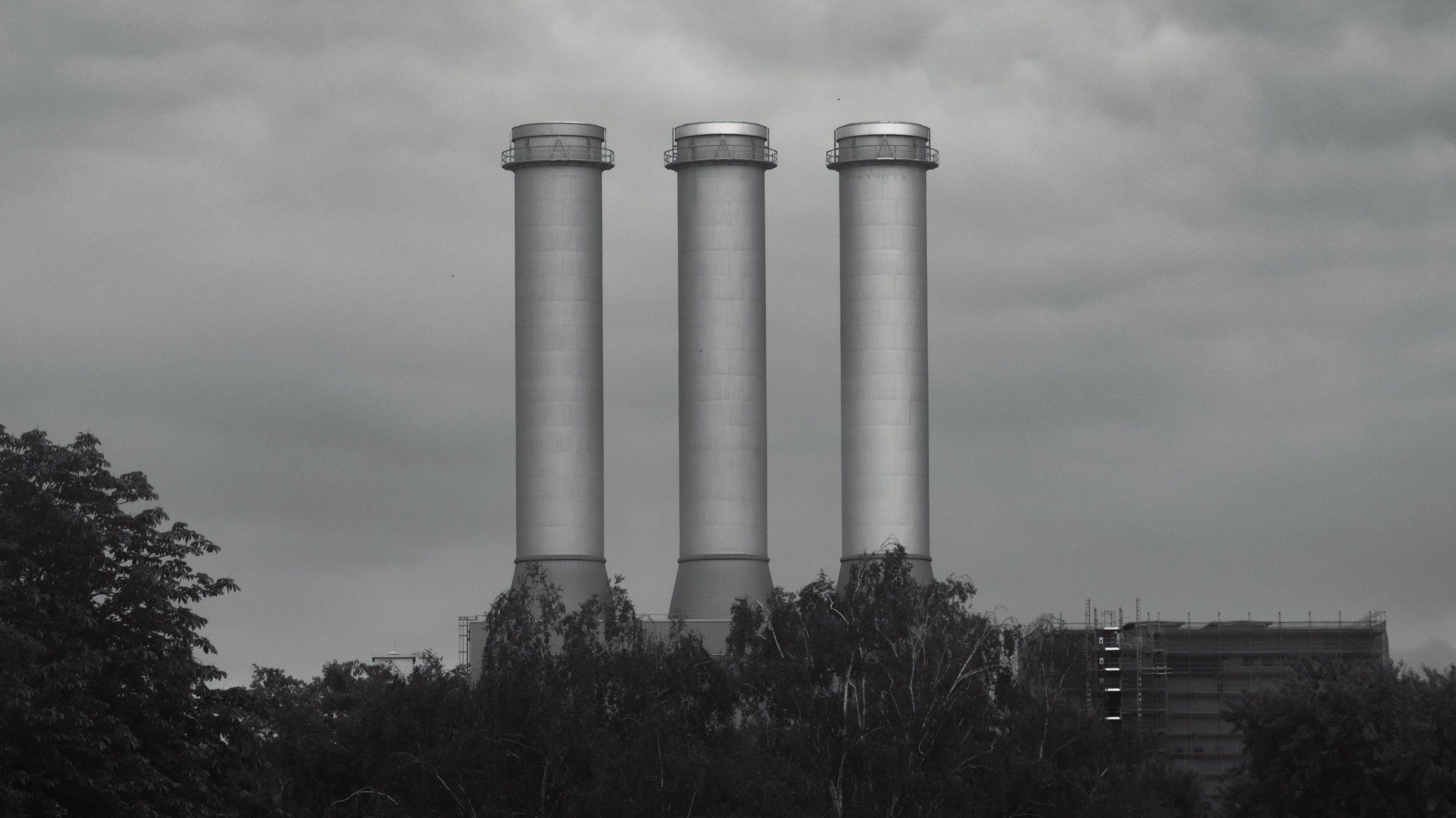
There are three chimneys. They stand in the middle of the frame, pushing straight up into an overcast sky, nearly matched in height and spacing. Only the metal bands around their tops shine white, and the shafts grow a deeper gray toward the bottom.
Nothing in the photograph could be called a color. There is no smoke either.
The light gives no clue whether this is midday or dusk.
The eye lingers on the fact that all three openings are empty. The equipment stands, and operation has stopped. Power generation equipment demands maintenance costs and interest even on the days it does not run.
Whoever put up three chimneys must have expected demand to hold that long, and the later that expectation fails, the higher the burden stacks up, as high as the concrete. The cost of moving out of fossil fuels usually shows itself in this form. What remains is too big to tear down and goes unused.
Look again at the right edge. A single low building, its roof just clearing the trees, is wrapped entirely in scaffolding. At first glance the chimneys draw the eye and this part goes unnoticed.
While the fire is out on one side, something is going up on the other. Industrial transition is closer to a shutdown and a groundbreaking happening at the same time inside the same fence, and this photograph has put those two scenes in one frame.
The bottom third of the frame is trees. The brush is darkest at the left and thins out toward the right. The bases of the chimneys are cut off by the leaves. The trees would not have been this tall when those were built.
The gray of the clouds and the gray of the concrete are nearly the same. Which of the three is the one blocking the sky, you find yourself looking once more.