A sparrow brought down by a toy air gun was left in a boy's hands. The yellow patch on its throat was unfamiliar, so the boy went to the Bombay Natural History Society, and W. S.
Millard told him the bird's name, the Yellow-throated Sparrow, and then took him to the room of stuffed specimens. From that day on the boy became someone who recorded birds instead of shooting them. That child, born the ninth and youngest, who lost his mother at three and was raised by his maternal uncle, would later become the first person to survey the birds of all India systematically.
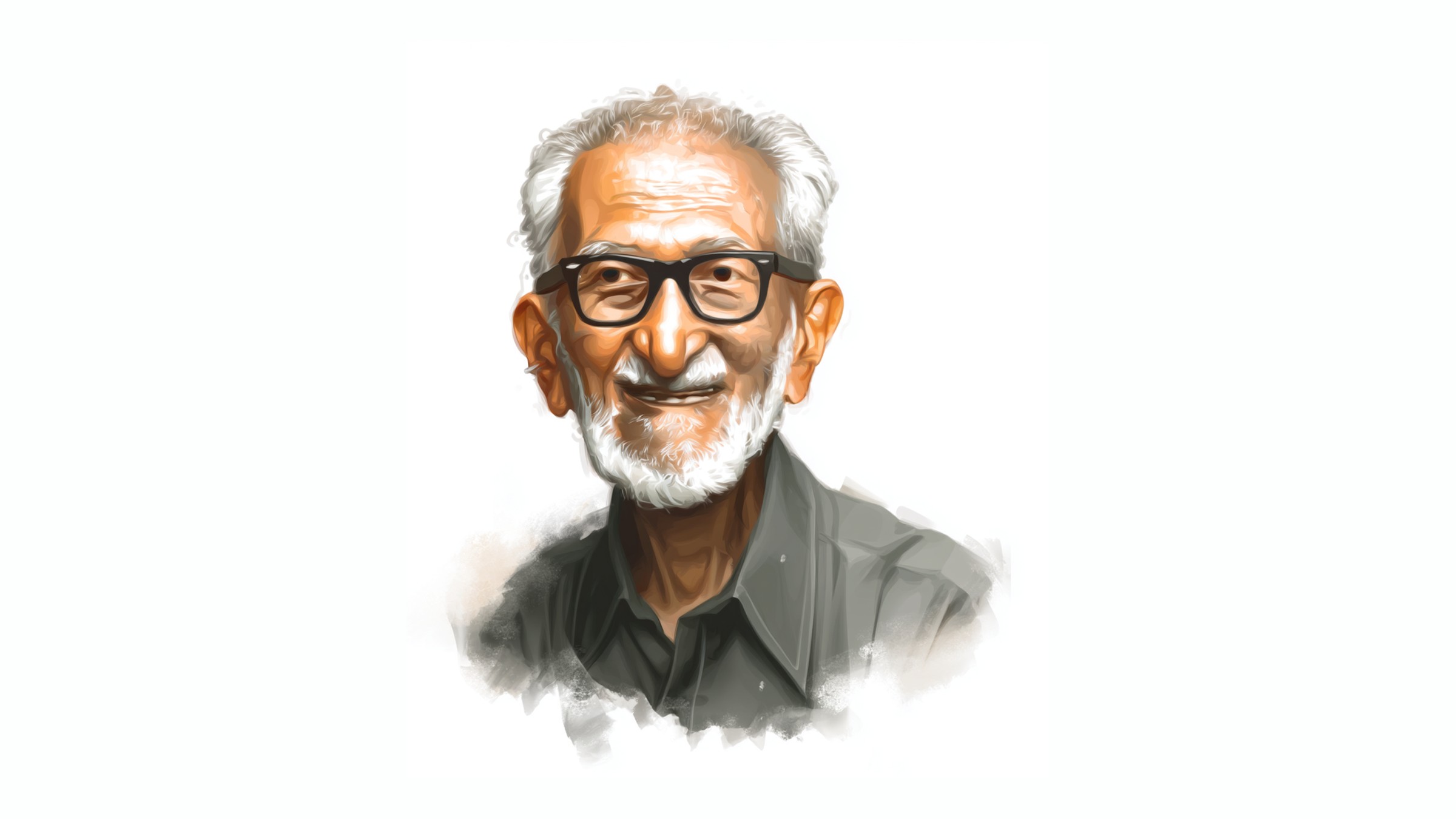
Salim Moizuddin Abdul Ali was born in Bombay on November 12, 1896, and died on June 20, 1987. After 1947 he became the figure who sustained the Bombay Natural History Society, and he drew government support to the society. He used his personal influence to create Keoladeo National Park and to stop the destruction of Silent Valley in Kerala, and with Sidney Dillon Ripley he left the ten-volume Handbook of the Birds of India and Pakistan. He received the Padma Bhushan in 1958 and the Padma Vibhushan in 1976.
Q1. You wrote yourself that the day you took the Yellow-throated Sparrow to Millard divided your life. What did that meeting change for a boy of about ten?
That was when I learned that the pleasure of shooting birds and the pleasure of knowing birds are different things. Shooting matches were held often in the neighborhood, and at the urging of my foster father Amiruddin I read hunting books first, so the gun came first. But when Millard opened the door of the specimen room, there were rows of birds with a label on every drawer.
He lent me books such as EHA's The Common Birds of Bombay, and said he would teach me how to skin birds and make specimens. From about that time I carried a notebook. One of my early observations was a record of how, after I shot down the male of a pair of sparrows, another male filled the empty place.
For an Indian to take up ornithology as a profession was a rare choice in those days.
Q2. You did not stay in school for long. Around the age of thirteen you often missed class with headaches, and you did not get past your first year at university either?
My headaches were severe and I was sent to relatives in Sind, and with my schooling broken off like that I barely passed the Bombay University entrance examination in 1913. I entered St. Xavier's College, left after a year and went to Tavoy in Burma. I went to look after the family's mining and timber business, but the forests of that area taught me.
I returned to India in 1917 and studied commercial law and accounting at Davar's College of Commerce. When the morning classes ended I would go over to St. Xavier's and sit in on lectures in zoology. That was thanks to Father Ethelbert Blatter, who noticed my interest and urged zoology on me.
I have no intention of hiding the flaws in my record. What made me a scholar was a notebook.
Q3. You kept to a method of watching a single species in front of your house over a long period. Why did you think scholarship was possible without going far?
If you watch one species through a whole season without losing sight of it, it comes out when that bird half-builds its nest and calls for a mate, and how many mates a single bird pairs with in turn. I did not think an expedition was required for it to be scholarship. Observation grows deeper by looking at the same subject for a long time.
The principle was the same in the surveys across India. I wrote down one by one which birds were where and in what numbers in each region. Joining those records together became the frame of the handbook later.
What pushed me was that no Indian had ever counted the birds of India from beginning to end. Someone had to write the first line.
Q4. You wrote several books that opened ornithology to the public. Was there a reason you wrote for general readers rather than for the inside of the academy?
The call to protect birds reaches only the people who know birds. Nobody misses a thing it cannot call by name when it disappears. So I tried to write books that could be opened out in the yard.
Writing plainly does not mean writing carelessly. The plumage, the call and the habits of a species had to be set down exactly, in sentences that a person seeing a bird for the first time could follow.
In the end those books went farther than the surveys did. People who had never set foot in a specimen room began to call birds by name.
Q5. Breath Journal is grouping this series under the 'Earth' axis. How does your work establishing Keoladeo as a sanctuary and preventing the loss of Silent Valley connect with counting birds?
They are the same work. Birds are only where there is water and there are trees. If you write down over several years how many of which ducks winter in a given wetland, then when talk comes of filling that wetland in, you have something to put forward.
The pools of Bharatpur do not look like much in themselves. But if that water disappears, birds that have flown from far away lose the place to come down. Silent Valley is the same, and if that forest goes, the things that exist only in that forest go with it.
I did not cast the people doing the development as villains. They had their own needs. What I did was to hold out a concrete list of what would be lost, and the more concrete the list, the more it became a conversation.
Q6. The wetlands of 2026 are being pressed from both climate change and urban expansion. Observations continue that the timing of migration and breeding is shifting as well. Among your methods, what is still usable now?
Writing down dates. If you record over many years when and where the same bird appears, you can recognize it when something begins to go out of joint. One year's record can say nothing, and twenty years' record cannot be made alone.
Nothing is protected by shouting that the world has gotten worse. Nothing is covered over by an announcement that a few trees were planted, either. What remains is the record built up over many years.
In my day I went around looking for patrons and pieced the surveys together. Now far more people can share that work, each in their own neighborhood, so the conditions are better than they were in my time.
Q7. The ten-volume handbook was completed only after you were gone. What would you like to hand on to those who come after?
There are a bird and a bat and a gecko that carry my name, and my name remains on sanctuaries and institutions too, but what I want to hand on is a single notebook.
Write one line today with the name and the date of the bird that came to your window. When those lines pile up, they become the grounds on which someone protects that wetland decades from now. I too started with a single sparrow.
This piece is not an actual interview. It is an imagined interview reconstructed by Breath Journal on the basis of Salim Ali's life, his writings and the records left behind. The questions were written by the reporter and the answers were drawn from the writings and the deeds he left.