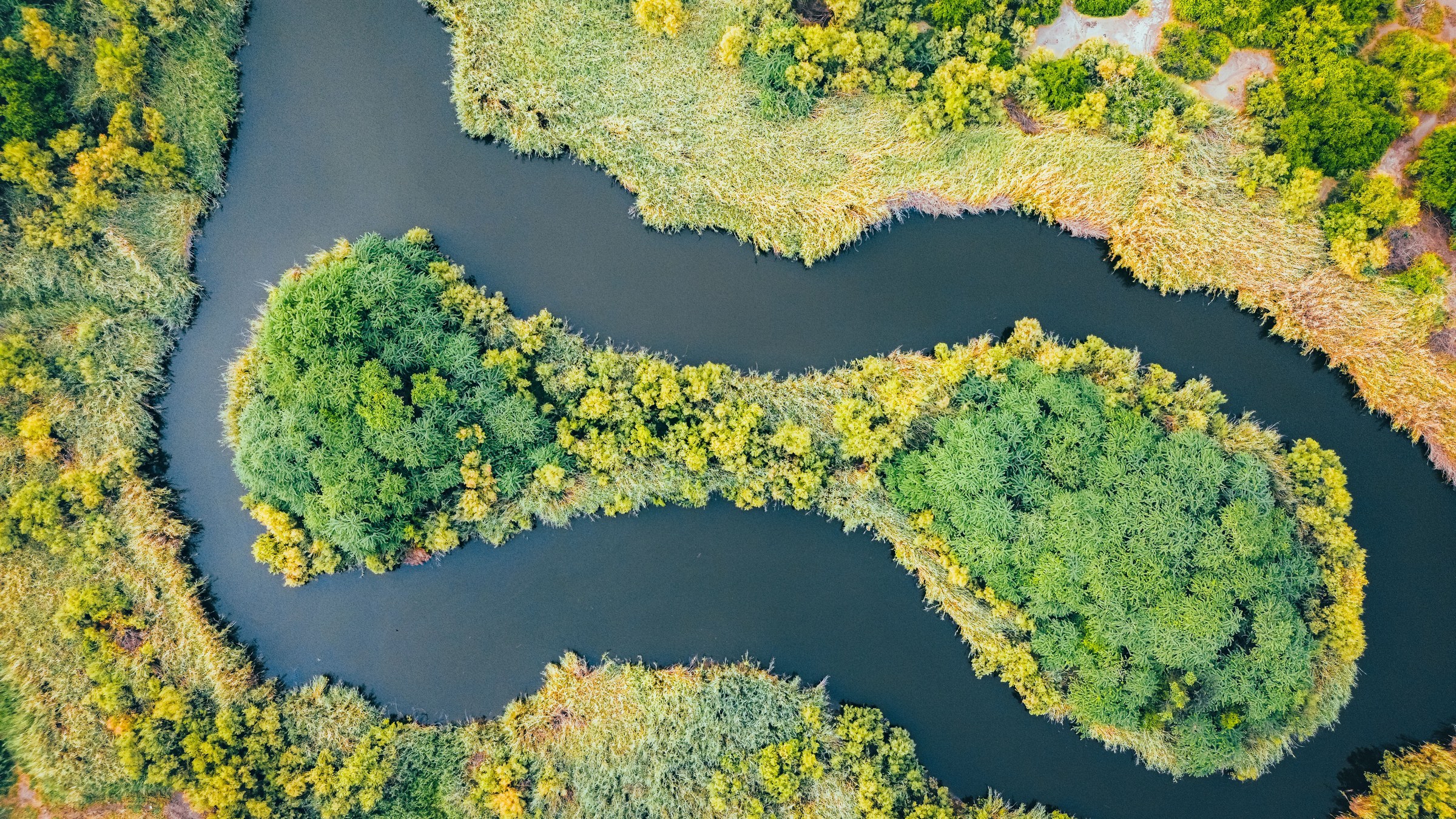
Seen straight down from above, the river curves twice in wide arcs. The water is a deep blue-green, and not a single ripple stands on its surface, so it looks less like a current than a still plane. Inside the arms of the bends float two round masses of forest, their edges rimmed yellow with dry reeds. The green of early summer and the brown left by the past season are held together in one frame.
There is a reason a river bends this way. As the outer bank is cut away and the inner bank builds up, over and over for a long time, the waterway shapes its own curves. The more bends there are, the slower the water runs, and slowed water sets down soil and seeds and leaves. The forest floating at the center of the photograph, and the reed beds around it, are what that slowness has piled up.
For a long time we have chosen to straighten rivers. A straight line is fast and easy to manage, but fast water passes through without setting anything down. Where the reed beds are gone, the carbon the soil held and the sponge that briefly took in heavy rain are gone as well. In the other direction, streams given their bends back have been drawing birds and fish again, something already confirmed in a number of places.
Traces of people remain in this frame too. A dirt road running off to the lower left, and a small roof at its end. The river does not push people out, and people have not pushed this bend out, and they are within one frame. The way to live without pushing each other out is drawn here in front of us.
Looking at the photograph again, green remains wherever the water has passed. It is green that remains because the water did not run in a hurry. Stopping the hand that would straighten it, leaving the bend as a bend, may be the simplest choice available now.