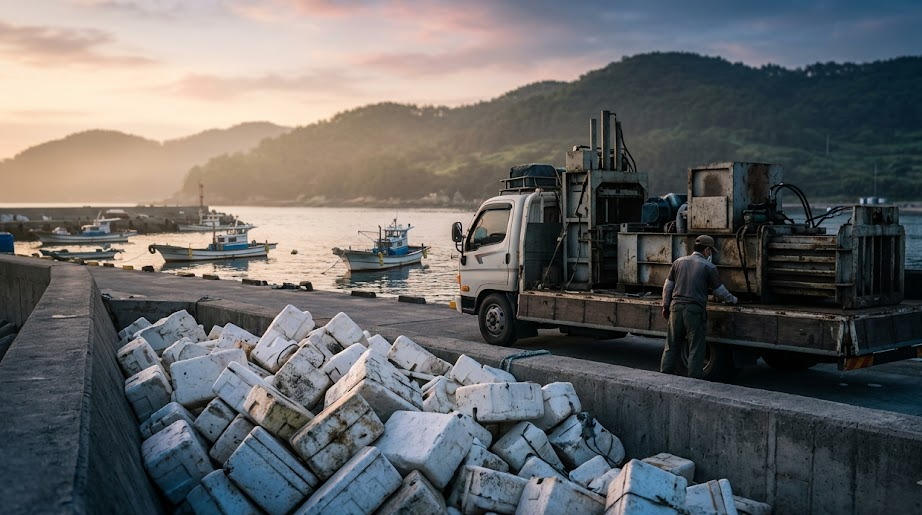
1.6 million white lumps. That is the number of waste styrofoam buoys that Haenam County in South Jeolla Province cleared from its shores between 2015 and last year. Put together they come to more than 220 tons, and the budget saved was analyzed at about 3.3 billion won. Now in its 10th year, the project has gone through on-site inspections by the Ministry of Oceans and Fisheries and the Korea Fisheries Infrastructure Promotion Association (한국어촌어항공단), and has been weighed as a model that could be carried over to other regions.
Styrofoam buoys hung at fish farms are battered by waves and ultraviolet light and break into small pieces. The path by which those fragments scatter into the sea and become microplastics has long been pointed out. From November 2023 the government banned new installations at fish farms outright. But even with a line drawn, the ones already floating on the sea do not disappear.
Haenam County's method lies in not hauling the buoys off to the city. A mobile volume-reducing machine, which shreds the buoys and then compresses and heats them to cut their bulk, is loaded onto a vehicle that tours the county's nine coastal townships and treats them on the spot. Fishermen and the "sea environment keepers," the personnel dedicated to collecting marine debris, gather the waste buoys at designated sites, and then the volume-reduction vehicle comes to them. In waste administration, where transport cost is the treatment cost, reversing that order is the key.
The reduced lumps are not thrown away but sold. Compressed and molded waste styrofoam is used as raw material for picture frames and construction materials, and the county is generating non-tax revenue from those sales. The savings on consigned treatment costs and the earnings from selling the raw material came together in the figure of 3.3 billion won. The amount treated through the end of May this year is about 12 tons.

The results have been recognized outside as well. The 2024 grand prize for best local government from the Taxpayers' Movement for the Right Use of Taxes, and the "2025 Climate and Environment Awards" co-hosted by the Ministry of Environment and SBS, went to Haenam County one after the other. At the 15th Local Government Productivity Awards, where 147 local governments nationwide competed on the economy, the environment, culture and welfare, it was also named an outstanding case in the environment category. The awards were organized by the Ministry of the Interior and Safety.
An inspection was carried out on the 19th of last month at Songpyeong Port in Hwasan-myeon. It examined whether treatment capacity is sufficient compared with the volume of waste buoys generated, and whether the volume-reduction facility is being run efficiently and economically. How to join hands to expand recycling and protect the marine environment was discussed as well.
Of course, a single award does not guarantee nationwide expansion. Follow-up plans and budget allocations have not been confirmed, and there is no guarantee that Haenam's conditions will fit other coastal local governments as they are. The county has said it will share the project's results and cooperate on reducing marine debris, responding to climate change and achieving carbon neutrality.
Styrofoam that washes in from the sea crumbles when you pick it up. Once you know where those crumbs go, it becomes hard to walk past a white fragment on the beach. If you head to the shore next weekend, bring a bag to pick up a few of those white fragments. What Haenam's volume-reduction vehicle does is, in the end, to catch those fragments before they scatter into the water.