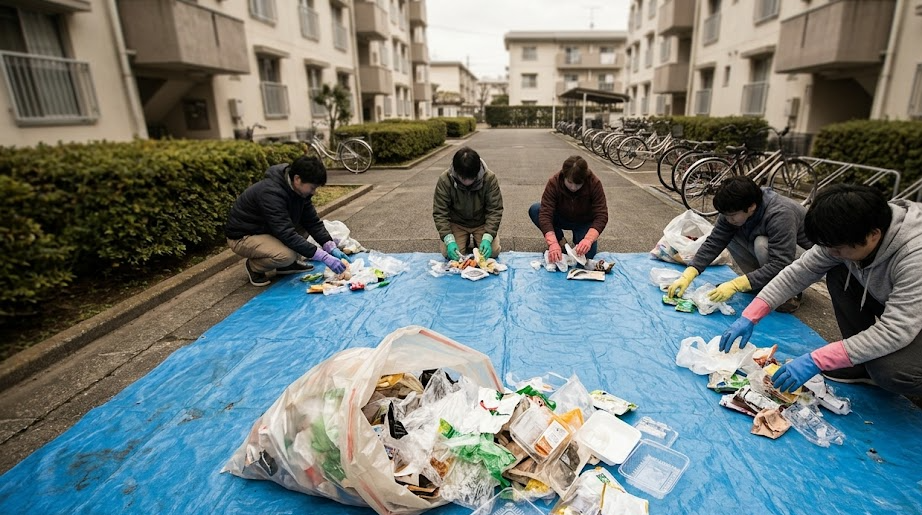
When residents opened standard trash bags and picked out only the recyclables, a single bag shrank by around 30%. The result comes from the site of the "bag-opening campaign" that the Seoul Metropolitan Government is running at apartment complexes. It means things that had no reason to be thrown away were mixed in inside the bags.
The bag-opening campaign is a participation program in which residents open standard trash bags themselves, see with their own eyes how much recyclable material and food waste is mixed in, and sort it out. It began in late April and runs through the end of May, with 25 apartment complexes in Seoul taking part. As of the 9th, nine complexes had opened bags.
Among the recyclable waste picked out on site, the most common was plastic film. Plastics and food waste followed. It is a story of snack wrappers, instant noodle packets and delivery containers, the things people pick up and put down every day, tangled together inside the bags.
This scene is confirmed in the statistics as well. In the 2024 composition analysis at Seoul's resource recovery facilities, plastic film and plastics accounted for 19.7% of the contents of standard trash bags, and food waste for 8.1%. More than one in four items should originally have gone another way.
This campaign was not created to catch anyone out. Surveyors who normally handle composition analysis assist residents with the work at their side, and together they learn the disposal standards using the actual cases of mixed-in material that turn up. It is far from a session of being told what you did wrong, and closer to a session of checking by hand the answers for items that had been confusing.
Sorting is difficult less because of indifference than because of ambiguity. Pick up a container that has not been washed properly, coated paper, or packaging with several materials attached, and the decision about which side to put it in comes to a halt. The experience of opening a bag once turns that ambiguity into a concrete object. Residents who sign up for the experience receive 1,000 Green Practice Mileage points.
Behind Seoul's campaign is the ban on direct landfilling of household waste. Once there is nowhere left to bury it, the only options are burning it or reducing it, and reducing the amount burned means starting with what goes into the bags. The city said it will use results such as the mixing rate by item in designing resource circulation policy suited to the characteristics of waste sources. Kwon Min, head of the Climate and Environment Headquarters, also explained the aim of the campaign and stressed the meaning of citizen participation.
The tally for all 25 complexes will be compiled after the campaign ends. There is no need to wait until then. Before you tie up the bag this evening, take a look inside, and pull out just one sheet of plastic film and one plastic container to put aside separately. The volume of the bag with those two removed is the beginning of the 30% that this campaign is confirming at 25 complexes.