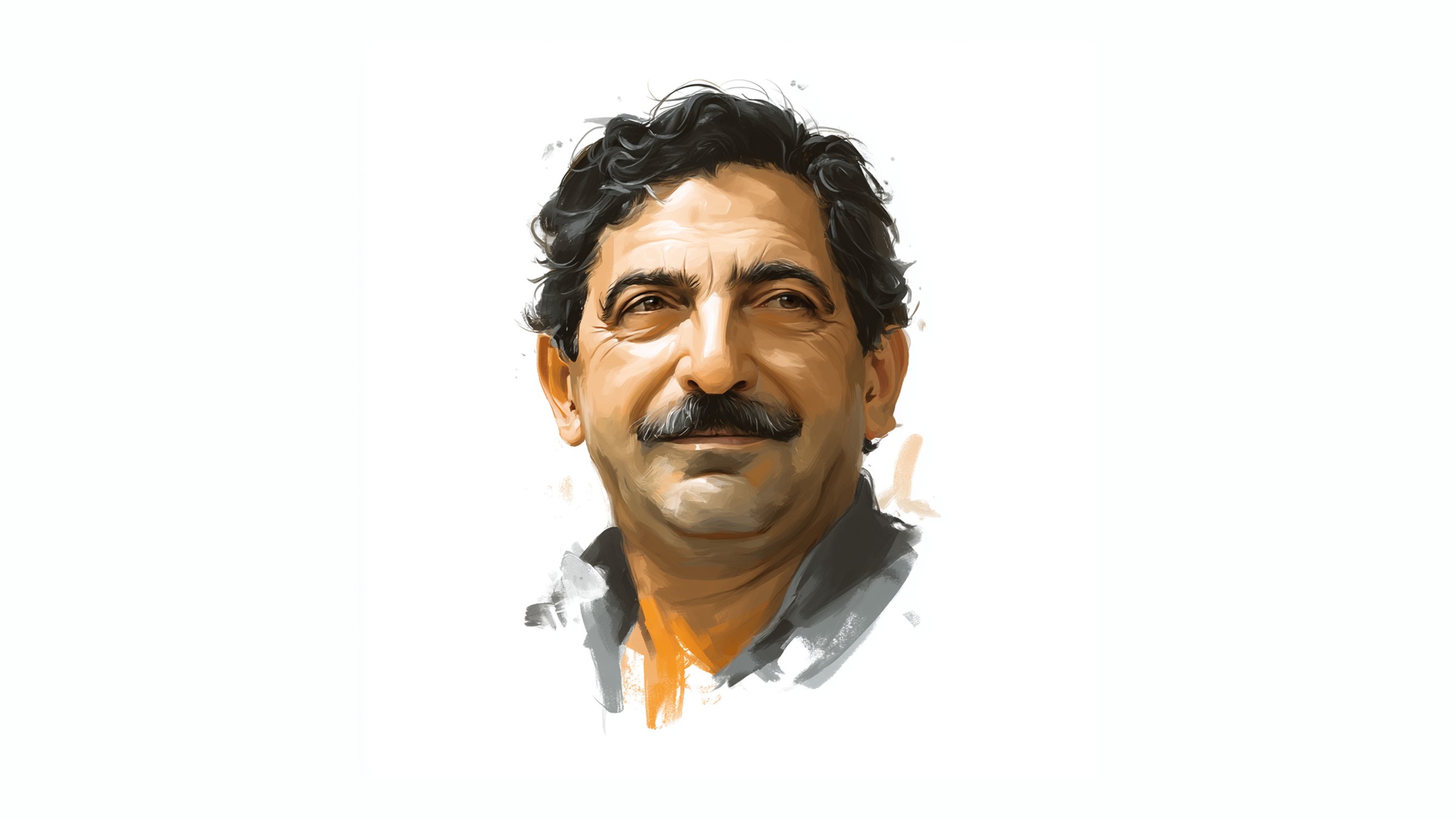
A nine-year-old boy follows his father into the forest before dawn. He cuts a slanting groove in the bark and waits for the white sap that runs down to gather in a cup. The man who grew up that way learned to read at eighteen, because he wanted to know what the bill in his hand meant.
Francisco Alves Mendes Filho, Chico Mendes, was born on the Bom Futuro rubber tapping estate outside Xapuri, in the Brazilian state of Acre. Born December 15, 1944. He was one of 17 children in a household whose father had been drafted as a rubber soldier and settled in Acre, and only six of the siblings lived past childhood.
He was a second-generation rubber tapper, a literacy teacher, and an organizer who built a rural workers' union and the Xapuri rubber tappers' union. In the mid-1980s he was called a radical union leader and an environmental activist, and he ran in elections for state deputy and city council. In 1985 he opened the first meeting of the National Council of Rubber Tappers in Brasília, and that November a British documentary director filmed the meeting.
On December 22, 1988, a week after his 44th birthday, he was killed by a gunman sent by a cattle rancher. The biodiversity conservation agency under Brazil's Environment Ministry bears his name.
Q1. You learned to read from Euclides Fernandes Távora at eighteen. I hear you picked up reading from scraps of newspaper, so what did that paper change?
If you do not know letters, you cannot count. If you cannot count, you cannot question how much the rubber you tapped is worth, or why the debt never shrinks. That was why the estate owners would not put a school near the rubber tapping areas.
Távora handed me words and, with them, the state of this country called Brazil. While I stumbled through newspaper articles on society and politics, I came to see that what the seringueiro goes through was connected to what was happening all over this country.
So I taught what I had learned to my neighbors right away. As more people could read, talk of a union began.
Q2. In 1975 a rubber tappers' union was formed in Brasileia, with Wilson Pinheiro as president and you as secretary. How did the "empate" you used around that time actually work?
People stand on the path where the loggers and the fire come in. They line up without weapons and block the way. The men who came to cut the trees were mostly poor people working for a daily wage, so we argued that if the forest disappeared, that wage would disappear too.
We demanded that the government set aside areas so that people who use the forest without ruining it could go on living.
Tappers from across the country gathered at the 1985 meeting in Brasília. It became clear in those discussions that road paving, cattle ranching and forest destruction were all one thing, and the term "extractive reserve" came out of there as well.
Q3. You said rubber tapping alone would not hold up. What was missing in your movement?
We could not stop the price of rubber from falling. The rubber industry declined across the whole country, and land was sold off and burned into pasture. In such a situation, if you stake your living on rubber alone, people end up leaving the forest.
So I said we should build a cooperative system that used many products together, nuts and fruit, oils and fibers. If we cannot build villages where children learn properly, that system will not last beyond one generation. I only made a start on that work.
I was criticized as well. When our union joined hands with the environmental movement, we were told that was a bourgeois concern. I answered that if we lose the forest, there are no workers either.
Q4. You did not step back from those paths even while being threatened. Why did standing in the way for the forest carry such a price?
While land was being sold and burned into pasture, we stood on those paths and a few times we brought it to a halt. On the side that was halted were people with a great deal to lose.
The threats were an old story. People lived counting them, and so did I.
On December 22, 1988, a week after my birthday, I was killed by a gunman sent by a cattle rancher. If you are going to remember me, remember the dozen or more years before that, and the people who stood on those paths with me, rather than my death.
Q5. You saw the forest and human rights as one issue. How do the two meet?
At first I thought I was protecting rubber trees. Then I thought I was protecting the Amazon. Only later did I understand that I was fighting for humanity.
A plan to push out the people who live in the forest and leave only the forest does not last long. Only when there are people who live off what that land yields do you get eyes that watch every day for who sets the fires and where the trees are disappearing.
Putting Indigenous people, tappers and farmers on the same side was a matter of principle and at the same time a practical matter of the forest's survival.
Q6. Now, in 2026, Amazon conservation is talked about as the core of climate action. International funding and corporate pledges have grown, so what would you check?
After the 1985 meeting the environmental movement outside took notice of us, and from then on we could speak of our situation in far wider places. Where the money flows decides the fate of the forest. If money goes into paving roads, cattle ranching comes in behind it.
So I would look at the contracts rather than the announcements. I would check whether the names of the people who actually live in that area are in the documents, and whether it is designed so that they can make a living selling their products.
When the promise to protect the forest and the recognition of the rights of the people who live in the forest come apart, that promise stops on paper.
Q7. Is there a scene you want to leave for the people who come after you?
Nothing grand. Ask where a bag of nuts or a sheet of rubber from the forest came from and whose hands it passed through. That one question is the same as what we were trying to do standing on those paths.
Every dawn I cut a groove in the tree and wait for the sap to gather. The tree has not been cut, and I come back the next day. What I wanted was for that repetition to go on.
This piece is not an actual conversation. It is an imagined interview reconstructed by Breath Journal on the basis of Chico Mendes' life, his writings and the records he left behind. The questions were written by our reporter and the answers were drawn from the writings and the actions he left.