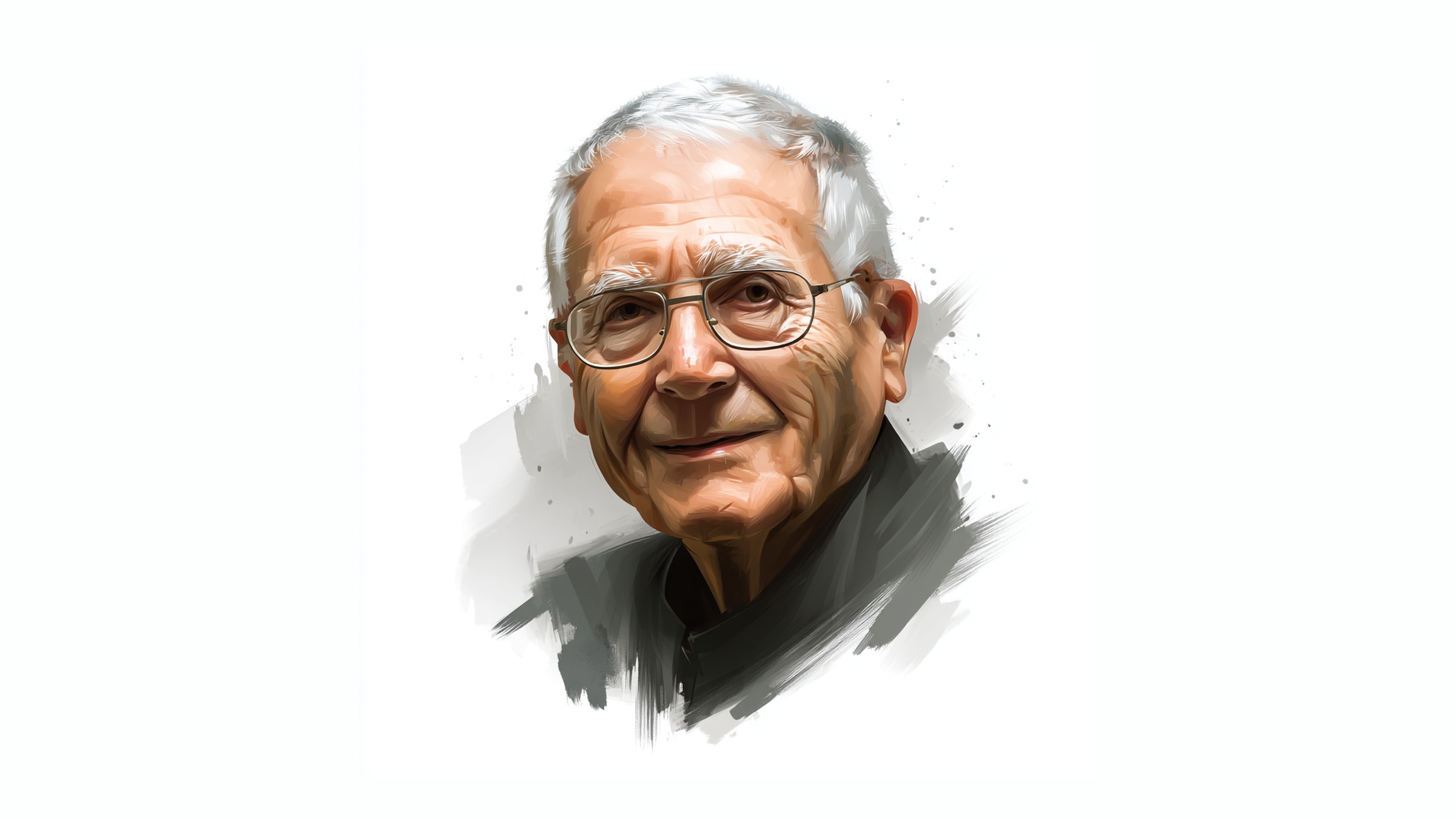
There was a young man who put his own skin under thermal radiation in place of an anesthetized rabbit. Assigned during the Second World War to research protecting soldiers from burns, he refused the method of using laboratory animals and obtained the data with his own body. He later wrote of that experience that it "hurt like hell."
James Ephraim Lovelock was born on July 26, 1919, in Letchworth Garden City, and died on the same date in 2022. He was an independent scientist tied to neither a university nor a company, an environmentalist, and a man who spoke about the future.
He received his doctorate in 1948 from the London School of Hygiene and Tropical Medicine for work in disinfection chemistry, and afterward spent 20 years at the National Institute for Medical Research. He also carried out research at Yale, Baylor College of Medicine, and Harvard Medical School. He invented the electron capture detector and was the first to confirm that chlorofluorocarbons (CFCs) were widely dispersed in the atmosphere, and while designing instruments for the National Aeronautics and Space Administration (NASA) he arrived at the Gaia hypothesis.
Q1. In early 1961, NASA put you in charge of developing instruments to analyze extraterrestrial atmospheres and planetary surfaces. You say that looking into Mars led you to see the Earth anew?
It was work on building very sensitive instruments. I thought that instead of digging up the soil, one could read the air first. If there is life, it will not leave the atmosphere alone but will use it and change it.
Then I turned my head and looked at the air of the Earth. The Earth's atmosphere was in a state that something was working on without rest. That something was life as a whole.
The question was the same when Viking went to Mars in the late 1970s. Is there life on that planet? I took the view that much of the answer was written in the air.
Q2. That idea became the Gaia hypothesis. Would you explain what it means to say the Earth regulates itself?
If you look at organisms, the atmosphere, the ocean, and the rocks separately, nothing happens. When you look at them bound together, you see the feedback that keeps the temperature and the composition suited to life. I called that a single system that regulates itself.
From the late 1970s I wrote several books on environmental science leaning on that idea. A hypothesis is not a proof. I wanted to add one way of seeing that does not treat the Earth as a heap of parts.
Q3. With the electron capture detector you were the first to confirm that Freon gases were widely dispersed in the atmosphere.
Building instruments to measure what no one had measured was the pleasure of my life. That detector picks up even extremely small amounts of a substance. That is how it came to light that substances made by human beings are everywhere in the Earth's atmosphere.
Measuring and interpreting are different things. The person who measures does not know the full meaning of the result. From that work I learned that science is not completed within one person.
I built instruments all my life. Some were used in planetary exploration, and some I made during decades of work for the British security service. People used to say I was like Q in the Bond films.
Q4. You were outside the formal academic world for a long time. Going back to the days when you could not afford university?
My mother won a scholarship but could not go to school, and began working in a pickle factory at thirteen. My father could not read until he attended a technical school, and later ran a bookshop. I was a child who disliked authority, so school life in London was not enjoyable for me.
Unable to pay the fees, I worked at a photographic company and attended Birkbeck College in the evenings. After that I studied chemistry at the University of Manchester, under Professor Alexander Todd. Not going straight to university was fortunate for me. I was not shut inside a single field.
While working on a Quaker farm, I took up a post with the Medical Research Council on my professor's recommendation. During the war I registered as a conscientious objector, then tried to enlist after learning of the Nazi atrocities, but I was told that medical research was more needed.
Q5. This series deals with the Earth. How do you use the word "circulation"?
If you follow to the end what the air and the water, the rocks and the organisms hand to one another, you come to know that the Earth is not a heap of parts. Carbon is the same. When it overflows in one place, every other place pays the price.
In the mid-1950s I carried out experiments freezing hamsters and bringing them back to life. They woke without harm even when 60 percent of the water in the brain had turned to ice, but other organs were damaged. Save one thing and another is injured. The body has to be seen whole.
Those experiments also influenced later theories of preserving people by freezing them. The sense I used in looking at the Earth was the same one.
Q6. The climate debate in 2026 is heated. In the 2000s you proposed climate engineering to revive algae, and you supported nuclear power.
I put forward in earnest a method of reviving algae in the ocean to absorb carbon dioxide. I spoke out as an environmentalist who supports nuclear power, and I said that fossil fuel interests lay behind the opposing opinion. Many people did not agree with that.
What I feared was warming caused by the greenhouse effect. I was just as wary of the talk that the world is about to end, and of the talk that pretends to change while changing nothing. Both take away people's power to act.
Q7. Please name one thing you would like to pass on to the next generation.
I was raised a Quaker. God is not a mysterious old gentleman on the far side of the universe. I was taught that it is a small, still voice heard from within. I left religion later on, but for a person who invents there was no attitude as useful as that.
If you ask me what to do today, I would say to follow just one thing to the end: where the air and the water around you come from and where they go. A single tree outside your window will do. Once you have followed that path all the way, the Earth no longer looks like a stranger.
This piece is not an actual conversation. It is an imagined interview reconstructed by Breath Journal on the basis of James Lovelock's life, writings, and the records he left behind. The questions were made by the reporter, and the answers were drawn from the writings and the deeds he left.