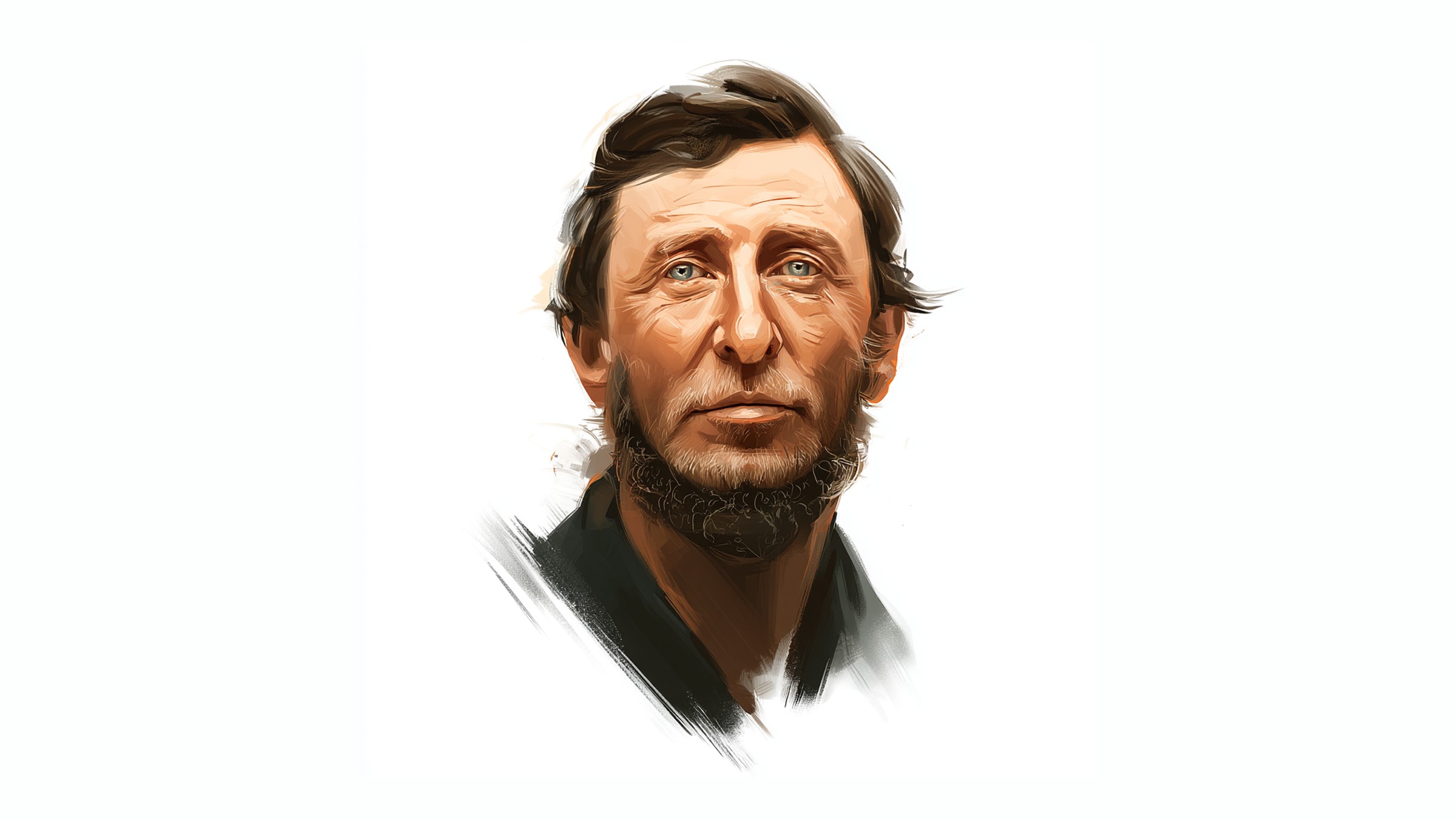
A man born the son of a pencil manufacturer never paid the five dollars attached to his Harvard diploma. Let the sheep keep its skin, was his answer. Not long afterward he went into the woods of Concord and built a cabin with his own hands, and he lived there for two years and two months, recording his life the way one keeps a ledger. That record is Walden, published in 1854.
Henry David Thoreau was born in Concord, Massachusetts, in 1817, and died of tuberculosis at the age of 44 in the same town in 1862. After finishing Harvard he moved among the family pencil business, teaching and surveying, but he stayed long in no occupation. He was close to Ralph Waldo Emerson and formed one pillar of Transcendentalism, and in writing that wove together observation of nature and philosophy he left a view that ran ahead of later ecology and environmental history.
His experience of being jailed for refusing to pay the poll tax became "Civil Disobedience" in 1849, and that essay passed on to Tolstoy, Gandhi and Martin Luther King. The books, journals and poems he left run to more than twenty volumes.
Q1. You became a teacher at the Concord public school in 1837 and quit after a few weeks. Was it because of an order to use corporal punishment?
I was told to take up the rod, and I decided not to take it up. I held out a few weeks and then handed in my resignation. A young man of twenty could hardly have felt no loss over the salary. Still, what can a hand that strikes a child teach?
The next year I opened Concord Academy with my brother John. We did not keep the children shut up in the classroom. We took them out to walk in the woods, and we went to the village shops and workshops so they could see what people actually make. When you learn the world only from books, you come to take the world lightly.
That school closed in 1842. My brother caught tetanus from a cut he got while shaving and died in my arms. After that I put less faith in the arrogance of a man who makes plans.
Q2. The first chapter of Walden is 'Economy.' You set down the housekeeping of the cabin in figures. Why did you choose the form of a ledger rather than a poem?
Because people buy and sell their freedom at a price without ever working out that price. A man works half a lifetime to get a good house, and for that half lifetime he cannot be in the house. I wanted to set down the accounts of a few nails, a few boards and one patch of bean field, and show whether that bargain pays.
I kept at the work of separating what is needed from what is wanted. One suit of clothes, one bowl of food, one roof. This much is the share that keeps life going, and beyond it the cost is mostly paid to other people's eyes.
Later generations read me as an early case of minimalism. I only said we should do the arithmetic.
In the woods I measured the temperature of the pond and wrote down the dates the ice froze and thawed. I also left the arrival of birds and the opening of flowers along with their dates. The ledger of the household and the ledger of nature were in the same notebook.
Q3. Your first book, A Week on the Concord and Merrimack Rivers, published at your own expense, came out in 1849 but did not sell. How did you bear that failure?
I confirmed in a pile of paper that the world did not want my writing. The unsold books came back and stacked up in my room. It was writing that gathered up the river trip I took with my brother, so that failure returned my mourning to me along with it.
I was criticized as well. They said that for a man living in the woods I came down to the village to be fed dinner, and word went around that my mother did my laundry. Not all of it was mistaken.
I did not go into the woods to turn my back on the world, and I was not even three kilometers from the village. That experiment was observation.
The judgment that I was a man who could not settle followed me too. I made pencils and then surveyed, I was a teacher and then wrote, so it is understandable. Instead of fitting my life to one occupation I fitted my work to my life, and for that I received poverty and suspicion.
Q4. You were shut up for a night for not paying the poll tax. It was a refusal to have taxes spent on slavery and the Mexican War. What was your time in jail like?
I did not feel that the walls had shut me in. The state could confine my body, but it could not confine what I consent to. The next day someone paid the tax in my place and I was released, and that made me uncomfortable for a long time.
I wrote that one night down as "Civil Disobedience" in 1849. It said that the hand which keeps an unjust law also takes part in that injustice. All my life I supported the abolition of slavery, I lectured against the Fugitive Slave Law, and I defended John Brown. I could not bring myself to say that only moderate means are right.
I died without knowing that my writing would later be taken up by other hands in India and the United States. It seems that when one person does not step back, it is worth that much.
Q5. You wrote down the freezing dates of the pond and the dates flowers bloomed year after year. Such observation records are being used today to read the Earth.
I did not expect those notebooks to be used by later generations. I only wanted to see the same place with the same eyes over many years. A single year of observation does not make a story, but when twenty years pile up, the land begins to speak for itself.
Earning my bread by surveying land helped as well. A man who measures boundaries sees at closest range how land is divided and sold and cut. Year after year I saw the woods of Concord cut away for firewood and timber.
I said we should give up waste and illusion and find what life truly needs. If you count what you burn and what you cut, it comes back as the arithmetic of the household.
Q6. People in 2025 move between despair and optimism over climate and resources. Which side would you stand on?
Both are comfortable postures. If you say it is all over, there is nothing to do today, and if you say technology will take care of it, there is nothing to do today. The two only come to opposite conclusions, and the result is the same.
I would tell people to open the ledger of their own household first. What they buy and what they throw away, and how much of it actually holds up their life. This arithmetic can be done without blaming anyone, and it can be begun this evening.
Personal restraint cannot take the place of demands made on institutions. I lived as a frugal man, and at the same time I refused the tax and went up to the lectern to attack the law. They are things done with each of two hands.
Q7. What do you hope the next generation takes from your name?
I hope they know the waterside of their own neighborhood better than they know my name. It is enough if each village has one person who writes down which bird comes when and on what day the ice breaks.
I closed my eyes in Concord in the spring of 1862, after an illness of the lungs. To the last I looked out the window at the trees of that town. That was life enough.
Pick a waterside or a single tree near where you live, and write down one line about what you saw along with today's date. Thoreau's notebook began that way.
This piece is not an actual interview. It is an imagined interview reconstructed by Breath Journal on the basis of Henry David Thoreau's life, writings and surviving records. The questions were written by the reporter, and the answers were drawn from the writing and the actions he left behind.