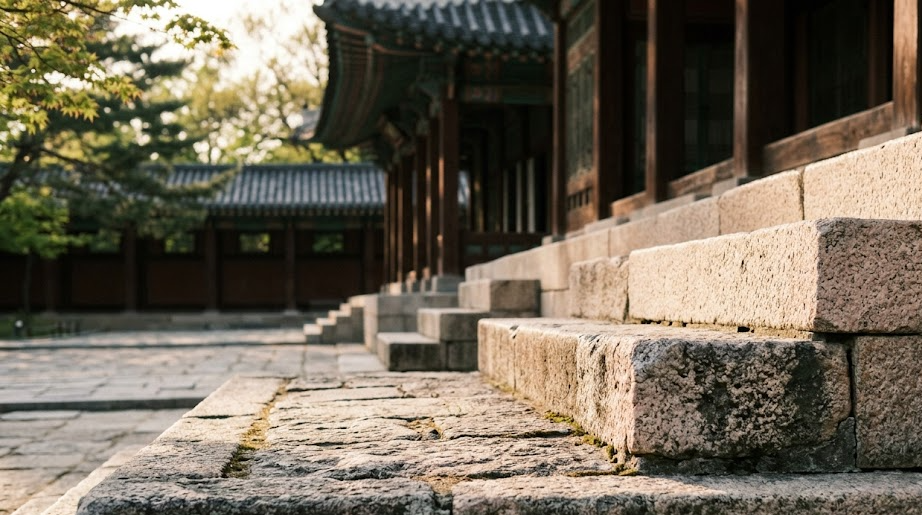
The National Research Institute of Cultural Heritage under the Korea Heritage Service released a report on the 28th titled "Scientific Information on the Stone Used at the World Heritage Sites Changdeokgung and Jongmyo." Examining 4,421 stones one by one, 2,922 at Changdeokgung and 1,499 at Jongmyo, researchers found that most of them were pink granite. This is the first time that the question of which stone the dynasty used for its palaces and shrines, and where it came from, has been organized in quantitative terms.
Pink granite is, as the name says, a stone with a faint apricot tint spreading across a white ground. Its feldspar grains carry a reddish cast, which comes alive especially after rain or when the sun sits low. A palm laid against it feels the rough crystals, and underfoot it gives a harder, drier sound than sandstone.
Surveying the mountains around Seoul, the institute confirmed that medium- to coarse-grained pink granite of the same family is distributed across the mountains around the old capital, including Ansan, Inwangsan and Bugaksan. That means the flagstones in the palace courtyard and the platform of Jongmyo have the same mineral composition as the ridgelines that ring the capital. The study did not pin down which peak served as the actual quarry, but established the geological correspondence that the same rock body is found there.
By the numbers, Changdeokgung is more than 90 percent pink granite once the new biotite granite members used in the 2020 restoration of the Donhwamun woldae and the 1994 restoration of Injeongjeon are set aside. At Jongmyo the share exceeds 99 percent. That the grain of the stone held steadier in the space enshrining the ancestral tablets has come to light through the dry language of statistics.
The survey is the product of the "Scientific Survey Project on the Stone Cultural Heritage of Seoul's Palaces and Jongmyo," which began in 2023. The Korea Heritage Service explains that restoring stone heritage to its original form requires stone of the same material as the original, but in many cases no record of the source mountain survives from the time of construction, or stone can no longer be cut from that mountain. Most of the mountains inside and outside the capital have become protected areas, and quarrying is itself an act of cutting into a mountain.
This is where preservation and use collide. The restoration most faithful to the original would mean opening the original mountain again, but that mountain is also something to be protected. That is why the institute combed old documents and compiled information on actual quarry sites alongside alternative quarry sites, and it is in the same vein that the report includes a mineralogical and geochemical comparison of granite from the Seoul and Pocheon areas. Whether Pocheon stone will be adopted as a substitute has not been decided.
The results of the material analysis were laid over drawings in color. The form makes it possible to see at a glance which stone on which staircase is original and which was swapped in later. It is a way of making the palace read again as a collection of thousands of individual stones in place of a single building.
The findings of the survey, led by Lim Jong-deok, director of the National Research Institute of Cultural Heritage, can be viewed free of charge as an e-book on the Korea Heritage Knowledge Portal website. Close the screen and a walk remains worth taking. Entering through Donhwamun, passing the flagstones in the courtyard before Injeongjeon and continuing to the platform of Jongmyo's Jeongjeon, one need only look closely at the reddish cast underfoot. Look up and the ridgeline of Inwangsan, holding that same color, stands beyond the wall.