
The Ministry of Health and Welfare submitted the revised plan for the Third Social Security Master Plan to the Cabinet meeting on the 26th, one day earlier. It is a document setting out where the country's welfare will go over the next five years, through 2030. Its vision is "Welfare for All, a Society Living Well Together," attached to a goal of broadening the scope of protection to accompany people through the entire life course, from birth to old age.
The plan is built on a pillar that protects income and holds up daily life, a pillar that strengthens the basic services needed in everyday life, and a pillar that rebuilds the foundations of social security to match the changes ahead. Nine priority tasks and 26 detailed tasks hang beneath these three pillars.
Behind the document's appearance now are deaths that left names. The three members of a mother-and-daughters family who died in Suwon in 2022 were people eligible for livelihood benefits and emergency welfare. Yet the support did not reach them. Their registered address differed from where they actually lived, and the administrative authorities never learned how they were living.
Similar cases followed. In 2023 there was a death in a one-room apartment in Jeonbuk, followed by a household raising a child in Ulju-gun, Ulsan, and a household in need of elderly care in Imsil-gun, Jeonbuk. A system in which support begins only when people come to the counter themselves and submit documents could not reach any of them.
This is the point the government intends to fix. The plan is to supplement the practice under which the system worked only upon application, creating a structure that pays benefits automatically or has the administration file applications on people's behalf, to find households in crisis using artificial intelligence, and to expand "Geunyang Deurim," which lets people take needed goods without cost. The details of which benefits it will apply to and from when still need further work.
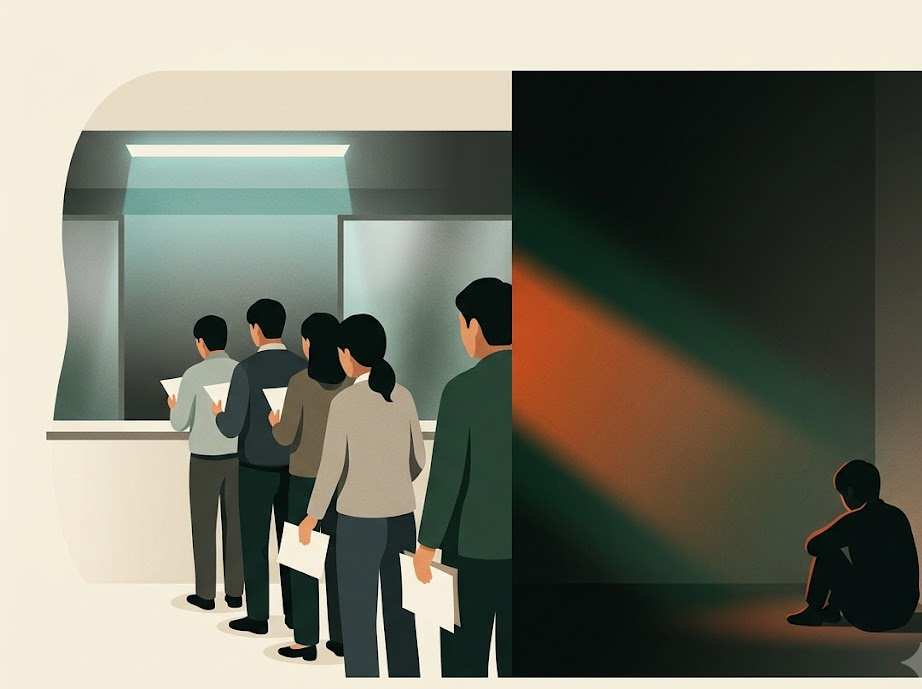
One notable item was included in the second pillar, which covers basic services. Along with establishing a community mental health management system, responding to social isolation and loneliness was listed as a separate detailed task. It states that a state of collapsing mental health and severed relationships is not left as a burden for individuals to bear, but specified as a matter for the state to handle.
Under the income security pillar, promoting the social solidarity economy was included as a detailed task. It was grouped together with region-specific income models and the pursuit of basic income. The ministry said it would establish a legal basis by creating a Framework Act on the Social Solidarity Economy, and support organizations such as cooperatives and social enterprises so that they actually supply local jobs and services in the areas of care, housing, and culture.
The statistics show two faces. Gross national income per capita in 2024 was 43.81 million won, up 3.5% from a year earlier, and the 2025 employment rate of 62.9% is the result of five straight years of increases from 60.1% in 2020. The relative poverty rate, on the other hand, rose 0.4 percentage points to 15.3%, and reaches 39.8% among those aged 66 and over. While employment rates for people in their 30s and 40s stand at around 80%, the rate for those in their 20s fell to 60.2%, and the low-wage worker share of 16.1%, while on a declining trend, remains above the OECD average.
It means that as the overall figures rise, people of certain ages and certain circumstances are pushed to the back. The blind spots the plan says it will address lie within this gap. How these indicators have changed five years from now will be the report card for this design.
Consultations on basic livelihood security are available at the community service center for one's registered address, and the channel for reporting a neighbor's crisis is the Health and Welfare Call Center at 129. This is not to say the era in which reports served as the starting point for identifying cases is about to end. Still, the character of a single document has changed. The country's five-year plan states that the administration should step forward and act rather than wait for people to come.