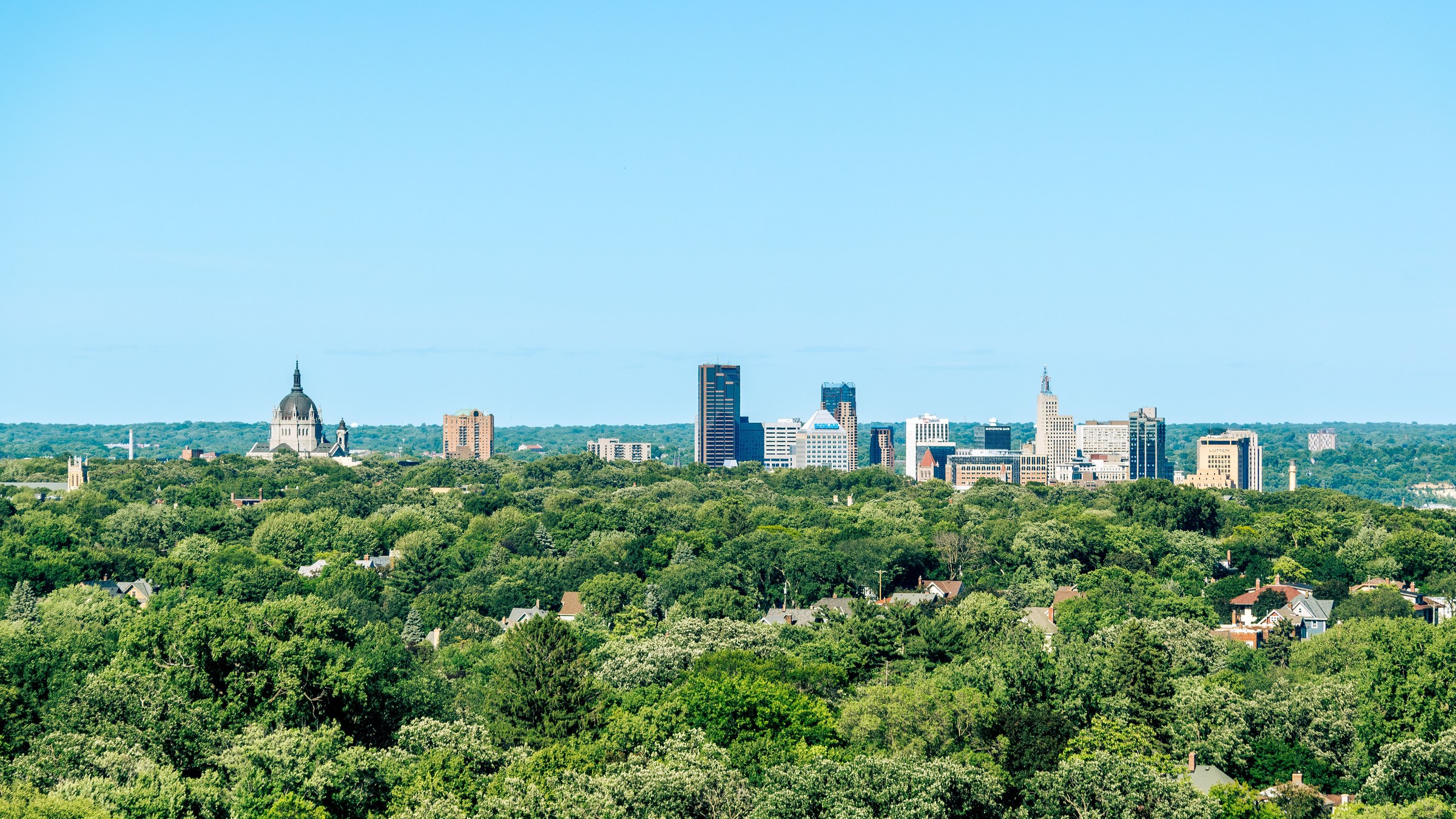
Under a cloudless midday sky, the city lies in the distance like a horizontal band. A domed roof and a few office blocks form the skyline, but most of the frame is not buildings. Tree canopies, layered in bright yellow-green and deep green under the summer light, fill more than half of the foreground.
Look closely between the green and red roofs and gray walls float here and there. It looks like a forest where no one lives, but it is a neighborhood whose houses, roads and yards sit beneath the trees. There is no trace of the city having pushed the forest back, and what remains is the shape of a forest holding the city.
Canopies like these scatter the midday summer heat instead of holding on to it. The leaves make shade and the roots take in downpours and release them slowly, and as they grow they store carbon in their bodies. It means that running one less air conditioner and keeping one tree standing have the same effect.
What matters is that this green did not appear on its own. Someone planted the street trees, someone pulled the development line back, and someone decided not to cut down the old trees. Those decisions piled up over decades to become the roof seen today.
The light comes in at an angle from the upper left. Below and to the right of the canopy, each cluster of leaves holds a short black shadow, and a few red roofs are half covered by that shade, showing only their outlines. If the sun tilts even a little, the length of those shadows changes, and so do the houses that fall inside them. There is a share carried in the angle that counting the width of the green alone cannot capture.
Look at the photograph again. Take your eyes off the skyline and scan the green below, and it occurs to you that the size of a city could be measured in leaves rather than in floors. Which shade is the one disappearing in our neighborhood today.