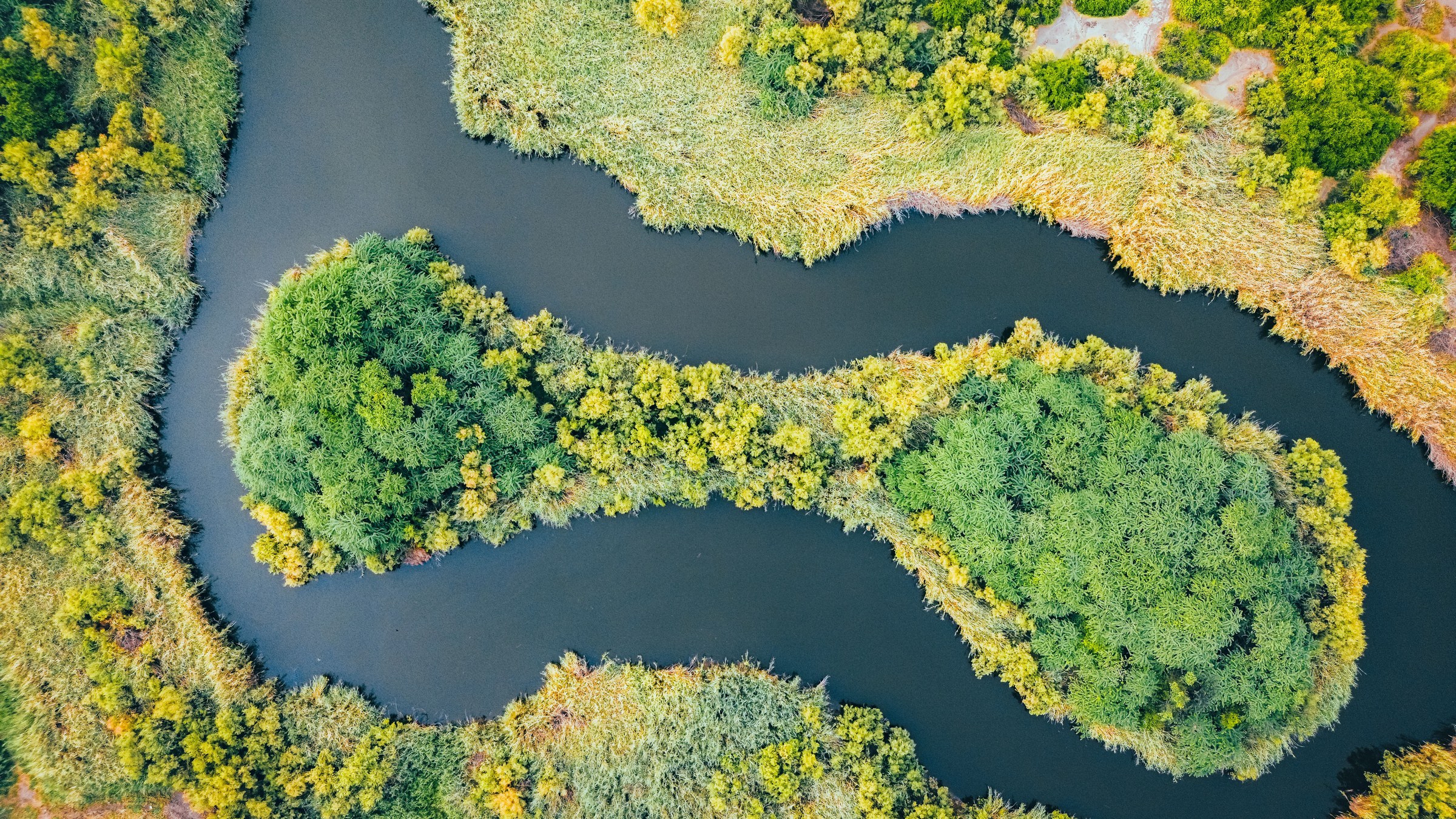
Seen from the sky, the river twists its body twice over. Teal water enters from the left, wraps around a rounded peninsula, and swings out again at the right edge in another wide circle. Inside the curve of the water, dark green trees cluster together, and along their edges yellowed reeds and pale green scrub form a border. The shadows are short, so it is midday with the sun high.
When water cannot run straight and instead curves, the flow slows. Slowed water sets down soil and seeds and leaves, and on the land that builds up this way reeds stand and willows put down roots. The clumps of green in the photograph are the thickness of time in which the river did not hurry.
This wet ground works quietly. Reed beds and waterside forests hold water when rain gathers, easing the burden on villages downstream, and they keep carbon fixed in the soil for a long time. In the water, places appear where eggs can be attached, and at the water's edge, places appear where birds can hide themselves. It is something that rarely happens in a channel that runs straight.
Straightening a river is fast, and restoring its bends is slow. Still, if room is left for the waterway, the river fills in the rest on its own. At the lower right of the photograph, young green has already begun to spread along an edge that is still the color of bare soil.
The forest inside the river bend takes in almost no light even at midday. Layer upon layer of tree shade piles up, and that dark blue-green interior remains a darkness in which, from above, what lives there is never visible. The bend did not produce only the green that is easy to see. It raised the sheltering shade along with it, and the places where birds and fish settle are usually the dark side.
Look at the photograph again. What has grown wherever the water turned away, and where that green began.